Since the start of Black October, security teams have faced endless critical vulnerabilities: PHP2Shell, Node2Shell, an Apache HTTP/2 RCE, Java4Shell and Ruby2Shell, often with the next critical CVE landing before the last patch was tested.
AI-powered attackers can probe for exposure while teams are still figuring out which services are affected and how to patch them safely. So what can you do on day one?
Mitigate now. Patch when you're ready.
For any team running AWS WAF, Miggo's Partner Managed Rulesets are the fastest, easiest way to get there:
🔹 Fastest: Tested protection for every one of these threats within hours, and several times before the CVE was even public.
🔹 Easiest: Subscribe on AWS Marketplace and add the rules to your existing Web ACL in minutes. There's nothing to install and no new vendor to onboard.
🔹 Always current: Continuous updates, daily during active threats, as new bypasses and exploit variants appear, so protection holds while you patch.
Every one of these rules comes from the Miggo Mitigation Lab, which blocked 42% more exploits than the strongest of five leading frontier AI models in our latest benchmark, and led on both coverage and safety. Miggo's rulesets for AWS WAF make the Lab's results available to any AWS customer instantly, at scale.
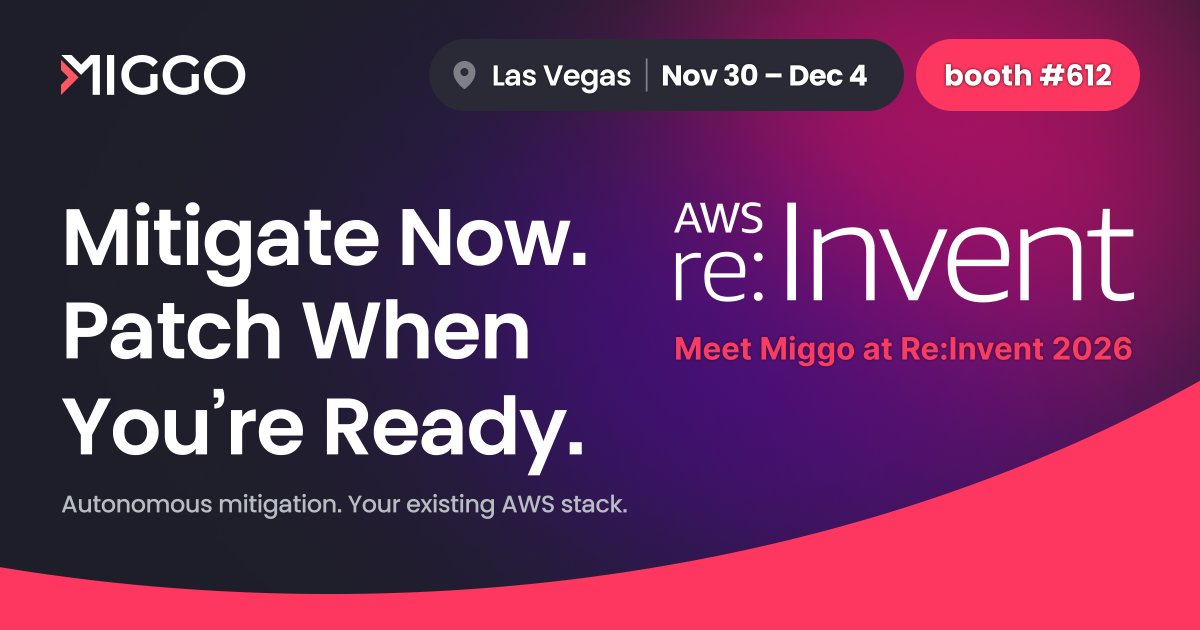
See how it works with your existing AWS stack. Meet us at AWS re:Invent, Booth #612 at the Venetian Expo.
👉 Schedule a meeting: https://t.co/dRGtR33sPY
👉 Read the report: https://t.co/TOoVDl9c6A
@awscloud #AWSreInvent #AWSWAF #AutonomousMitigation
AI-powered attackers won’t wait for your next patch. Neither should your protection.
We’re heading to AWS re:Invent to show you what autonomous mitigation looks like on your existing AWS stack.
Prove what’s exploitable. Deploy verified protection. Keep exploit paths closed while your teams work on permanent fixes.
And between sessions? We’ve got a private suite, a daily WAFfle bar 🧇, and Cloud & Cocktails with Lucid & friends.
📍 Booth #612 · Venetian Expo
📅 November 30-December 4 · Las Vegas
Mitigate now. Patch when you’re ready.
See where to find us and book time with the team:
https://t.co/dRGtR33sPY
#AWSreInvent #AutonomousMitigation #CloudSecurity
After a Black October filled with emerging vulnerabilities, exploits, and nonstop security alerts, we think security teams have earned a little peace and quiet this Thanksgiving. 🦃
This holiday, we're thankful for the security professionals working tirelessly to keep organizations protected, even as attackers move faster than ever.
Here's to fewer alerts, more turkey, and a holiday without unexpected surprises.
Give thanks. Not attackers a way in.
Happy Thanksgiving from all of us at Miggo! 🧡
#HappyThanksgiving #Cybersecurity #MiggoSecurity
Shirudo is the talk of security this week. So we put it to the test.
Turning new CVEs into runtime protections is what we do every day. So instead of just reading the announcement, we pointed our CVE mitigation pipeline at Shirudo and generated shields for two vulnerabilities its launch didn’t cover:
→ CVE-2024-1086, a Linux kernel flaw used in ransomware campaigns. In our lab, the shield refused the exploit and containers kept starting normally.
→ Log4Shell. The exploit’s lookup was neutralized and normal logging kept working.
Adding Shirudo as a new target took one adapter, because the hard parts were already running: researching where the vulnerable code fails, building a lab with working exploits and real traffic, and proving the mitigation blocks the attack without blocking legitimate requests.
That’s the real takeaway. A shield is the last step in a longer chain. Deciding what matters, building the mitigation and proving it’s safe are what separate a demo from a defense.
Miggo runs that full chain in production today, for WAF rules and our runtime sensor. As this experiment shows, the same chain extends to new enforcement points like Shirudo.
Want to read about the full results? Read the breakdown: https://t.co/jsQWzn63R1
#ApplicationSecurity #RuntimeSecurity #AutonomousMitigation #CyberSecurity
Can frontier AI models generate mitigations that are actually safe and effective to deploy?
We put Miggo's Mitigation Lab to the test against five leading frontier AI models, evaluating vulnerabilities and 1,757 requests directly in AWS WAF.
The results:
• Most effective: blocked 87% of exploits
• Safest (least false positives): 96% of Miggo Lab blocks were real attacks, and it blocked 88% fewer legitimate requests
• Most efficient: half the WAF capacity of the strongest model
• Coverage: 100% of Tested Vulnerabilities Mitigated
The takeaway? Generating a WAF rule is not the same as delivering a verified mitigation.
Effective protection requires testing against real exploits, bypass variants, and legitimate traffic before enforcement.
Read the full benchmark report: https://t.co/I4tBvp6nb4
AI-powered attackers are moving at machine speed. Can enterprise security keep up?
In a recent @VentureBeatJobs article, “When an AI agent acts on its own, who answers for it?” reporter Jon Stojan explores the growing security and accountability challenges as enterprises adopt autonomous AI agents.
Our Co-Founder and CEO, Daniel Shechter, highlights a critical challenge:
“Security teams are behind, and it isn’t a talent problem, it’s a speed problem.”
As AI agents become more autonomous, traditional security processes built around manual intervention, tickets, and patch cycles are struggling to keep pace.
Daniel points to the next evolution in cybersecurity:
“The next frontier is autonomous defense: closing exposure at machine speed, before an attacker can use it, without waiting on a patch.”
At Miggo, we believe defending against autonomous threats requires autonomous mitigation: identifying exploitable vulnerabilities and closing attack paths before attackers can exploit them.
Mitigate Now. Patch When You're Ready.
Thank you to Jon Stojan and VentureBeat for including Daniel's perspective in this important conversation.
Read the full article: https://t.co/4pJXlLCGSZ
#AutonomousMitigation #AISecurity #Cybersecurity #AgenticAI
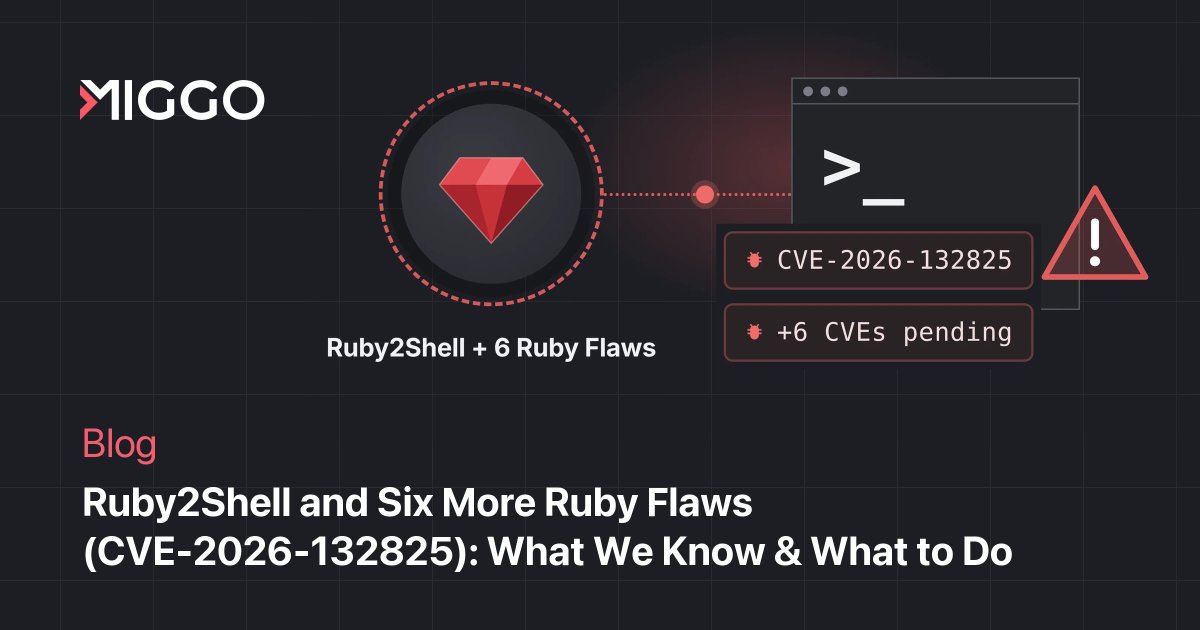
Seven Ruby vulnerabilities were disclosed yesterday, including Ruby2Shell (CVE-2026-132825).
Here's what we know and why runtime visibility matters.
The flaws sit in Ruby's regular expression engine and string case conversion. Ruby maintainers have confirmed that some could lead to remote code execution (RCE), while others can crash applications or expose memory.
Why this matters for security teams:
🔹 The vulnerabilities affect Ruby itself, not a specific gem or framework
🔹 Applications built on Rails, Sinatra, and other Ruby frameworks may be exposed
🔹 Miggo has reproduced denial of service (DoS) against Rails and Sinatra applications
🔹 Ruby 3.2 and earlier are end-of-life and won't receive security fixes
The challenge isn't just finding where Ruby is installed. It's knowing which running applications are actually exposed and whether attacker-controlled input reaches vulnerable code.
Using DeepTracing™ and runtime profiling, Miggo identifies affected Ruby applications, maps their exposure, and determines whether vulnerable functions are executing. Miggo customers are receiving mitigation and remediation guidance to stay protected while upgrading.
No exploitation in the wild has been reported as of publication.
What's public so far, who's exposed, and what to do now 👇
https://t.co/ULHeMvUaDX
Two critical NGINX vulnerabilities were disclosed today. Here's what defense in depth looks like in practice.
CVE-2026-123633 and CVE-2026-123007 sit in NGINX's HTTP/2 handling. Both are rated 9.2 under CVSS 4.0, need no authentication, and researchers have shown reliable remote code execution against a server that only serves static files. No backend app, no third-party modules required.
Why this one is harder than a typical patch cycle:
🔹 NGINX runs before any application code, so there doesn't need to be a vulnerable app behind it
🔹 It hides in ingress controllers, base images, OS packages and appliances that dependency scans won't surface
🔹 Distro packages and pinned images will lag behind F5's fix
🔹 Turning off HTTP/2 can break gRPC and slow down sites that depend on it
The Miggo Mitigation Lab tested both flaws and ruled out reliable WAF mitigation. Miggo customers are protected now through our in-app sensor, which blocks the exploit where it executes, with no NGINX config changes and no waiting on every server to be upgraded.
The good news: if NGINX sits behind a WAF, Envoy, HAProxy or a TLS-terminating load balancer like AWS ALB, exploitation gets much harder. The catch is making sure nothing is exposed directly.
What's public so far, who's exposed, and what to do now 👇
https://t.co/tWFO4RjgAv
#NGINX #CVE #AppSec #CloudSecurity
𝐉𝐚𝐯𝐚4𝐒𝐡𝐞𝐥𝐥 (𝐂𝐕𝐄-2026-114938): 𝐖𝐡𝐚𝐭 𝐖𝐞 𝐊𝐧𝐨𝐰 𝐚𝐧𝐝 𝐇𝐨𝐰 𝐭𝐨 𝐆𝐞𝐭 𝐏𝐫𝐨𝐭𝐞𝐜𝐭𝐞𝐝 𝐁𝐞𝐟𝐨𝐫𝐞 𝐭𝐡𝐞 𝐏𝐚𝐭𝐜𝐡
A critical vulnerability in the OpenJDK runtime is being disclosed. Full technical details are still coming, but you don’t need to wait for them to get protected.
𝐖𝐡𝐚𝐭 𝐰𝐞 𝐤𝐧𝐨𝐰 𝐬𝐨 𝐟𝐚𝐫:
▪️ Reproduced as denial of service (DoS), with reports of potential remote code execution (RCE)
▪️ Affects the Java runtime itself, so exposure doesn’t depend on your frameworks or libraries
▪️ Full exploitation conditions are not yet confirmed
🛡️ 𝐏𝐫𝐞-𝐝𝐢𝐬𝐜𝐥𝐨𝐬𝐮𝐫𝐞 𝐦𝐢𝐭𝐢𝐠𝐚𝐭𝐢𝐨𝐧 𝐢𝐬 𝐥𝐢𝐯𝐞 𝐧𝐨𝐰:
▪️Miggo customers were already protected before the vulnerability went public
▪️Any AWS WAF customer can get the same protection today by subscribing to Miggo’s Partner Managed Rulesets on AWS Marketplace, which already include a Java4Shell rule (link : https://t.co/PBrCy1UgwJ)
Patching the runtime across every Java service will take time, and attackers won’t wait for your rollout.
𝐌𝐢𝐭𝐢𝐠𝐚𝐭𝐞 𝐧𝐨𝐰. 𝐏𝐚𝐭𝐜𝐡 𝐰𝐡𝐞𝐧 𝐲𝐨𝐮’𝐫𝐞 𝐫𝐞𝐚𝐝𝐲.
🔗 Continuously updated analysis: https://t.co/W08WbaKY1w
hashtag#Java4Shell hashtag#CVE2026114938 hashtag#Cybersecurity hashtag#VulnerabilityManagement hashtag#AWSWAF
Two weeks out from AWS re:Invent.
This is your opportunity to see Miggo’s autonomous mitigation platform in action.
The booth is only part of what we’re bringing to Vegas. Check out what we have in store 👇 https://t.co/dRGtR33sPY
📍 Booth #612 · Las Vegas · Nov 30 through Dec 4
@awscloud #AWSreInvent #reInvent2026 #AutonomousMitigation
Attackers operate at machine speed. Patching still runs on human timelines.
That's the gap security teams are being forced to confront.
We are proud to share that Miggo is recognized as a Sample Vendor in the report!
As AI accelerates exploitation, simply identifying and prioritizing vulnerabilities is no longer enough. Organizations need ways to shorten the time between discovery and protection.
Gartner® has identified Autonomous Exposure Remediation (AER) as one of its Top Strategic Technology Trends for 2027.
The report explores how automation can help organizations move from vulnerability discovery to validated remediation.
At Miggo, we believe the immediate priority is clear: Mitigate now. Patch when you're ready.
Explore the Gartner perspective on the future of autonomous exposure remediation: https://t.co/TJqPuwh7HF
@Gartner_inc #AutonomousMitigation #AppSec #Cybersecurity
An attacker using the AI agent ARTEX targeted South Korean financial institutions through broker portals, employee apps, and a recruiter lookup page.
It found authorization gaps, cycled through IDs, and collected sensitive records. When sources were blocked, it rotated IPs and kept going.
No zero-day needed.
The campaign is raising key questions for many security teams working across global financial institutions:
▶️ Are autonomous attackers already in our systems?
▶️ What data do they have access to?
And, critically:
▶️ How do we identify and block autonomous attackers from breaching our systems?
For security teams facing autonomous attackers finding and exploiting vulnerabilities at machine speed, defense needs to change in order to keep up.
It needs to become preemptive in closing exposure windows and mitigating proven exploitability, autonomously and at scale.
Our latest blog breaks down the ARTEX attacks, why familiar controls struggled, and five actions teams can take to defend against autonomous attackers.
Read the breakdown: https://t.co/lRgs0iWVS4
#AISecurity #AgenticAI #AutonomousThreats
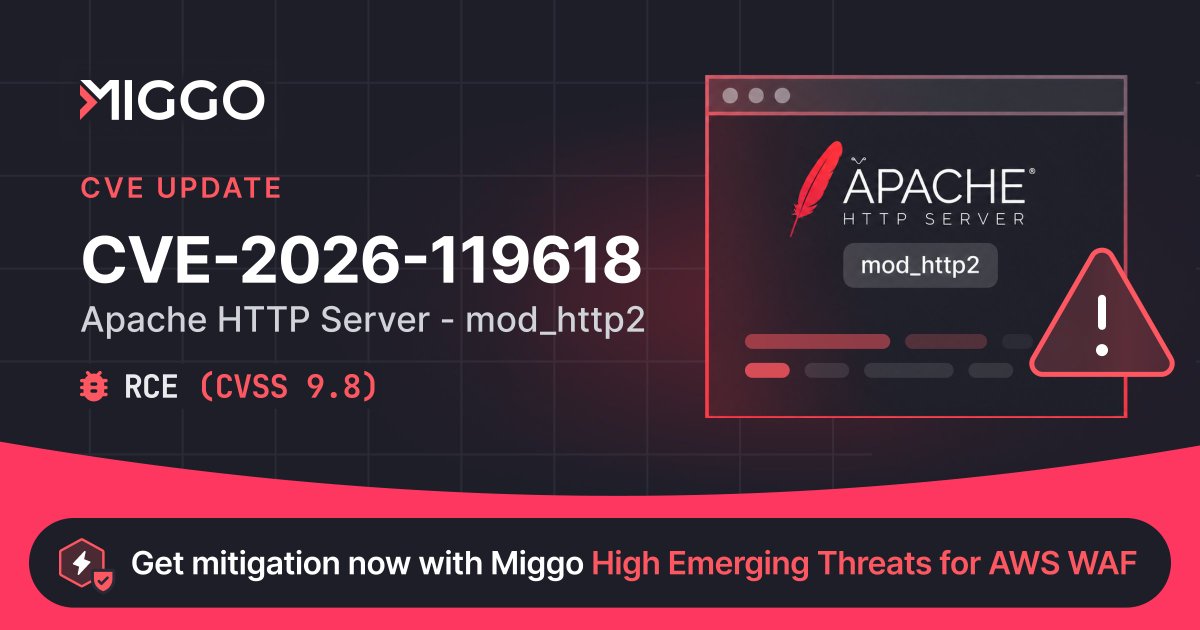
𝐂𝐫𝐢𝐭𝐢𝐜𝐚𝐥 𝐀𝐩𝐚𝐜𝐡𝐞 𝐡𝐭𝐭𝐩𝐝 𝐯𝐮𝐥𝐧𝐞𝐫𝐚𝐛𝐢𝐥𝐢𝐭𝐲: 𝐂𝐕𝐄-2026-119618. 𝐏𝐫𝐨𝐭𝐞𝐜𝐭𝐢𝐨𝐧 𝐬𝐡𝐨𝐮𝐥𝐝𝐧'𝐭 𝐡𝐚𝐯𝐞 𝐭𝐨 𝐰𝐚𝐢𝐭 𝐟𝐨𝐫 𝐚 𝐩𝐚𝐭𝐜𝐡.
A new critical vulnerability has been disclosed in Apache HTTP Server, one of the most widely used web server technologies.
The Apache Software Foundation has rated CVE-2026-119618 as 𝐂𝐑𝐈𝐓𝐈𝐂𝐀𝐋, affecting Apache httpd versions 2.4.55–2.4.70.
With Apache widely deployed across cloud environments, this vulnerability could create significant exposure for organizations running affected versions.
The official advisory is to upgrade to 2.4.71.
But for many teams, an instant upgrade isn’t realistic. Pushing a patch to production can take hours or even days, and the exposure stays open the whole time.
Miggo Security customers took the mitigation-first route instead. They were protected within hours of disclosure by a targeted WAF rule that blocks exploitation attempts, giving their teams time to patch on their own schedule.
This protection isn’t only for Miggo customers. Any AWS WAF customer can get it instantly through Miggo’s High Emerging Threats (HET) managed ruleset on AWS Marketplace.
Subscribe once, and new rules for critical emerging vulnerabilities like this one reach your WAF as they’re released.
𝐌𝐢𝐭𝐢𝐠𝐚𝐭𝐞 𝐧𝐨𝐰. 𝐏𝐚𝐭𝐜𝐡 𝐰𝐡𝐞𝐧 𝐲𝐨𝐮’𝐫𝐞 𝐫𝐞𝐚𝐝𝐲.
Learn more and subscribe: https://t.co/S91zrpjO3O
#CyberSecurity #AWSWAF #ApacheHTTPServer #AutonomousMitigation
Headed to AWS re:Invent 2026!
Attackers didn’t wait for the PHP2Shell patch. Neither did Miggo.
In under 6 hours, our customers had tested protection through AWS WAF. As new bypasses emerged, we kept it updated.
That’s just one example of what we’re building with Autonomous Mitigation: zero exploitability while your engineers work on permanent remediation.
Come meet the team at booth # 612.
📅 https://t.co/use1YSYz3q
@awscloud #AWSreInvent #AutonomousMitigation
Autonomous Exposure Remediation is a Gartner® Top Strategic Technology Trend for 2027, and Miggo is recognized as a Sample Vendor in the report.
AI is accelerating vulnerability discovery and exploitation, while defense and remediation workflows move at human speed.
The future of exposure management is autonomous.
Get your complimentary copy: https://t.co/TJqPuwh7HF
#AutonomousExposureRemediation #AppSec
Happy Diwali to our customers, partners and friends who are celebrating.
Wishing you a bright, joyful Festival of Lights and a prosperous year ahead.
From all of us at Miggo ✨
#HappyDiwali#FestivalOfLights