"Do we want to be afraid of the AI disruption ? Or do we want to look at the opportunities of what is now possible ? I want to focus on the later"
The sell-off in Indian IT stocks is fueled by a powerful narrative that AI agents will automate complex enterprise workflows & capture a disproportionate share of software budgets.
I spoke with Dr. Vishal Sikka, former CEO of Infosys & someone who has been intimately involved with AI for a long time.
10 key points. Hope it helps.
1. Disruption is Real but Gradual -> While the application of generative AI to knowledge work is a "real" disruption that is "here," large enterprises are like "civilizations" or "countries"; their complexity means adoption takes significant time.
2. The Gap Between Potential & Reality -> Addressing fears of immediate price deflation, Sikka notes there is a "gap" between the potential of AI and the "actual reality of creating an enterprise-ready offering". Whether it hits a particular project or quarter "depends on the nature of the situation," and for many complex services, it "might take years" for these new offerings to show up.
3. The Lesson of Waymo -> Sikka notes that autonomous driving was proven at Stanford 20 years ago, yet today Waymo still accounts for "less than 1% of all the taxi type rides" in the US, illustrating that technological breakthroughs take decades to fully diffuse.
4. Acceleration through Integration -> The pace has accelerated shaprply (in the last few weeks) because "frontier model companies have integrated tools into the models," such as Python interpreters & compilers, making them exponentially more powerful & easier to integrate into workflows.+
5. The Productivity Leap -> Sikka highlights a staggering real-world example where a student rebuilt a site that previously took 15 people over nine months by himself in just 14 days.
6. The "Jagged Frontier" -> Not all tasks or people see the same gains; productivity increases depend on the "nature of the task" & whether the individual has the "fundamentals" to wield AI effectively.
7. Deflationary Pressure is Conditional -> Whether AI hits a specific project's pricing or a particular quarter's revenue depends on the "service line" & the "nature of the situation," as the gap between AI's potential & enterprise reality varies.
8. Strategy in Minutes, Not Months -> Using his product, Hila, Sikka's customers performed complex business "scenario simulations" in "one minute to five minutes" that would have normally taken "armies of people" & months to execute. He highlights this example to point out that AI is being used not to just code faster but also for strategy purposes.
9. Switch from Operators to Creators -> The fundamental challenge for India's IT professionals is to "switch from being operators and executors of what is known, towards being creators and innovators of what is not yet known".
10. Adaptation is the Survival Equation -> India has thrived through disruptions like Y2K, mobile & cloud; the current goal is to "adapt to this and make it a tailwind" faster than it destroys the prior generation of work. Much like how everyone is now a "photographer" because of phone cameras, AI is shifting power to the end user. Sikka warns, "it behooves us to find opportunities in that shift... There is not that much time"
#Nifty #BankNifty #India #stockmarkets @CNBCTV18News@ShereenBhan
max: ''i think we executed it well this weekend. very alert at the start, great acceleration out of turn 1, and charles was in the right spot and that helped me. especially in the first stint, that's where you make the difference because charles was holding up lando.''
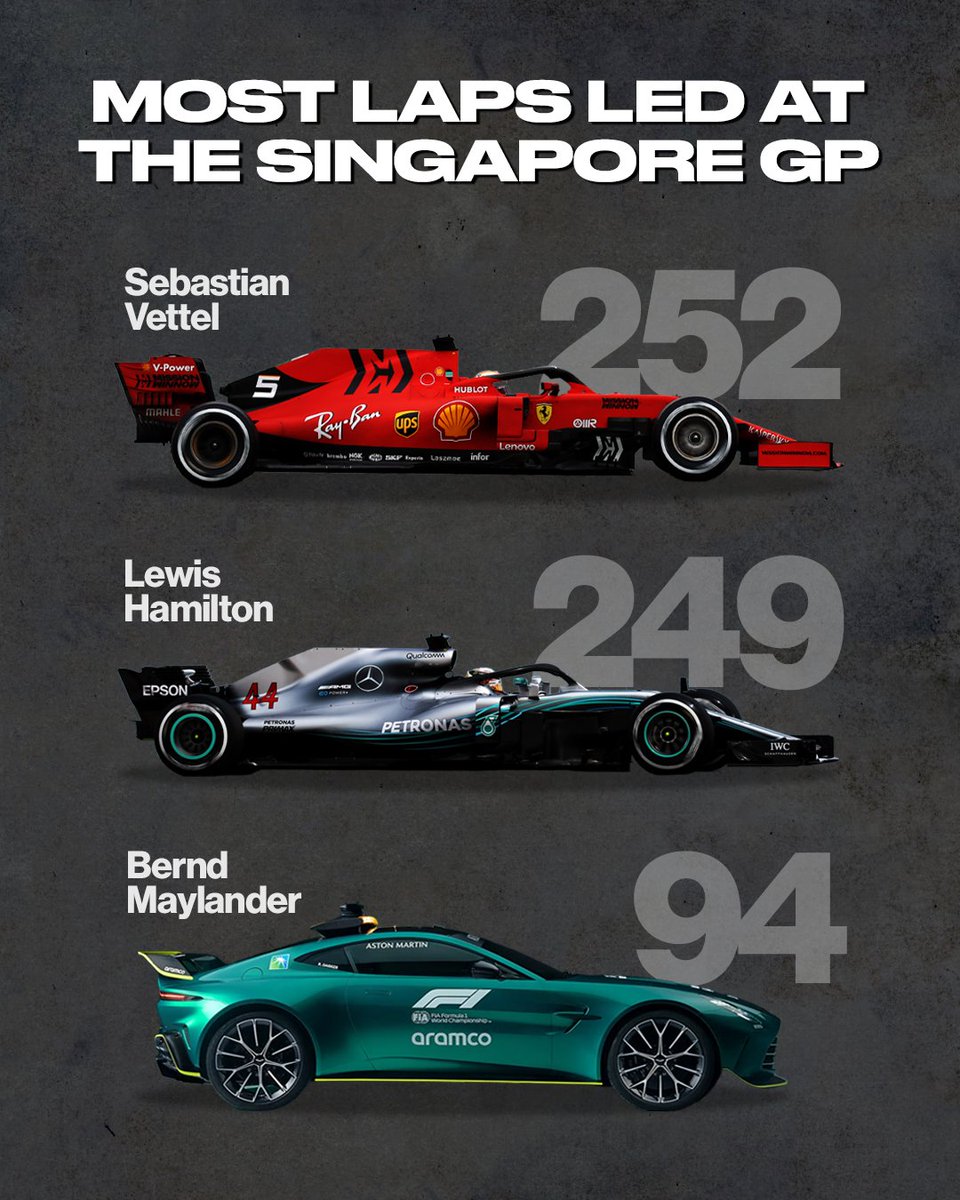
14 out of 15 Singapore GPs have seen a full safety car period, putting Bernd Maylander third on the list of most laps led at the Singapore GP 😅
💻 @f1statsguru
🚨 Set For Launch By Year-End, India's 1st Urban Public Transport Ropeway is Located in Varanasi, Uttar Pradesh.
Length - 3.75 km
Total Cost - ₹807 crore,