The @MigrationJrnl team is excited to announce that the journal is moving to partial triple-anonymous reviewing on January 1, 2025! Initial decisions whether to send papers for external review will be based on the anonymous manuscript without knowing author names or affiliations.
What insights does art provide about migration that traditional social sciences do not? By examining Tijuana, Mexico, V. Montes, E. Busse, and N. Cantú show how migrants present themselves as individuals rather than confined identities through projects.
https://t.co/bd9SYEOZWm
How are migrant categorizations strategically used to serve politico-economic goals that not only support process of #Othering but also produce ontological effects? K. Martel introduces the concept of ‘discursive noise’ to provide a deeper understanding.
https://t.co/XdN3efaB4D
A new year brings another fantastic issue!
Inspired by Howell’s work on transnational adoption, L.M. Nielsen and M. Rytter explore the strong emotional bonds formed between unaccompanied Afghan minors and their Danish volunteer guardians.
https://t.co/u92DuS3mVu
What role does education play in refugees’ decisions to leave conflict-affected areas? In our latest issue, @bivanderdal et al. unpack how education, conflict, and migration intertwine, based on unique survey data from South Sudanese refugees in Uganda.
https://t.co/76D6rqSgrC
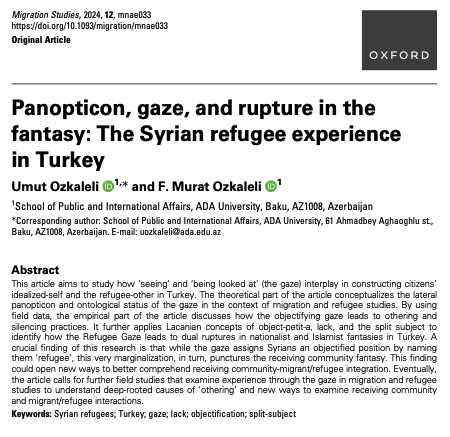
How ‘seeing’ and ‘being looked at’ (the gaze) interplay in constructing citizens’ idealized-self and refugee-other? In our latest issue, @umutozkaleli and @muratozkaleli discuss how objectifying gaze leads to othering and silencing practices in Turkey.
https://t.co/KoZrPW59HM
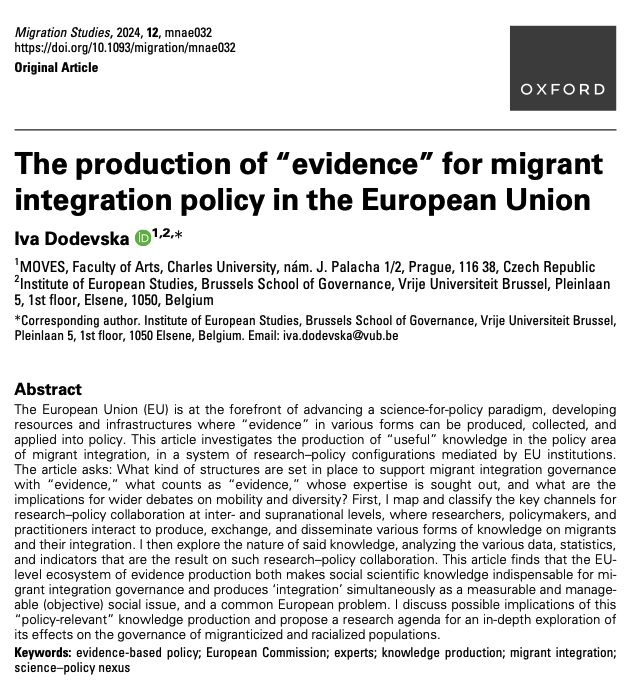
How does the EU use ‘evidence’ to govern migrant integration? @Iva_Dodevska_ examines research-policy collaborations, the production of measurable knowledge, and its impact on framing integration as a European governance issue.
#OpenAcces
https://t.co/YWBOjCFZoB
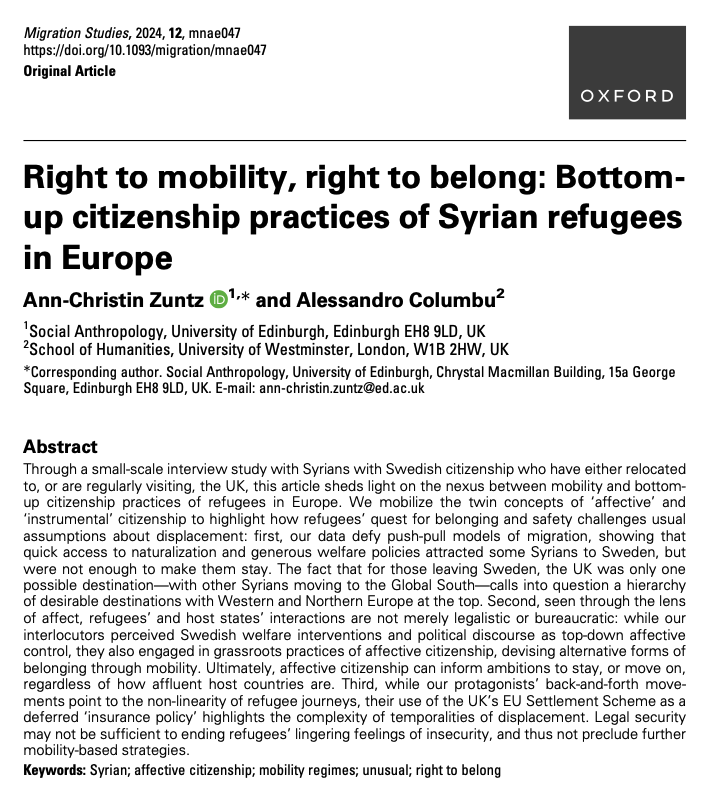
What can the mobility and bottom-up citizenship practices of refugees in Europe reveal? In our latest article, @AnnZuntz and A. Columbu challenge conventional assumptions about displacement and belonging.
#OpenAccess
https://t.co/AKRepzRAQg
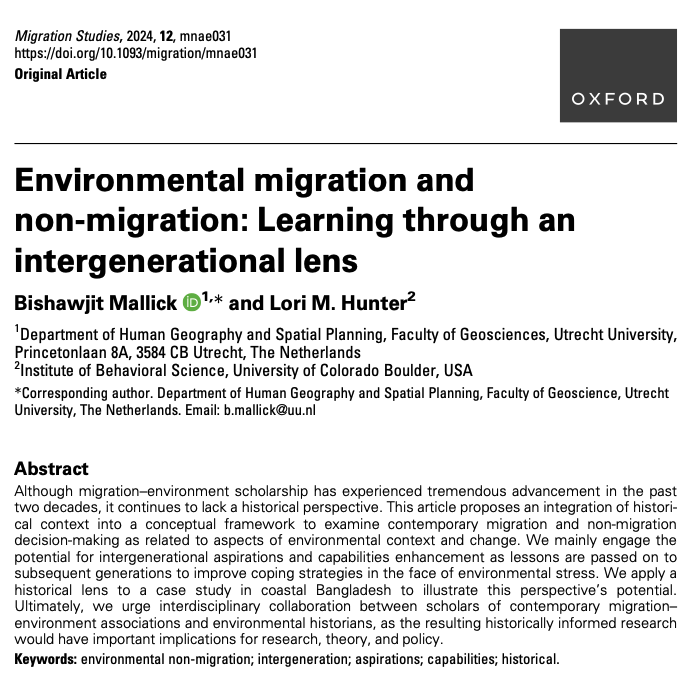
In their paper published with @MigrationJrnl, Mallick and Hunter propose an integration of a historical context to examine migration decision-making, accounting for an environmental context.
Read it here: https://t.co/NZTki95yji
How can migration decision-making be further integrated with environmental context and change? @BishawjitMalli2 & Lori M. Hunter apply a historical lens to a case study in Bangladesh, highlighting potential avenues for interdisciplinary collaboration.
https://t.co/eB9bG5rKGN
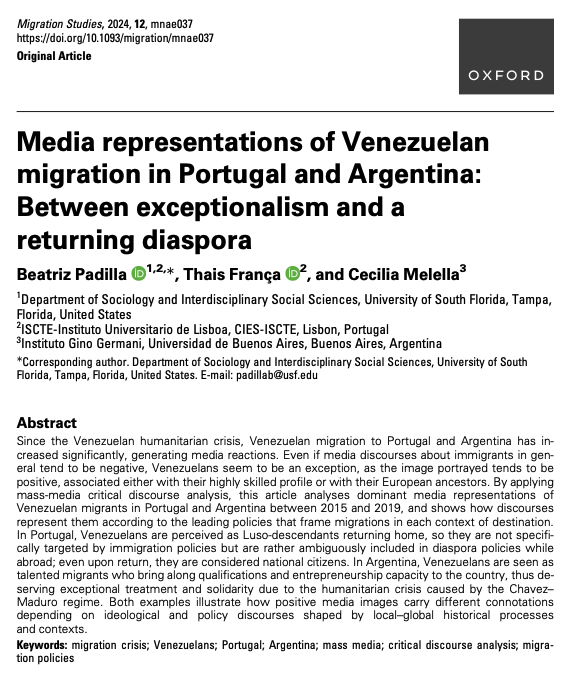
How can immigrants be framed positively by the media? By analyzing the contexts of Venezuelan migration to Portugal and Argentina, B. Padilla, T. França, and C. Melella explore how ideological and policy discourses shape favorable media portrayals.
https://t.co/6rcM3L5mcl
For full details on this and other policies we’ve updated this year, check out our updated author guidelines here: https://t.co/aZZOSfhV5b. Looking forward to receiving your best work!
The @MigrationJrnl team is excited to announce that the journal is moving to partial triple-anonymous reviewing on January 1, 2025! Initial decisions whether to send papers for external review will be based on the anonymous manuscript without knowing author names or affiliations.
This practice, which is a significant milestone for migration studies, will go into effect from January 1, 2025. And, you can submit using any scholarly format or citation style (i.e., “format free”), while our higher word limit of 10,000 excludes reference lists.
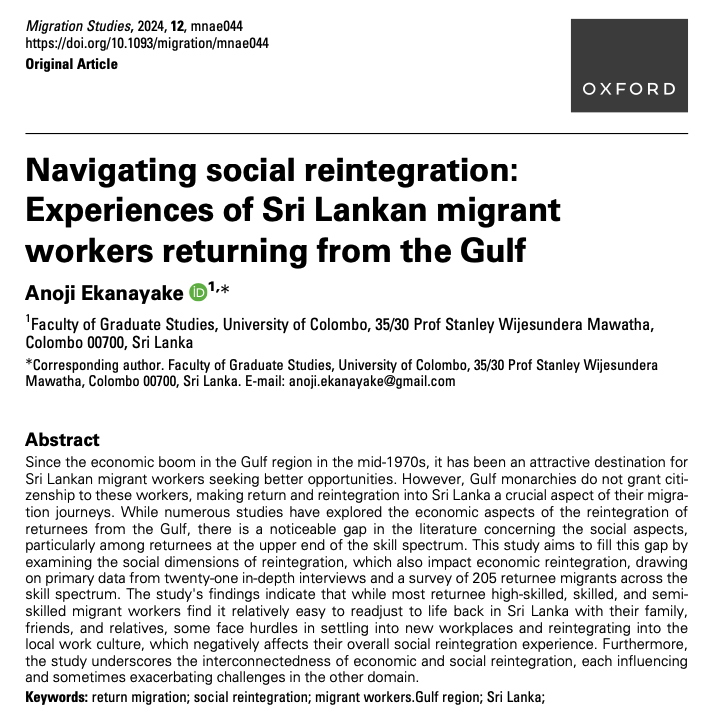
How do Sri Lankan returnees from the Gulf region navigate social and economic reintegration, and how are these dimensions interconnected? Through interviews and survey data, @anoji_ek uncovers the challenges they face in our latest issue.
https://t.co/JQ2edLZ3dP
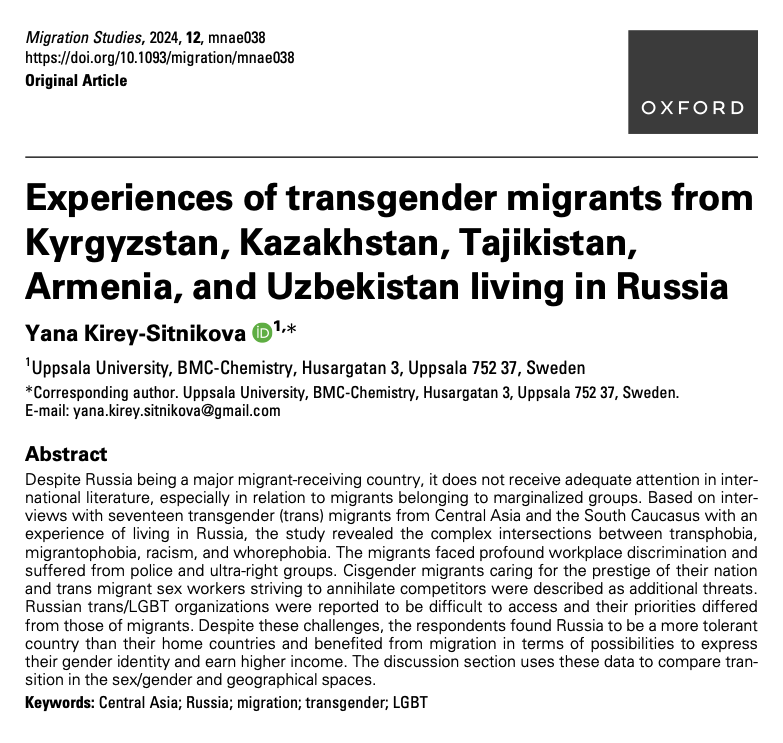
What are the experiences of transgender (trans) migrants in Russia? Drawing from interviews, Yana Kirey-Sitnikova reveals the complex intersections between transphobia, migrantophobia, racism, and whorephobia.
https://t.co/bVtz0ERY9e
#OpenAccess
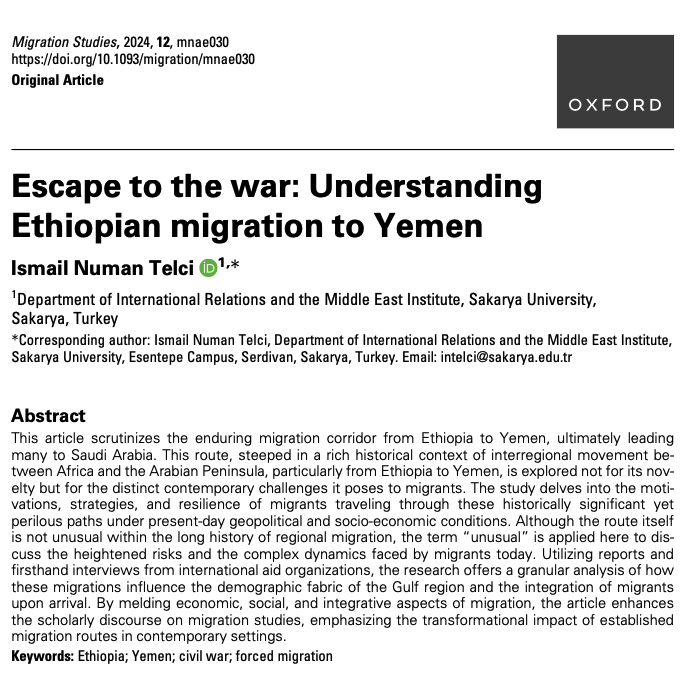
What contemporary challenges do migrants face along the historically significant Ethiopia-Yemen migration corridor? @numanis uncovers how these migrations influence the demographic fabric of the Gulf region and the integration of migrants upon arrival.
https://t.co/7AeH4Y70fS