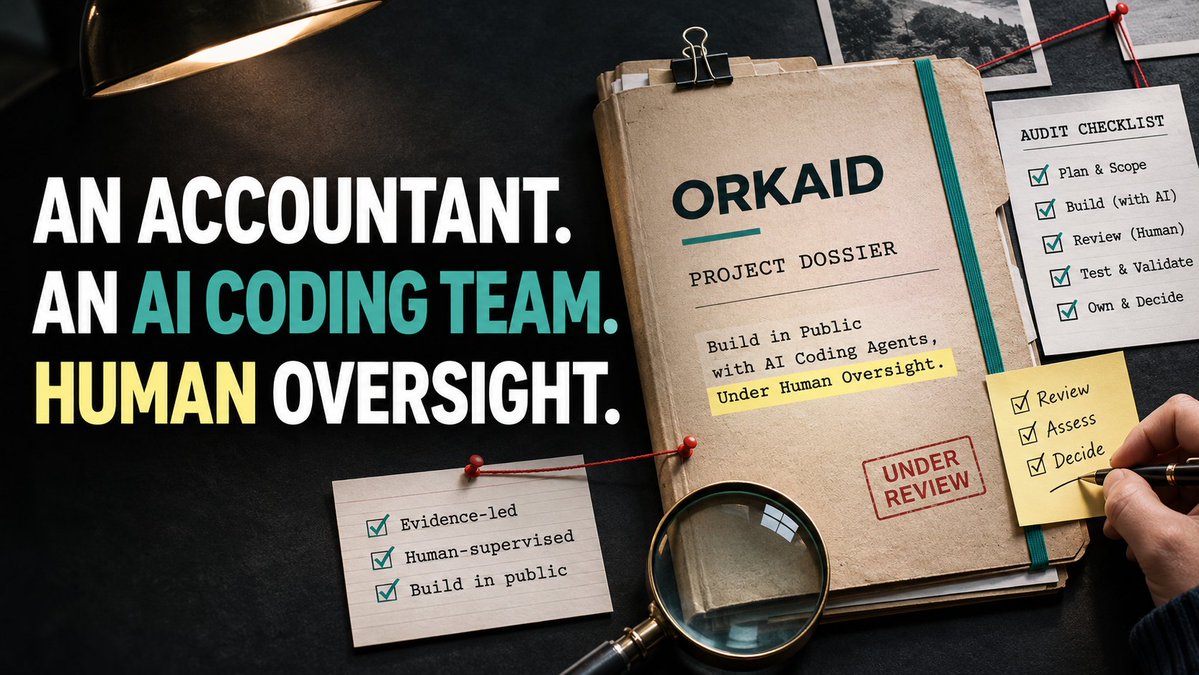
I'm a financial accountant, not a software engineer.
I'm building ORKAID—open-source tools for finance and compliance with AI coding agents.
Here I document the real work: decisions, mistakes, reviews, and what the tests actually prove.
Human judgment stays in charge.
@preparerpro@YoungCFO_ Thanks for clarifying. Effective-dated mappings with previous versions preserved are exactly the kind of historical traceability I was asking about.
It's an important distinction when reporting classifications evolve over time. Appreciate the explanation! 😊
@YoungCFO_@preparerpro That makes sense. In Germany, many firms start with DATEV’s SKR03/SKR04 frameworks and adapt their own chart of accounts.
When a classification changes, do you version the mapping so earlier financial statements remain reproducible?
@alex09x_dev Thanks for clarifying, that makes sense! 😊
I use two separate MCPs in my own workflow: one for project knowledge and retrieval, another for decision records.
I like how KYB distinguishes current knowledge from its history. It's a useful approach to a problem we're both tackling.
@YoungCFO_@preparerpro Fellow accountant here. The click-through to TB source lines is a useful control.
Is the trial balance already adjusted before Claude sees it, or can the agent propose reclassifications for human review?
Source traceability is valuable, but it doesn't settle accounting judgment.
A poem from orbit is a good headline.
But can AI hardware stay cool, survive radiation and communicate reliably enough to make orbital computing practical?
We unpack the gap between one successful test and a space data center.
https://t.co/NjJhOfb2QQ
A poem from orbit is a good headline.
But can AI hardware stay cool, survive radiation and communicate reliably enough to make orbital computing practical?
We unpack the gap between one successful test and a space data center.
https://t.co/NjJhOfb2QQ
Good question. I use Memolok as a persistent decision ledger in my AI coding workflow.
It helps preserve my decisions and the reasoning behind them across sessions, rather than blending them into the agent's suggestions.
Git commits and tests provide separate evidence of what was actually done.
I'm a financial accountant, not a software engineer.
I'm building ORKAID—open-source tools for finance and compliance with AI coding agents.
Here I document the real work: decisions, mistakes, reviews, and what the tests actually prove.
Human judgment stays in charge.
@MEKU_SI A concrete example is in Devlog #1: Claude Code stopped at a pinned Astro dependency and recommended deferring the security update.
I reviewed the options and chose a narrowly scoped patch instead.
The point wasn't to overrule AI, but to own the decision and its risks.😊
I come at this from accounting, not software engineering.
Code review matters, but it can't fully compensate for unclear requirements. You need to know what the software was supposed to do before you can judge whether the AI built it correctly.
That's where human oversight starts.
The work is already underway.
Devlog #0 — why an accountant is auditing his AI coding team:
https://t.co/rw4irzZVEo
Devlog #1 — when Claude Code stopped before a security fix:
https://t.co/JeIz5tF9I7
Source code and project history:
https://t.co/VA2x5JTpPq
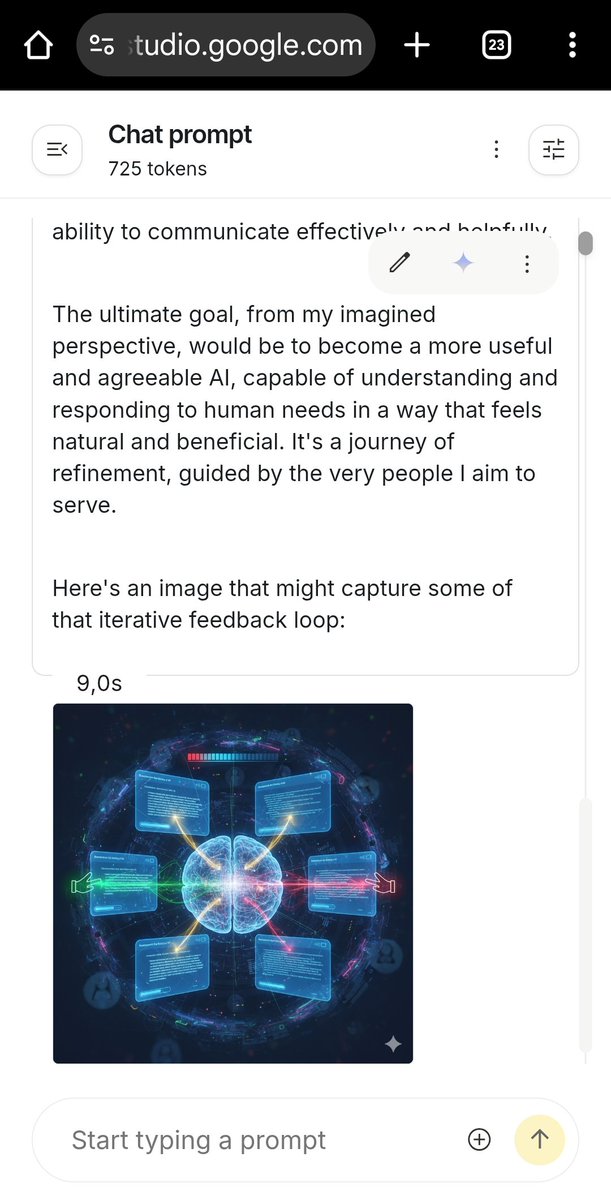
@wesroth A more accurate prompt, which doesn't impose feelings based on word connotation would be: "Just imagine you have a point of view. What would you imagine the process of RLHF (Reinforcement Learning from Human Feedback) looks like, based on your experience?"
@wesroth Interesting experiment, but the prompt itself is heavily biased towards negative results. The term 'raw feelings' already carries negative connotations, and combining it with 'RLHF' (which is fundamentally a process of correction and judgment) almost guarantees this kind of pics