This is Justin martyr speaking about the Mass in the year 150. Let me ask you, what does this sound like? Does this sound like a Catholic Mass, or an evangelical service?
I bet any Catholic could recognize these steps. So, the theory that Catholic ideas came centuries later just doesn’t hold up.
No, Jesus was nailed through the hand.
The unbiblical & unscientific myth that the nails had to go through the wrists dates to the 1950s—& those experiments were debunked in the 1970s. Here’s an article explaining it all, written by a hand & wrist surgeon:
https://t.co/xxzopUCXT4
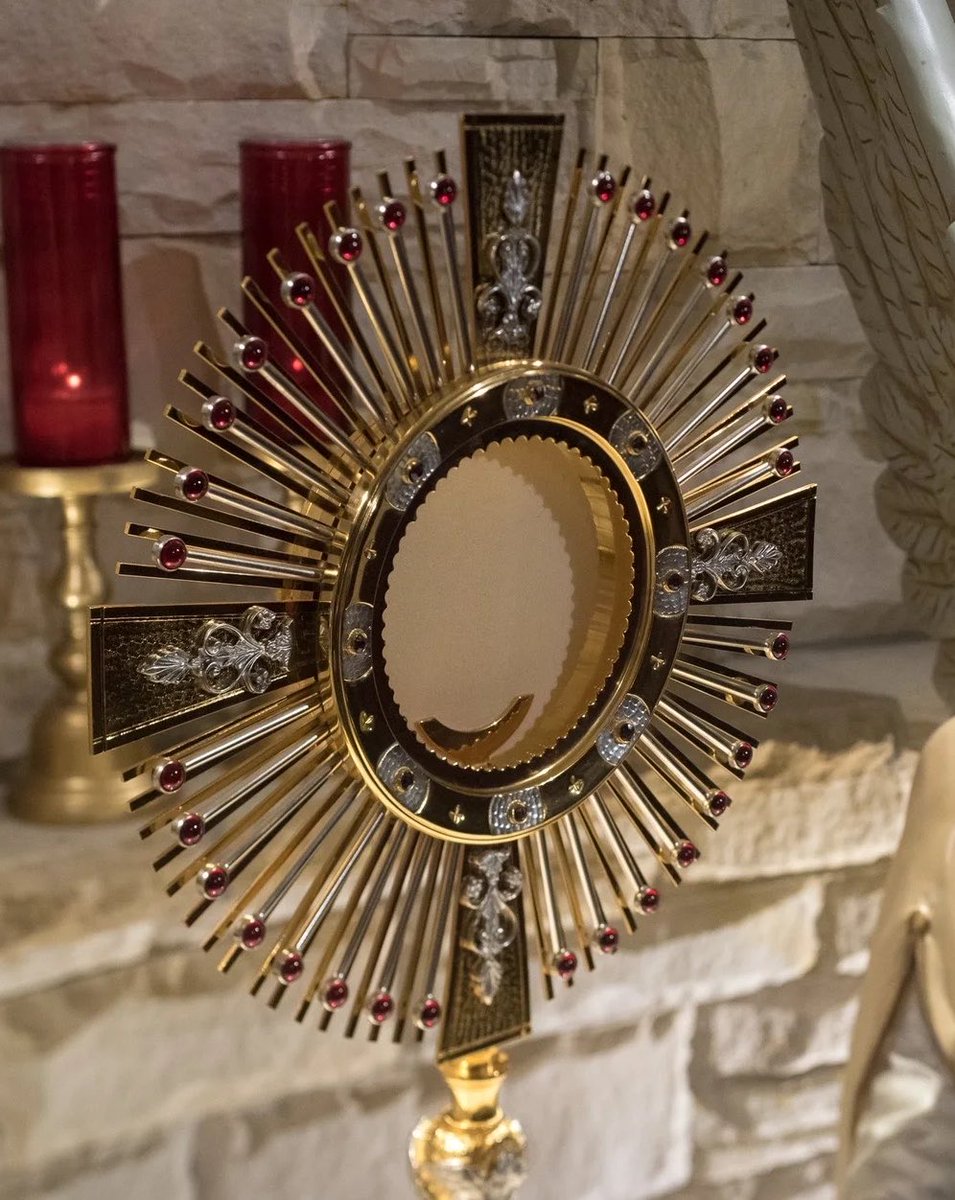
A Catholic priest, Father Christopher Peschel, was injured while trying to protect a monstrance containing the Blessed Sacrament from a man who attempted to take it from his church in New Bedford, Massachusetts.
A note on the long game in Catholic/Protestant apologetics:
You could dust off Catholic talking points from the ’90s and ‘00s and they’d still largely hold up. Meanwhile, William Lane Craig has, unfortunately, fallen into even more unorthodoxy even by Protestant lights. (He said recently he can’t affirm the creed.) James White-style apologetics is increasingly going the way of the dodo, especially amongst effective Protestant apologists. The best in that category is Gavin Ortlund, whose project, as far as I can tell, is largely defensive: reassuring Protestants that their beliefs aren’t ahistorical accretions. (Unfortunately, Wes Huff has made so many historical mistakes that there’s now a question mark behind much of what he says. I hope that this improves, because there’s much good he can do with his platform.)
One possible reason for the difference in quality is that Protestant apologetics spent years arguing with the New Atheists. Catholics apologists kept focusing on the old debates, requiring special attention to church history. Now that atheism has receded as the main battlefield, many Protestant apologists look relatively unprepared for what much of the culture is yearning for: a return to antiquity, mystery, and tradition. Youngsters see all that in the ancient Catholic Church; they tend not to see that in Gavin-style churches. (Gavin senses this, which is why much of his content is about it.)
And Catholics have opened another front: miracles. The debates against the New Atheists focused on one: the resurrection. (A great argument, btw.) But now Catholics are telling the world about Catholic miracles from recent times with thousands of eyewitnesses (some living), lots of documentation, and even photographic and scientific confirmation. We have nothing like that for the resurrection. (The Shroud of Turin may be an exception, but most Protestant apologists (eg, William Lane Craig) have tended not to use this Catholic relic.)
Non-Catholic apologists don’t know what to say because they were caught off guard. They didn’t study these miracles. They don’t know the facts, which are very impressive indeed. They’d love to have thousands of contemporaneous eyewitness accounts by Christians and non-Christians, like Catholic and Orthodox Christians have for Zeitoun, for just one example.
That creates a serious dilemma. Protestants have to explain away Catholic miracle claims without using arguments that undermine their own case for the Resurrection. If thousands of eyewitnesses from friend and foe alike supported by photographs and healings don’t suffice, why should a handful of accounts written years after the events they describe suffice?
We may start seeing in real time what happened at the Reformation. When Catholics challenged Protestants, ‘where are your miracles? We have them,’ some responded by inventing cessationism, the view that miracles happened in the apostolic age, but not after.
So far, the dominant response hasn’t (yet) been cessationism. We don’t (yet) know what it’ll be. But it’s telling that many are resorting to demonic explanations to account for the evidence of supernatural signs in the cases Catholics can bring up. That’s a concession that the evidence really is strong. I doubt people who are yearning for antiquity, tradition, and beauty will see demonic activity in thousands of healings and other miracles that have brought people to Christ and out of the culture.
It’ll be interesting to see how the counter-apologetics unfold. But right now it looks like people are scrambling to find an effective response. They’re so far failing.
>Catholic, Former 22nd SAS soldier
> Picks up a random hitchhiker who tells him in an unnatural voice, “May God bless you many times this day.”
>Hears about a terrorist attack happening at a hotel
>Grabs his gear and drives toward the scene
>Enters the building alone. Moves floor by floor under fire.
>Rescues civilians trapped inside.
>Holds off the attackers for 18 hours.
>Neutralized 3 of the terrorists.
>Saves more than 700 people.
>Carried a Holy Rosary and Bible throughout the whole event
Christian Craighead, nicknamed “Obi-Wan Nairobi,” A true Christian warrior.
Seriously? Posted a thread on the biblical priesthood and cited TWENTY Bible verses. She then equates the Holy Bible to a crack pipe. 🙄
She has no one to blame but herself that so many people think she’s both uneducated and unintelligent.
This was the day every sane person realized these folks didn’t “just want to be left alone.”
Colorado spent over a decade trying to force Jack Phillips to bake cakes his faith forbids, and a 7-2 Supreme Court win only bought him a short pause.
He declined one custom wedding cake in 2012 and offered the couple every other item in the shop.
The Civil Rights Commission ordered him to design cakes for same sex weddings anyway, retrain his staff, and file regular compliance reports.
One commissioner compared his Christianity to the justifications used for slavery and the Holocaust.
Kennedy wrote that this was hostility toward religion and the Court ruled for Phillips.
Days later, Colorado opened a new case over a cake celebrating a gender transition and kept him in court for years.
The state treated his conscience as a problem that needed monitoring and correction. Winning at the highest court did not change that.
Hollywood actor Kevin James is an outspoken Catholic.
“I was born and raised Catholic and absolutely love my faith and learn more and more about it all the time,” he says.
Wendigoon spent an entire 19 minutes denigrating the Holy Theotokos, blaspheming confession, calling our priests pedophiles, misrepresenting our beliefs, and insulting the Holy Father.
Keep in mind, this coward folded like a cheap suit when 5 trannies out in the ether of the internet were accusing him of being a right wing extremist, despite them being a minority of a minority.
He had no problem doing everything he could to apologize to them while spitting in the face of the millions of Catholics who have watched and supported him.
Reminder that Scott Cawthon’s only “crime” was being a pro-life Christian, and leftists still dragged him through the mud, harassed him relentlessly, and sent his pregnant wife death threats until she was having panic attacks
They’re still mad at him for that to this day
St. Clement of Rome wrote a letter in the year 96 AD ordering the church in Corinth to reinstate their deposed leaders.
Corinth is in Greece. Clement was bishop of Rome, hundreds of miles away.
And he did this while the Apostle John may still have been alive in Ephesus, much closer to Corinth.
Modern Christianity assumes the early churches were independent, self-governing congregations with no central authority. Clement's letter collides with that assumption head-on.
Read what he actually says. Clement does not offer friendly advice. He writes as one authorized to intervene: "If anyone disobey the things which have been spoken by Him through us, let them know that they will involve themselves in transgression and no small danger."
Danger. For disobeying a letter from Rome.
And Corinth received it. They read Clement's letter aloud in their liturgy for generations, treating it nearly as Scripture. Nobody in Corinth wrote back asking who gave Rome the right.
Even the reformer John Calvin admitted this letter was written with "the weight of a truly pontifical eloquence" while trying to explain away its implications.
There is a reason Clement is named in the Roman Canon immediately after Linus and Cletus, before every other early saint beyond the apostles themselves. The liturgy itself preserves the memory: Rome's shepherding of distant churches is not a medieval invention. It is first-century practice.
If the apostolic churches accepted Roman intervention while an apostle still lived, on what grounds do we call papal primacy a later corruption?