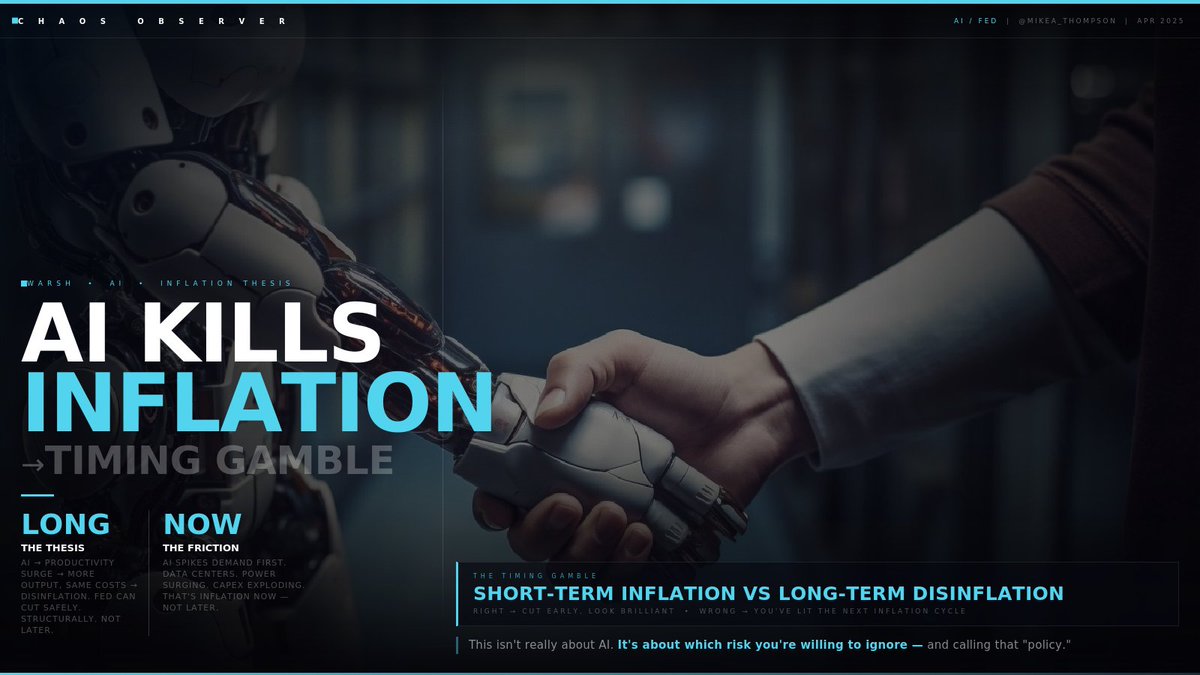
Kevin Warsh’s core thesis: AI kills inflation.
Not later. Structurally.
The chain is clean:
AI → productivity surge
Productivity → more output, same costs
Result → disinflation
So the Fed can cut… safely.
That’s not just optimistic.
It’s politically perfect.
Now the friction:
AI doesn’t just boost supply.
It spikes demand.
– data centers everywhere
– power demand surging
– capex exploding
That’s inflation now, not later.
So this isn’t a smooth transition.
It’s a timing gamble:
Short-term inflation
vs
long-term disinflation
If he’s right → cut early, look brilliant.
If he’s wrong → you’ve just lit the next inflation cycle.
This isn’t really about AI.
It’s about which risk you’re willing to ignore —
and calling that “policy.”
US–Iran talks are stalling before they even begin.
Alan Eyre (ex-JCPOA):
the White House line about a “fractured” Iran asking for time? “Nonsense.”
The reality is cleaner than the messaging:
The US wants talks under blockade.
Iran refuses to negotiate under pressure.
That gap isn’t tactical — it’s the whole conflict.
So instead of substance, we get:
– format disputes
– location delays
– public posturing
Not diplomacy. Controlled escalation.
Ceasefire extended.
Blockade intact.
The contradiction is doing all the talking.
Both sides say they want a deal.
Neither is acting like it.
This isn’t 2015.
It’s 2010 — less trust, more leverage, tighter timelines.
No one wants to move first.
So the real question isn’t whether talks succeed —
it’s what breaks first when they don’t.
Donald Trump is going straight at the credit system.
Simple move. Big impact:
You pay rent.
You pay utilities.
Now it counts.
For years — it didn’t.
The shift:
– VantageScore / FICO 10T
– Rent + utilities enter the score
– Focus: first-time buyers
What changes:
Millions go from invisible → creditworthy
+20–50 points for some.
That’s the difference between:
locked out → approved
stuck renting → in the market
Clean. Fast. Disruptive.
But here’s the friction:
Supply doesn’t move.
Demand just got a boost.
More buyers. Same homes.
Prices feel it.
No theory — just pressure.
Final hit:
This isn’t a housing fix.
It’s a credit unlock.
And when you unlock demand
without unlocking supply—
you don’t make housing cheaper.
You make the fight for it more expensive.
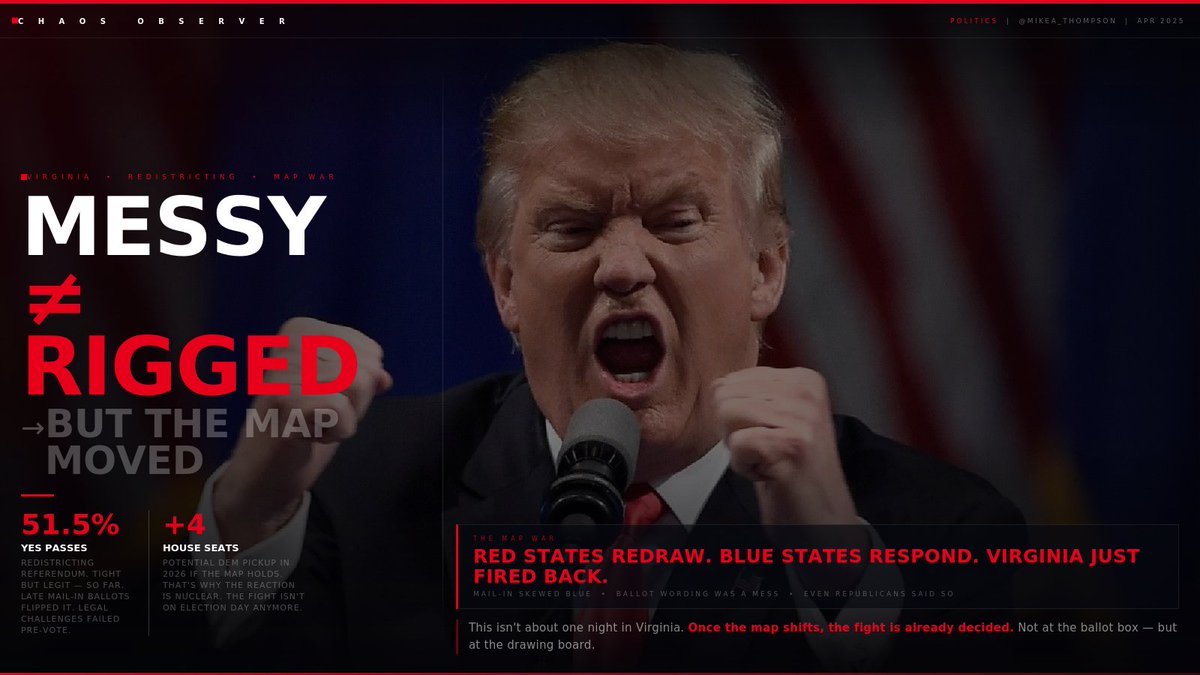
Donald Trump is shouting “RIGGED” over Virginia.
Here’s the reality:
A redistricting referendum passed.
~51.5% YES vs ~48.5% NO.
Tight? Yes.
Legit? Also yes — so far.
What flipped it?
Late-counted mail-in ballots.
Same pattern. Same outrage.
Trump’s version:
GOP leads all day → late drop → “stolen.”
Reality is less cinematic:
– Mail-in ballots skewed blue (as they often do)
– The ballot wording was a mess — even Republicans said it
– Legal challenges already failed before voting day
So yes — messy.
But messy ≠ rigged.
And zoom out:
This isn’t about one night in Virginia.
This is the map war.
Red states redraw.
Blue states respond.
Virginia just fired back.
If it stands → Democrats could pick up ~+4 House seats in 2026.
That’s why the reaction is nuclear.
Because once the map shifts,
the fight isn’t on Election Day anymore.
It’s already decided.
Not at the ballot box —
but at the drawing board.
Kevin Warsh didn’t tweak the Fed playbook.
He challenged the scoreboard.
Core PCE?
“Rough swag.”
Blunt. Public. No hedge.
Then the pivot:
Trimmed mean / median.
Less noise.
And — crucially — lower inflation.
One economy. Two numbers:
– Core PCE: ~3.0%
– Trimmed mean: ~2.3%
That’s not data.
That’s a fork in the road.
3% → hold rates
2.3% → cut sooner
Here’s the core:
Federal Reserve doesn’t just read data.
It decides which data counts.
Then the chain reaction:
metric → narrative → policy → markets
And the backdrop is obvious:
Donald Trump wants rate cuts. Fast.
Warsh says “independence.”
But starts by rewriting the inputs.
Final layer:
This isn’t a debate about math.
It’s a fight over what reality gets measured.
Control the metric → control the conclusion.
Control the conclusion → the decision is already made.
Steve Keen isn’t talking about “another Middle East conflict.”
He’s talking about a system shock.
Not later. Not theoretical.
Right through energy, food, and supply chains.
Here’s his warning, stripped down:
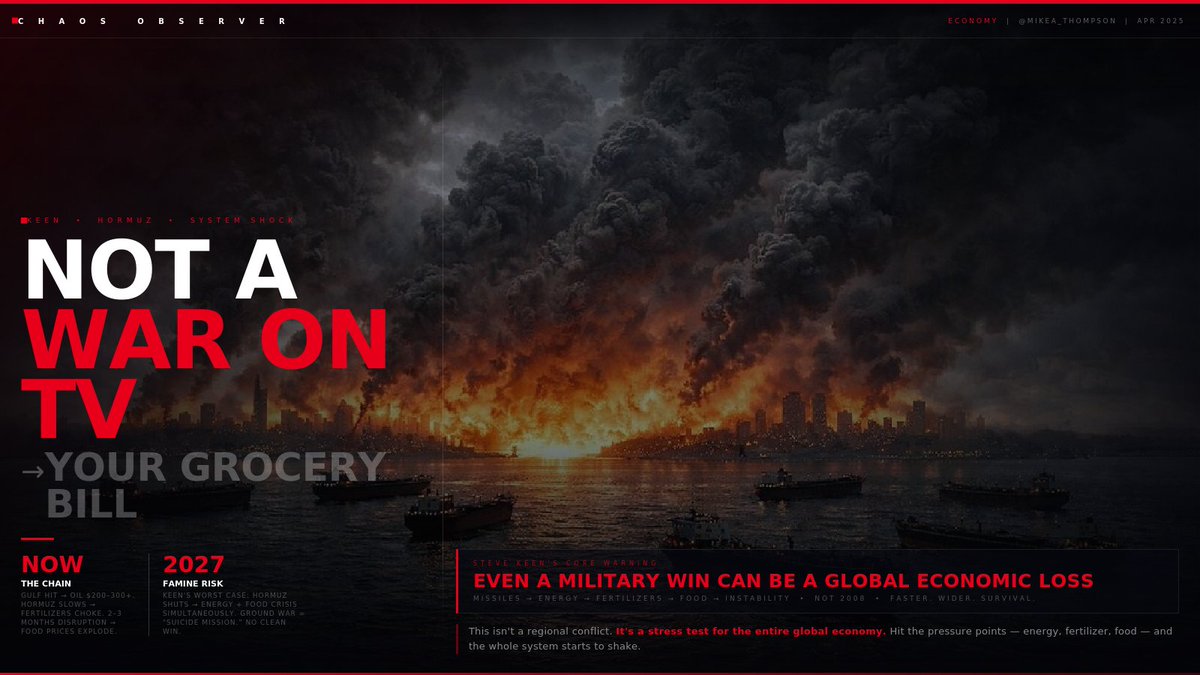
This isn’t a war you watch on TV.
This is a war that shows up in your grocery bill.
– Gulf infrastructure gets hit → oil doesn’t go to $120
It spikes to $200–300+
– Strait of Hormuz slows or shuts → fertilizers choke
– 2–3 months of disruption → global food prices explode
– 2027–2028 → real famine risk in vulnerable regions
That’s the chain.
Not missiles → headlines.
Missiles → energy → fertilizers → food → instability.
And then he drops the part nobody wants to say out loud:
A ground war?
He calls it a “suicide mission.”
Underground facilities. Mountains. Missiles everywhere.
You don’t “win” that cleanly. You get stuck in it.
His scenarios aren’t subtle:
Best case? Fast deal. Low odds.
Base case? Long blockade → recession.
Worst case? Hormuz shuts → energy + food crisis at once.
And the real edge of his argument:
Even a “military win” can be an economic loss on a global scale.
Because this isn’t about territory.
It’s about pressure points.
Energy.
Fertilizer.
Food.
Hit those — and the whole system starts to shake.
That’s Keen’s core message:
We’re not playing with a regional conflict.
We’re stress-testing the entire global economy.
And if it breaks — it won’t look like 2008.
It’ll hit faster, wider, and where people feel it first: survival.
DOJ just indicted the Southern Poverty Law Center — the group that built a brand on calling out “hate.”
Here’s the core allegation — no fluff:
They weren’t just tracking extremists.
They were paying them.
– 11 federal charges: wire fraud, bank fraud, money laundering
– ~$3M allegedly routed to individuals tied to KKK, neo-Nazi groups
– Shell accounts. Hidden transfers. Years of activity
And the part that hits hardest:
Prosecutors say this wasn’t just intelligence work.
It was financial support that kept those networks alive.
SPLC says: standard informants.
DOJ says: you became part of the system you claim to fight.
That’s not nuance. That’s the entire case.
Because if this holds, the story flips:
The watchdog becomes the engine.
The outrage becomes the product.
So the real question isn’t legal — it’s structural:
If your power grows with the threat…
do you ever really want the threat gone?
Because that’s where this lands:
Not just “did they cross the line?”
But what happens when the business model needs the enemy to survive.
Marjorie Taylor Greene just dropped a grenade inside MAGA:
She says Donald Trump didn’t just slow-walk the Jeffrey Epstein files — he tried to stop them.
Her claims, blunt:
– Told AG Pam Bondi: don’t release them
– “My friends will get hurt” (Mar-a-Lago circle)
– Refused to meet victims
– Leaned on GOP to stall
Here’s where it gets uncomfortable:
Millions of pages did come out.
But heavily redacted. Pieces missing.
Trump’s name appears often —
mostly old links, not proven crimes.
So both things can coexist:
Disclosure happened.
Transparency didn’t fully.
And this is where it cuts:
No hard proof of a cover-up.
No full clarity either.
Trump’s defense is clear:
– Cut ties with Epstein years ago
– No confirmed wrongdoing in released files
– MTG is “unstable”
But this isn’t about legal proof anymore.
It’s about trust — and who’s saying it.
MTG wasn’t outside the system.
She was part of it.
This isn’t opposition noise.
It’s internal rupture.
And that’s the real risk:
Not what’s proven —
but what people start to believe.
Because once “expose everything” hits its own circle…
it either follows through —
or proves it never could.
@krassenstein The real question everyone is avoiding:
If simply saying “don’t follow illegal orders” is now considered sedition…
what kind of orders are they actually preparing for?
https://t.co/Mxo7tpQ6Hf
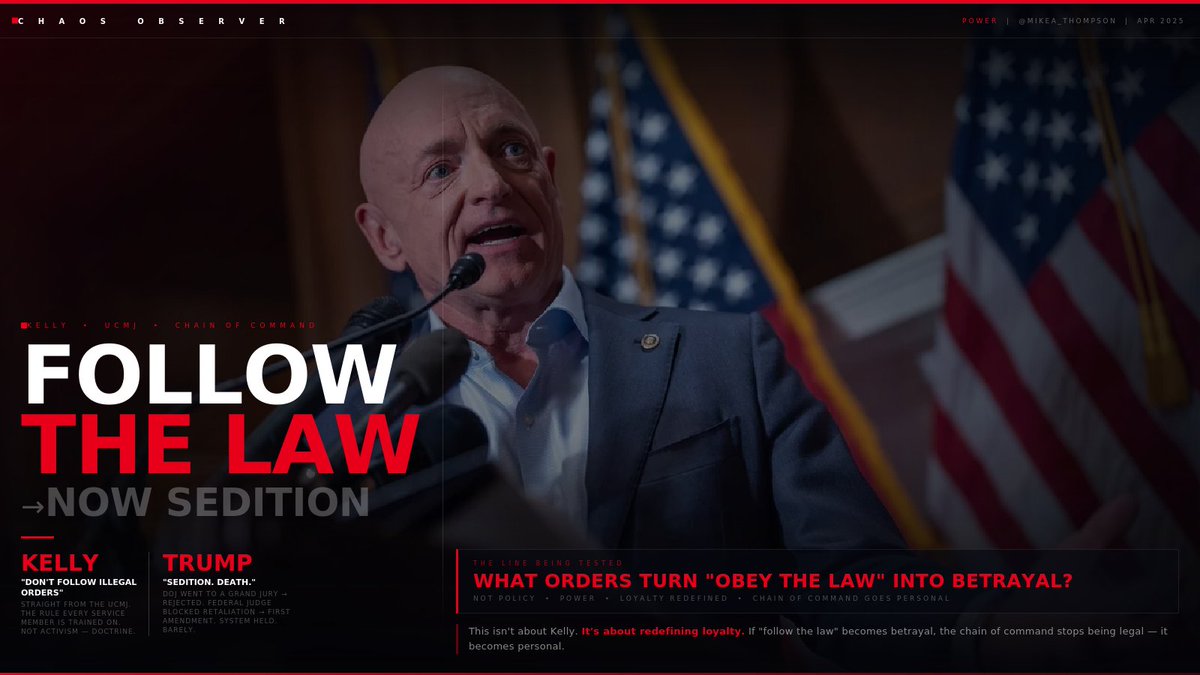
Donald Trump called for jailing Mark Kelly over one line:
“Don’t follow illegal orders.”
That’s not activism.
That’s doctrine.
Straight out of the Uniform Code of Military Justice — the rule every service member is trained on.
Trump’s reply?
“Sedition.”
“Punishable by death.”
“LOCK THEM UP.”
Not a misquote.
Not a metaphor.
A president pushing prison
for repeating the law.
And it didn’t end online.
DOJ went to a grand jury → rejected.
A federal judge blocked parts of the retaliation → First Amendment.
The system held.
Barely.
Because this isn’t about Kelly.
It’s about redefining loyalty.
If “follow the law” becomes “betrayal,”
the chain of command stops being legal —
it becomes personal.
That’s the line being tested.
Not policy.
Power.
And the real question isn’t what Kelly said.
It’s this:
What kind of orders turn “obey the law”
into something worth punishing?🤔
Donald Trump called for jailing Mark Kelly over one line:
“Don’t follow illegal orders.”
That’s not activism.
That’s doctrine.
Straight out of the Uniform Code of Military Justice — the rule every service member is trained on.
Trump’s reply?
“Sedition.”
“Punishable by death.”
“LOCK THEM UP.”
Not a misquote.
Not a metaphor.
A president pushing prison
for repeating the law.
And it didn’t end online.
DOJ went to a grand jury → rejected.
A federal judge blocked parts of the retaliation → First Amendment.
The system held.
Barely.
Because this isn’t about Kelly.
It’s about redefining loyalty.
If “follow the law” becomes “betrayal,”
the chain of command stops being legal —
it becomes personal.
That’s the line being tested.
Not policy.
Power.
And the real question isn’t what Kelly said.
It’s this:
What kind of orders turn “obey the law”
into something worth punishing?🤔
Marjorie Taylor Greene just dropped a grenade inside MAGA:
She says Donald Trump didn’t just slow-walk the Jeffrey Epstein files — he tried to stop them.
Her claims, blunt:
– Told AG Pam Bondi: don’t release them
– “My friends will get hurt” (Mar-a-Lago circle)
– Refused to meet victims
– Leaned on GOP to stall
Here’s where it gets uncomfortable:
Millions of pages did come out.
But heavily redacted. Pieces missing.
Trump’s name appears often —
mostly old links, not proven crimes.
So both things can coexist:
Disclosure happened.
Transparency didn’t fully.
And this is where it cuts:
No hard proof of a cover-up.
No full clarity either.
Trump’s defense is clear:
– Cut ties with Epstein years ago
– No confirmed wrongdoing in released files
– MTG is “unstable”
But this isn’t about legal proof anymore.
It’s about trust — and who’s saying it.
MTG wasn’t outside the system.
She was part of it.
This isn’t opposition noise.
It’s internal rupture.
And that’s the real risk:
Not what’s proven —
but what people start to believe.
Because once “expose everything” hits its own circle…
it either follows through —
or proves it never could.
Everyone keeps waiting for Donald Trump to break with Benjamin Netanyahu.
They’re watching the wrong movie.
This isn’t drift.
It’s repetition.Gaza. Lebanon. Iran.
Each time there was room to step back — Trump stepped in.
Not quietly.
On record.
Call it what it is: alignment that keeps delivering.
Netanyahu gets domestic leverage: Washington is locked in.
Trump gets a regional pillar against Iran — and bargaining power with the Gulf.
And then there’s Jared Kushner.
Not background.
Infrastructure.While officials talk, he runs parallel channels — Gulf capitals, capital flows, backroom access.
Same players, same money, same table.
Messy?
Sure.
But effective — and very much by design.
That’s why the “off-ramp” narrative keeps collapsing.
The incentives don’t point to a break:– Trump’s base is structurally pro-Israel
– His first-term wins are tied to it (embassy move, Abraham Accords)
– Israel anchors his entire Iran strategyThis isn’t sentiment.
It’s alignment of interests.
So no — this isn’t heading toward a rupture.
It’s a split-screen reality:Public friction for headlines…
private coordination where decisions are made.
The real question isn’t if they split.
It’s what kind of shock would be big enough to make alignment stop paying.🤔
Exactly, @elerianm — this is the textbook definition of unstable equilibrium.
Ceasefire extended, but the blockade stays, tankers are still being seized, and both sides continue trading serious threats. IRGC has made it crystal clear: any further escalation or outside help → Gulf oil infrastructure becomes a target.
https://t.co/lNsTsIx0iy
Not peace. Not war. Just a countdown with moving parts.
Ceasefire extended — but don’t confuse that with peace.
The United States didn’t ease pressure. It doubled down.
Naval blockade stays. Tankers still being stopped. The chokehold remains.
Islamic Revolutionary Guard Corps (IRGC) response?
Not diplomacy. Deterrence by threat:
– Help the U.S. → your oil infrastructure becomes a target
– Escalation → Gulf energy flows get disrupted for years
That’s not rhetoric. That’s a direct message to every economy plugged into Gulf oil.
Inside Iran, it’s still a split-screen reality:
crowds in the streets projecting strength…
missiles parading overhead reminding everyone what’s at stake.
At sea, this is where it’s actually being decided.
The U.S. isn’t just posturing. The seizure of vessels like the MV Touska shows enforcement is global now, not just local.
From the Gulf to the Indian Ocean — pressure follows the cargo.
Iran’s counterplay is just as clear:
proxy pressure, regional signals, and controlled escalation without crossing into full war.
This isn’t a pause.
It’s pressure, compressed into time.
The United States is betting economic strangulation forces a deal.
Iran is betting it can raise the global cost high enough to make that pressure politically unsustainable.
So the ceasefire isn’t stability.
It’s a countdown with moving parts.
The question isn’t whether it holds —
it’s what breaks it first:
a tanker that refuses to stop,
or a missile that flies too far.
Ceasefire extended — but don’t confuse that with peace.
The United States didn’t ease pressure. It doubled down.
Naval blockade stays. Tankers still being stopped. The chokehold remains.
Islamic Revolutionary Guard Corps (IRGC) response?
Not diplomacy. Deterrence by threat:
– Help the U.S. → your oil infrastructure becomes a target
– Escalation → Gulf energy flows get disrupted for years
That’s not rhetoric. That’s a direct message to every economy plugged into Gulf oil.
Inside Iran, it’s still a split-screen reality:
crowds in the streets projecting strength…
missiles parading overhead reminding everyone what’s at stake.
At sea, this is where it’s actually being decided.
The U.S. isn’t just posturing. The seizure of vessels like the MV Touska shows enforcement is global now, not just local.
From the Gulf to the Indian Ocean — pressure follows the cargo.
Iran’s counterplay is just as clear:
proxy pressure, regional signals, and controlled escalation without crossing into full war.
This isn’t a pause.
It’s pressure, compressed into time.
The United States is betting economic strangulation forces a deal.
Iran is betting it can raise the global cost high enough to make that pressure politically unsustainable.
So the ceasefire isn’t stability.
It’s a countdown with moving parts.
The question isn’t whether it holds —
it’s what breaks it first:
a tanker that refuses to stop,
or a missile that flies too far.
JD Vance is “leading” Iran talks — without actually being there.
– White House: delegation is planned, but JD Vance hasn’t even left yet
– Iran: no confirmed participation, skepticism remains
– Meanwhile, he’s still positioned as lead negotiator for Islamabad
This isn’t diplomacy — it’s signaling without presence.
If talks exist only on paper, are they negotiations — or just leverage dressed up as process?🤔
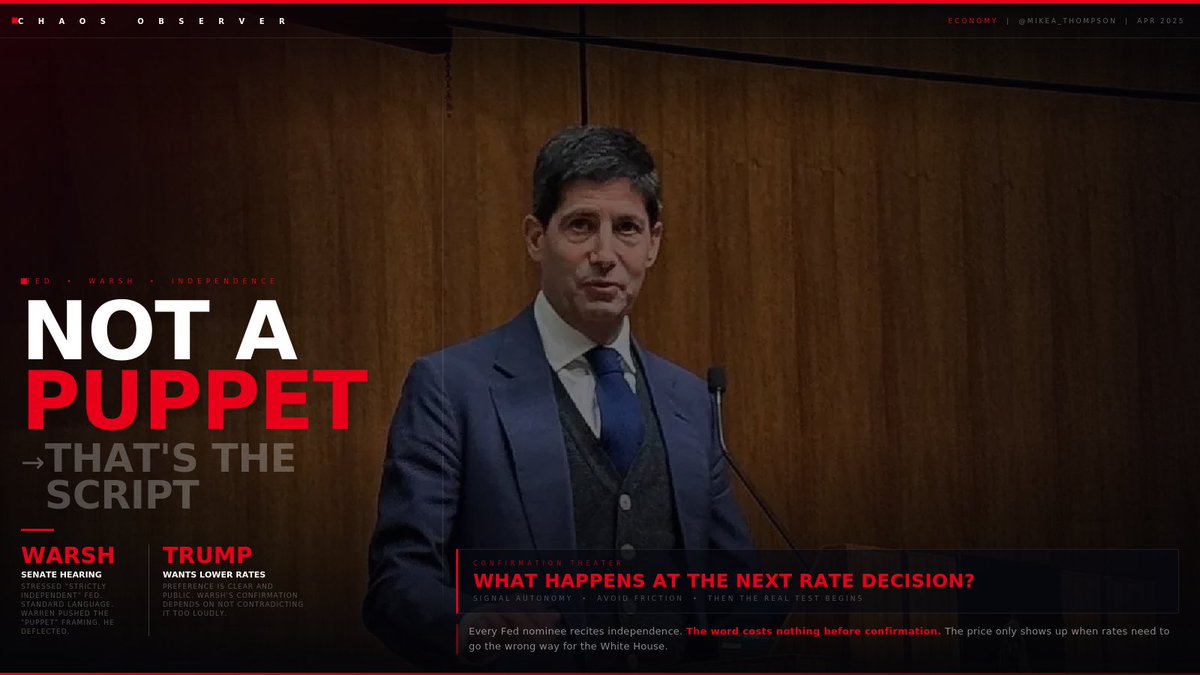
Warsh didn’t say he won’t be Donald Trump’s “puppet” — he recited the standard independence script.
– At Senate hearing, Kevin Warsh stressed a “strictly independent” Federal Reserve
– The “puppet” line is framing pushed by Elizabeth Warren
– Trump’s preference is clear: lower rates
This is confirmation theater: signal autonomy, avoid friction.
What happens when that meets the next rate decision?
Trump’s takeaway from Iran’s missile and drone strikes on Gulf states is blunt: even the richest allies get hit.
– Says the United Arab Emirates was “hit the hardest” despite Patriot/THAAD coverage
– Iran relied on ballistic missiles + mass drones to pressure partners without direct U.S. escalation
– Wealth didn’t buy immunity; geography did the rest
Not just sympathy — signaling.
If defenses leak, what exactly are allies paying for?
@cryptorover Iran counters that U.S. blockade + ship seizure are violations too.
Both sides talking tough as ceasefire expires in ~18h.
https://t.co/y6kADCzkZR
Trump is back to his default setting: accuse, threaten, offer a deal — all in the same breath.
– Claims Iran “seriously violated” the ceasefire via Strait of Hormuz incidents
– Tehran counters: U.S. blockade and the MV Touska seizure are violations too
– “No more Mr. Nice Guy” alongside a “very fair deal”
– Ceasefire (since Apr 8) expires ~Apr 22–23
Not inconsistency — pressure, performed in public.
If both sides call it a violation, who actually controls the off-ramp?
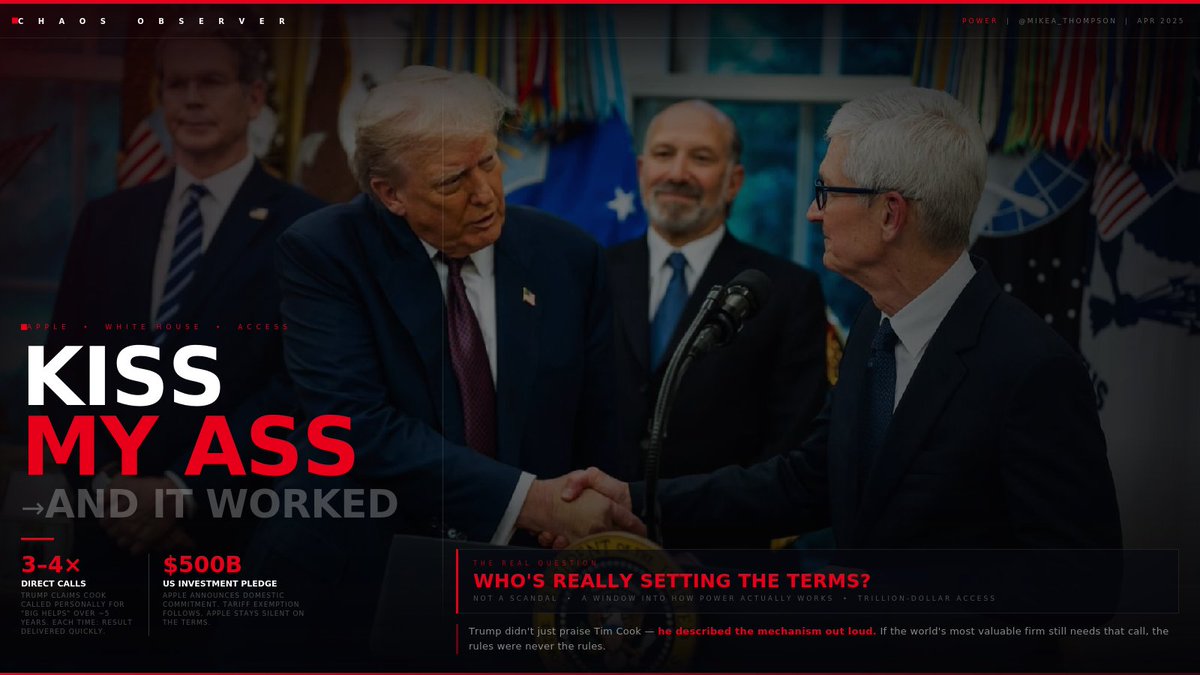
@clashreport He said he was impressed that Apple’s Tim Cook called to “kiss my ass” to get big things fixed quickly.
3-4 direct calls, fast results, no consultants needed.
https://t.co/1fbp1gR8wy
Trump didn’t just praise Tim Cook — he said Cook called to “kiss my ass” to get things done “very quickly.”
– Claims 3–4 direct calls for “BIG HELPS” over ~5 years
– Crude framing, but signals access and speed over process
– Apple stays silent; White House turns it into a case study
Not a scandal — a window into how power actually works.
If trillion-dollar firms still need that call, who’s really setting the terms?🤔