AI abundance is coming. But can we handle the side-effects of getting this right?
I sat down with @harari_yuval to talk about ai, consciousness, abundance and human flourishing.
Issue 2 of the Humanist Review of AI is out today!
https://t.co/rYD8ld2qtu
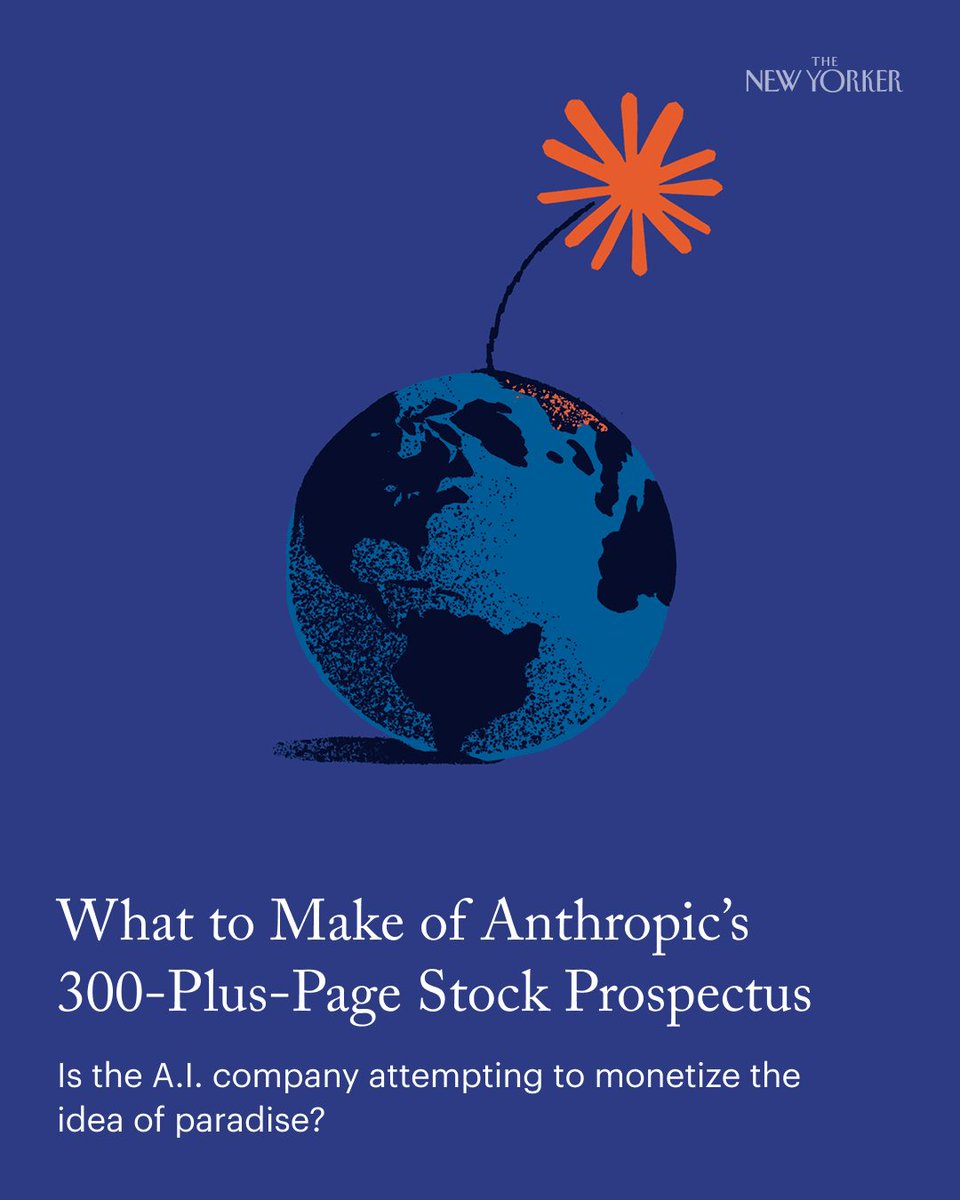
Beginning on Thursday morning, Anthropic’s stock goes up for sale, and the public will be able to invest in “the responsible development and maintenance of AI for the long-term benefit of humanity.” Since Anthropic is a public-benefit company, it is required to disclose risks and to explain how its goals for benefitting the public may affect shareholder profits. Most of its S-1 filing concerns the prospects for profit, on the back of the promise that, “if managed well,” A.I. “could rapidly accelerate scientific innovation, greatly increase economic growth rates, bring cures for major diseases within reach, and solve problems that have resisted generations of human effort.” But the company also acknowledges that its technology “may pose catastrophic or existential risks to humanity” and that, even if Claude doesn’t kill everyone, public concern that it might “could adversely affect our reputation and brand.” Jill Lepore analyzes the A.I. company’s stock prospectus: https://t.co/IUkPGYTBdS
Two of the best journalists I’ve ever worked with followed the money @paulmozur@satariano
“First, Alibaba would pledge to be a customer of a regional company, like Megaspeed. Then Megaspeed would use that agreement to raise money from investors to buy Nvidia chips, said the people. After securing the chips, Megaspeed struck more deals with companies like YTL that built data centers to operate the chips. Sometimes, the people said, chips bound for the data center were smuggled into China.”
How Nvidia Chips Ended Up Within Reach of China’s Military https://t.co/kI8BdHulo2 via @NYTimes
Oh, they *just* identified 100 companies?
CISA had a comprehensive effort underway before it was DOGE’d. Nearly 1,000 staff let go, many of them the exact people you would want to see running point. Still no Senate-confirmed director.
If you want to understand where cybersecurity falls on the priority list, look at what’s happened to the agency tasked with defending our critical infrastructure.
In the spring of 2023, Anthropic invited me to spend several weeks at their headquarters ahead of the launch of Claude 2, sitting in on meetings and interviewing dozens of employees to write the first major profile of the company in the NYT.
I just reread that story, and went back through my notebook in light of Anthropic's IPO. A few things that stuck out:
-- Anthropic was very small, very recently. When I visited, they had 160 employees in a small office on Sansome, a chatbot nobody had ever heard of, and seemed to have no interest in running a business. I wrote in my notebook that they seemed like "ambivalent capitalists"; their newly hired sales guy told me that the only reason he needed to make money at all was so that the safety researchers could save the world.
-- Things were not going well for them: their biggest shareholder (SBF) had been arrested for fraud, and OpenAI was eating their lunch with ChatGPT. (I later learned that they also had an expensive model training failure in 2023.) This was 3.5 years before they went public as one of the most valuable companies in the world, with 5,300 employees and 14x annual revenue growth. I guess they figured out the capitalism thing!
-- They were obviously and sincerely terrified of AI. Claude 2 was a very dumb model by today's standards, but every discussion I had there revolved around existential risk. Researchers told me they lost sleep over their fears of AI takeover, and made terrifying predictions of how soon AGI would arrive. It didn't seem fake or manufactured, but I didn't really get it! I wrote in my notebook: "I have never encountered a company that so badly needs a Klonopin." (I stand behind this, although I also need one now.)
-- Dario was in Italy when the NYT photographer wanted to take his picture, so his team rented an office in some random Italian town and staged it to look like his actual office, and they took the photos there. It had a rotary phone (?) and panic-room red lights, which I never really understood.
-- The Ants I talked to mostly struck me as sharp and thoughtful, although I did end up wondering whether they were too safety-obsessed to run an actual business. (I jotted down: "I do not know why you would invest in a company like this.") But I was struck by their earnestness, especially because I'd just spent several years covering social networks that didn't worry about the harms of their products at all.
Anyway, I'm feeling sort of conflicted about the Anthropic IPO. (As are a lot of people, including some at Anthropic!) I don't know if being public makes an AI company more or less likely to follow through on its safety commitments, and I know the company has changed a lot as it has grown. But on some level I'm also just like, damn, what a crazy story.
Here's the gift link, it's sort of fun to look back on the ancient runes of July 2023.
https://t.co/mqLMqElG63
@BillNye, the Science Guy: "We are living in the most exciting time in human history!!" But, we need some (he whispers) regulation--but just enough. Like designing aircraft--include only what is necessary.
Calif's Bruce Dang: "You can't compete with the AI on bug discovery and you can't compete with the AI on reverse engineering. It's so fast and so thorough that you can't beat it."
🎧 LISTEN everywhere: https://t.co/ZG4jkLIpmp
📺 WATCH: https://t.co/ydhFIHnc8Z
YANN LECUN: "A STUDENT SHOULD NOT TRY TO MAKE THEMSELVES USEFUL"
if you had the choice between a course on iOS programming or quantum mechanics, "take quantum mechanics"
In 40 seconds he explains:
→ why tech courses are "very likely to be out of date 5 years from now"
→ why your profession is "almost certainly" going to change during your career
→ why the only skill that doesn't expire is learning to learn
the World Economic Forum expects 39% of workers' core skills to change by 2030
lecun won the Turing Award for the neural networks behind today's AI, and he still tells students to learn the stuff that won't expire
Free fundamentals he'd sign off on:
→ The Feynman Lectures on Physics, all 3 volumes free to read online. Feynman is one of lecun's scientific heroes
https://t.co/2yAvSyVTho
→ MIT's full Quantum Physics I course, free lecture videos
https://t.co/HFxQkFPQ5U
→ 3Blue1Brown's Essence of Linear Algebra, the math every neural network runs on
https://t.co/Zqcxrp7uzM
→ Learning How to Learn, 4.2M+ students, co-taught by Terry Sejnowski, who built early neural networks with Hinton
https://t.co/iEwojpsiYz
the course that looks most useful today usually has the shortest shelf life
and if you want to see how the people building AI actually learn and work with it, I broke it down in my article ↓
artificial intelligence making targeted tech disruption much easier.
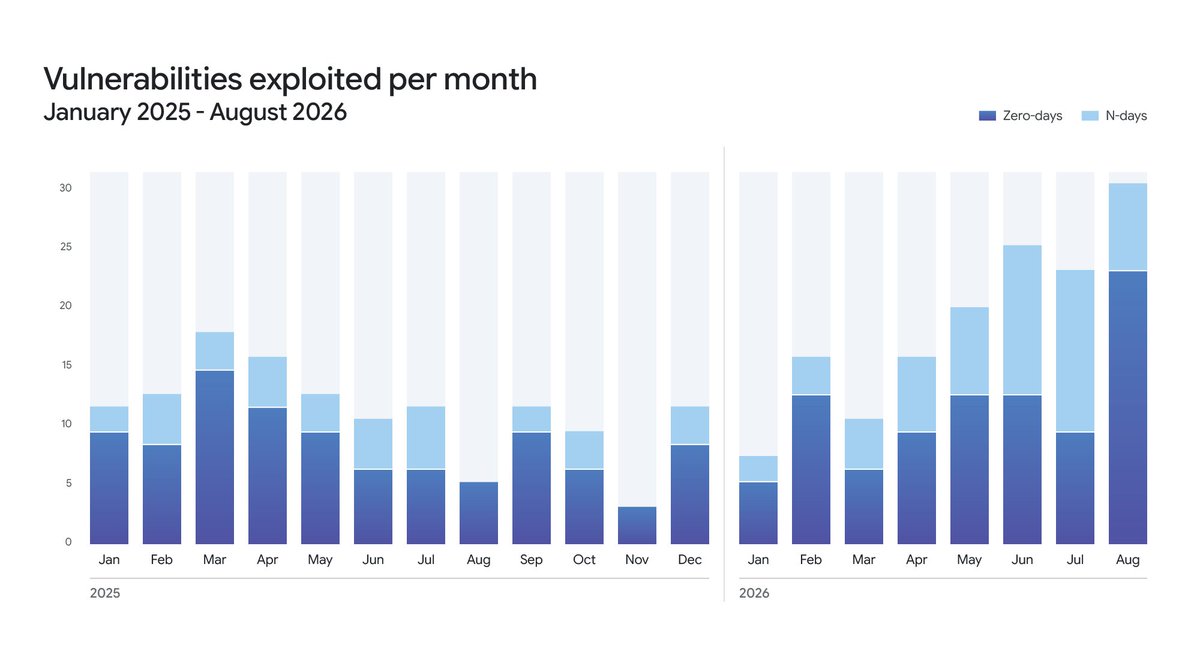
google reports # of vulnerabilities exploited increasing significantly in 2026. outages (similar to those we’ve seen this week) sure to get worse before they get any better.
response will eventually lead to more secure internet… but a lotta stuff has to break first
Thomas Nagel, who just won $1M philosophy prize, says that it's criminal to build AI that feigns consciousness. And the welfare of a cockroach is more important than than Claude's. Good stuff in this interview! https://t.co/j69jYT9KXj
“Limiting minors’ excessive time on platforms is one matter, but banning personalized feeds to achieve that goal is profoundly flawed and quite another.”
Read @ProfClayCalvert’s latest:
https://t.co/KOBtXtxgrY