It could also do things like tighten up the temporary foreign worker program, which the UN has likened to a contemporary form of slavery.
There are lots of options here, that would create a better, fairer system for newcomers and existing residents alike.
This is a good thread, though for some reason it leaves out an obvious option: Leave total PR intake unchanged, and increase the proportion of NPR to PR transitions. Which would be fully aligned with the 2025 Levels Plan.
It is entirely fair to criticize Prime Minister Mark Carney for the way his government has presented Canada's immigration levels for 2027. By emphasizing its target of 380,000 permanent residents, while excluding additional admissions contemplated through one-time initiatives and time-limited measures, the government has created a misleading impression of how many people may actually become permanent residents. When these additional measures are included, the potential total could reach approximately 662,000.
What is considerably less reasonable is the suggestion that these additional admissions demonstrate that Carney has somehow lost control of Canada's immigration system. Such criticism ignores the situation his government inherited and the choices available to address it.
Over the past decade, Canada admitted millions of temporary residents, many of whom were encouraged, explicitly or implicitly, to view temporary residence as a pathway to permanent residence. Hundreds of thousands subsequently applied, only to find themselves caught between annual admissions caps and enormous processing backlogs.
Carney did not create this imbalance. It developed over many years, particularly toward the end of the Trudeau government's term, when temporary resident numbers expanded dramatically without a corresponding increase in permanent residence capacity.
Faced with this situation, the Carney government essentially had three choices:
It could maintain existing permanent residence targets and leave applicants waiting, potentially for decades, renewing temporary permits and living with uncertainty.
It could dramatically expand immigration enforcement and deport large numbers of temporary residents who can no longer maintain their status, requiring something resembling the U.S. Immigration and Customs Enforcement model.
Or, it could facilitate the transition to permanent residence for eligible individuals already in Canada.
Consider the tens of thousands of Hong Kong residents and Ukrainians who came to Canada under special immigration policies. Many established careers, enrolled their children in schools and applied for permanent residence. If critics believe these individuals should continue renewing work permits for decades or be required to leave Canada, they should clearly say so.
There is also an important distinction between granting permanent residence to someone already in Canada and admitting someone from abroad. A family that has lived in Vancouver for four years does not suddenly need another home when its permanent residence application is approved. Its children do not suddenly start attending school. They are already here.
Equally important, temporary resident admissions remain constrained by targets and restrictions, well below the extraordinary levels associated with the expansion during and after the pandemic. The Carney government is restricting new temporary immigration while facilitating the transition to permanent residence for people already here. Higher permanent residence admissions therefore do not necessarily mean a comparable increase in Canada's population.
None of this places the government beyond criticism. Canadians deserve transparent numbers and consistent eligibility criteria.
But criticism should confront the actual choices facing the government. Those who oppose these regularization measures should explain what they would do instead. Until they address the choices faced by the government and the reduction in people moving to Canada, claims that Carney has lost control come across as political rhetoric designed for social media clips rather than serious immigration policy discussion.
My latest at the Globe. Life expectancy inequality is on the rise in Canada. Being born in the wrong community, or even wrong neighbourhood greatly lowers how long you'll live, on average.
https://t.co/1oCaVPq5E3
New Homes and Growth Coalition piece!
As it turns out, the traditional NIMBY-to-YIMBY axis is too simple; there are five distinct types of housing voters. And only a relatively small portion of them are BUILD BUILD BUILD.
Read here: https://t.co/tJKgwoJAtD
Young Canadians are stuck in their longest job searches in decades, per The Globe and Mail.
Among unemployed Canadians aged 20 to 24, 28% of women have been looking for work for six months or more, the highest share since records began in 1976. For men it’s 27%, the highest since 1983. That’s according to a new C.D. Howe Institute study by economists Parisa Mahboubi and Tammy Schirle.
A university degree isn’t helping. Unemployed young graduates are searching just as long as those with a high school education or less.
Questions I never thought to ask. Turns out fans of Joe Rogan, Jordan Peterson, and Donald Trump vote Conservative, while fans of King Charles, the Pope, and the Ryans (Reynolds, Gosling) vote Liberal.
The Liberals dominate among voters who are fans of the Pope and the King. The Conservatives would win every seat if only Donald Trump fans voted.
See over 50 segmentations: https://t.co/kJi6VWoZhU
"It's like having a dinner guest unexpectedly become your roommate. Yeah, the number of people doesn't change but it's not what you agreed to"
-@SabrinaMaddeaux describing the government's new immigration sleight of hand on her latest pod. Brilliant!
Loosely transcribed.
"Canada to admit more than 600,000 new permanent residents in 2027".
Yet, I'm somehow wrong to assert that RBC estimates that we'll admit more than 600,000 new permanent residents in 2027?
Bruh... The opening minute immediately misleads asserting RBC estimates we'll admit ~660k PR next year. This is false. & fear-mongering abt possible record PRs is especially stupid when the lion's share would be already residents...
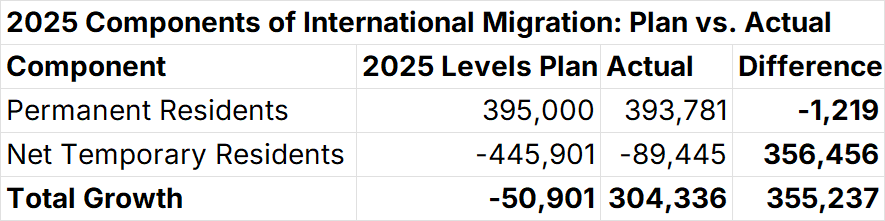
The point that is consistently getting missed here is that those temp -> perm residents then leads to admission of more temporary residents. Here's the 2025 plan numbers vs. what actually happened.
Canada missed its planned number by 350,000!
This guy’s complaint boils down to the fact that we took the federal government’s 2025 immigration levels plan at face value, whereas a more rigorous economist would have assumed the government was actively lying to Canadians. Noted.
Bruh... The opening minute immediately misleads asserting RBC estimates we'll admit ~660k PR next year. This is false. & fear-mongering abt possible record PRs is especially stupid when the lion's share would be already residents...
There’s two inconvenient facts here that keep getting overlooked:
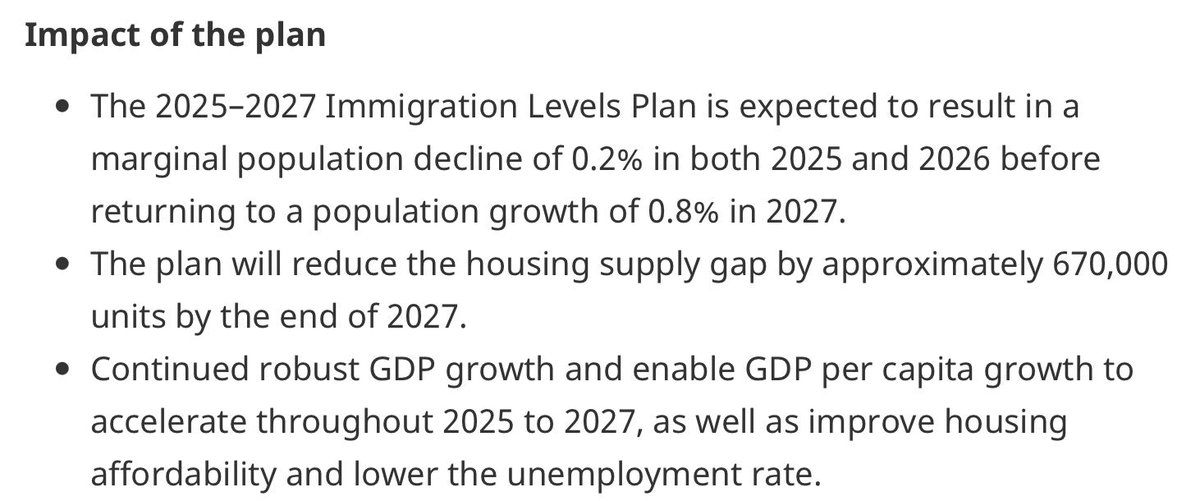
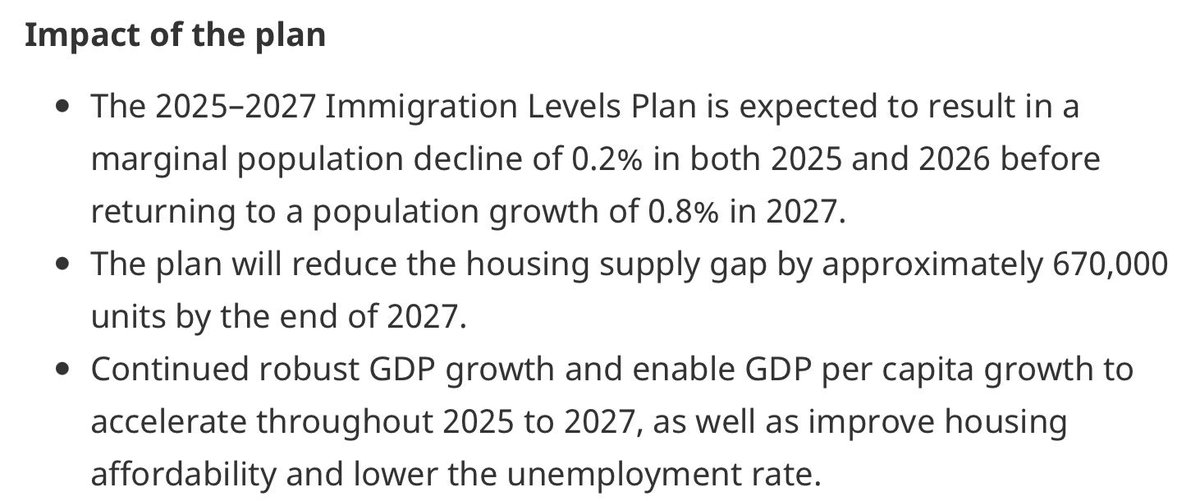
- Population growth was/will be much higher in 2025, 2026, and 2027 than what was in the 2025 Levels Plan.
- That slow population growth was part of the government’s strategy to reduce housing shortages.
@jg7796 Your complaint boils down to a suggestion that we shouldn’t have taken the previous two plans at face value, and instead assumed the government was either wrong or actively lying.