There seem to be two main groups
1️⃣ Those who post all day long about using coding agents but don’t seem to ship anything
2️⃣ A small group whose output has dramatically increased and are constantly shipping valuable things
The irony is that the ratio of these probably remains unchanged from before AI even existed. It also seems 2️⃣ can outship 1️⃣ even more so the “ship-rich will get richer” so to speak.
"Everyone gets FDEs wrong.
The job of an FDE isn't to make the product work, it's to accelerate customer adoption and time-to-value.
If you need FDEs just to deliver the product, you're not running a software company, you're running a services business with a bad product." @matanSF
Do you agree and what do people misunderstand most about what it takes to do FDE motion well? @ssankar@chadwahl@nikogrupen@barrald@lkothari@LeoMehr@zkevinbai
Hoy Miguel Sebastián, exministro y economista, firma una tribuna VOMITIVA explicando que las joyas incautadas a Zapatero (1,3 millones según el informe pericial) no había por qué declararlas.
Que un regalo personal no es renta en especie.
Que llevárselo a casa "es una opción personal tan aceptable como la otra".
Mientras tanto, este año Hacienda ha incluido 437.000 avisos a contribuyentes por ingresos en plataformas como Wallapop, Vinted o Airbnb.
El umbral para que la plataforma te delate: 2.000 euros o 30 ventas al año.
El mismo Estado que, si te casas, considera que el dinero que te regalan tus invitados es una donación sujeta a impuesto.
Eso, para el ciudadano de a pie.
Si eres político, juegas con otras reglas.
This is, perversely, good news for Britain, Australia, Japan, Europe, and other countries being cut off that would once have seen themselves as close allies of the United States.
It shows us what the future may hold if AI is the strategically and economically decisive technology of the 21st century and is controlled by the US and China. It is good news because *it may be happening early enough to give us time to act.*
I think this will be rescinded pretty soon, but it’s a sign of things to come. In a future where frontier models cannot be used outside the US, our industries and economies will fall behind and American businesses may not be able to operate overseas. We won’t be able to defend ourselves militarily with defence systems built on obsolete software. Europe 2031 is a good scenario of what a future like this could mean: https://t.co/AMc5LrFJeS
Some of the things we need to do are ‘no regrets’ measures we should do anyway. But some are genuinely costly and risky.
We need cheap electricity – powered by gas, coal (this is costly, coal is very bad), deregulated nuclear fission – whatever can provide *cheap, reliable, 24/7* power. This almost certainly excludes wind power, which is enormously expensive and unreliable. We need projects to be able to connect to the grid in days rather than years by paying for fast-track connections.
We need to make it incredibly easy to build data centres, with the property taxes retained locally and hypothecated for local tax cuts so there is some direct benefit for locals. This doesn’t need to be nationwide.
We need to create new regulatory regimes for innovative businesses that give them the right to hire and fire staff with ease. The difficulty and cost of firing staff is one of the main reasons Europe has fallen behind so badly. We need to create a parallel employment regime that companies and workers can opt in to: https://t.co/YaNOXK1Po2
Even though I think it will probably fail, I think we should probably try to create a good, non-American frontier AI lab. I am quite pessimistic about this – even extremely well-resourced, innovative software companies are struggling to do this. But the stakes are so high that not trying seems foolish.
One thing that might work in our favour is the number of brilliant AI engineers who are not US citizens, who under the current export controls do not have access to Mythos/Fable even if they live and work in the US. What happens to Demis Hassabis, Ilya Sutskever, Andrej Karpathy, and the many other Europeans, Canadians, etc who are working on AI models in Britain and America who are affected by this?
I do not think we should force our own companies to use model, because this would exacerbate their economic weakness – this lab should have to compete on an even playing field. I am deeply sceptical that this can work, but we cannot rule it out. If we do it, it has to be able to pay US salaries, operate without political constraints. https://t.co/Um05rUF4Vq
It is cope to tell yourself that Trump is an aberration or that these export controls are a one-off. To repeat, I think these specific controls will be lifted quickly and it will be easy to move on and forget it happened. But this is a look into a potential future. Every one of us that is not a US citizen is at risk. The standard political divides do not apply here; the question is whether you grasp the enormity of AI as a technology. We have to act!
Today I'm publishing a new essay, Policy on the AI Exponential. AI is progressing extremely fast—much faster than the policy process was built to handle. The essay lays out where I think the technology is now, and the action needed to close the gap: https://t.co/Lh6PWae178
Hay libros para leer, trabajar, consultar y otros para dialogar con ellos. @mike_arias en El latido de mi #startups https://t.co/hFghYuYr2g consigue a través de sus breves capítulos introducir una o dos ideas fuerza con las que parar, coger papel y lanzar preguntas.
Preguntas que nos deben provocar incomodidad, ¿Por qué estamos haciendo las cosas así?, ¿Por qué no pivotar?, ¿Por qué no somos atractivos para determinado perfil de clientes, trabajadores, inversores, mercados…?
Mucho que aprender, cambiar, probar, ajustar… es un libro para que muchos de los actores del ecosistema lo trabajen, si lo lees te vas a quedar en lo superficial. Os puedo asegurar que lo he trabajado y no poco, pues tengo la sensación que en unos meses debo volver a releerlo por los pelos que se me quedaron en la gatera.
🔵 OJO: Las megarrondas están aquí, como avisamos.
Theker (robots con IA) cierra una Serie A de $85M. Lidera CRV.
La cifra es interesante, pero no es lo más relevante de lo que ha pasado. Lo más relevante es cómo se fraguó. Lo desvelamos en @Ecotechers Pro.
2026 is a BRUTAL grind in VC. You start in Davos, freeze in Aspen, hit Upfront, survive Milken, then it’s straight to Paris for the French Open. Briefly back in NYC for the Knicks. Then, total blur: SuperReturn in Berlin, Founders Forum in London, then back stateside for the World Cup, back to Paris for Raise AI, Idaho for Sun Valley, quick respite in Mykonos, then the Goldman tech gauntlet, Slush in Finland, NeurIPS in freakin’ Sydney… and *boom*, a productive year of thought leadership and adding value is over, and you’re a wreck.
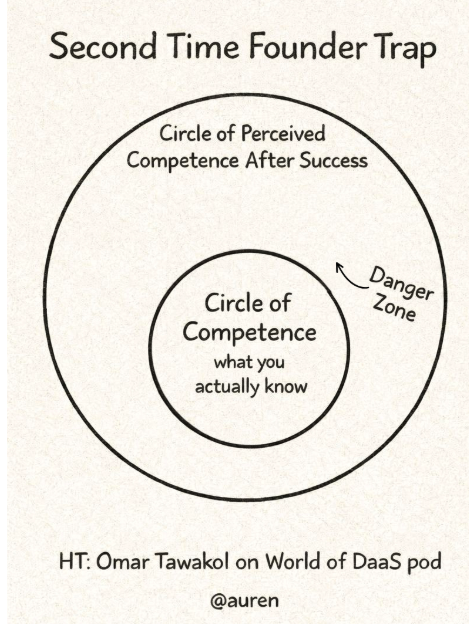
repeat founders make different mistakes than first time founders. It is easier to make first sales and get a false signal on product market fit when you have good connections and know how to sell
Everyone's talking about the AI context layer. Almost nobody tells you what's actually inside it.
@elisenda_bou and I just published what we think is the most comprehensive map of the space to date. Her breakdown of the pieces is in the thread 👇
3 buckets: the agent's own context, the institutional knowledge your company already lives in, and the systems of record holding the hard operational data. Plus governance and an emerging public data layer cutting across all of it. Not complete & evolving daily. Missing? Tell us
🟡 Mi startup tiene 68/100 en Salud Operativa.
He completado el Test de Salud Operativa de "El Latido de tu Startup" y estos son mis resultados:
• Bloque más crítico: Visión y diferenciadores
¿Cuál es la salud operativa de tu startup? https://t.co/0E6kDYzEEZ