The current decline in US bonds is unprecedented:
15+ year Treasuries have returned -2% per year on average over the last 10 years, their worst performance in history.
This is also only the 2nd period in data going back to 1936 where Treasuries have posted negative 10-year annualized returns.
By comparison, US stocks have returned +15% per year on average, while commodities have returned +11% per year on average over the same timeframe.
To put this into perspective, before the 2020 pandemic, Treasuries gained +9% per year on average over a 10-year period.
Since the start of 2020, the popular bond-tracking ETF $TLT has dropped -26%, with its biggest drawdown at -34%.
The bond market is no longer the safe haven it once was.
“Term out the debt honestly and pay the price the market sets. If the 30-year must trade at 5.5% to clear, that isn’t a crisis. It is an invoice. Then do the only thing that durably lowers long-term yields: address the primary deficit.” https://t.co/GWyEmPnKZW
In Warsh’s first two months as Fed chair, M2 has grown about 0.9%, an annualized pace of nearly 6%. Properly defined, inflation is the expansion of the money supply; higher prices are the consequence. A 6% monetary inflation rate is hardly consistent with the Fed's 2% CPI target.
Bessent’s plan to use the TGA to fund Treasury buybacks makes possible exactly what I warned would happen. This reckless plan will substantially shorten the average maturity of the national debt, increasing our exposure to rising short-term rates and making it even harder for the Fed to hike rates without exploding federal interest expense and budget deficits. It’s a recipe for massive QE and runaway inflation. Got gold?
Trump is trying to boost the U.S. economy by making it harder for Americans to trade with the rest of the world.
He is also promising to destroy Iran's economy by making it harder for Iranians to trade with the rest of the world.
Treasury bond yields have already resumed their rise. Treasury is going to need a much bigger boat to stop this train. That means not only a much larger buyback than what has already been announced, but the Fed will have to join the party with an official QE program. Got gold?
JD Vance one year ago today:
“I empathize with Americans who are exhausted after 25 years of foreign entanglements in the Middle East. I understand the concern, but the difference is that back then we had dumb presidents"
🌽U.S. corn exports are projected to reach a record 3.325 billion bushels in 2025/26.
China's share: 0
Five years ago, China accounted for nearly a third of total U.S. corn exports. Yet total shipments this year are more than 20% larger.
According to U.S. Treasury data (Debt to the Penny and Schedules of Federal Debt):
- Debt held by the public rose **$243 billion** in May 2026: from $31.272 trillion (April 30) to $31.515 trillion (May 31).
- The unified budget deficit was **$293 billion** (per Monthly Treasury Statement).
Gross federal debt (including intragovernmental holdings) fluctuated but ended the month near $39.21 trillion. The difference between deficit and debt-held-by-public increase reflects cash balance changes and other factors.
Official sources: https://t.co/94w2u3J8Cy.
US headline CPI inflation was in line with the consensus forecast, resulting in the first 4%-handle (4.2%) in three years. Core inflation was softer than expected, suggesting limited spillover in May.
#economy#inflation#markets
BREAKING: May CPI inflation rises to 4.2%, the highest level since April 2023.
Core CPI inflation also rises to 2.9%, the highest since September 2025.
Inflation in the US is officially back above 4% and more than double the Fed's target.
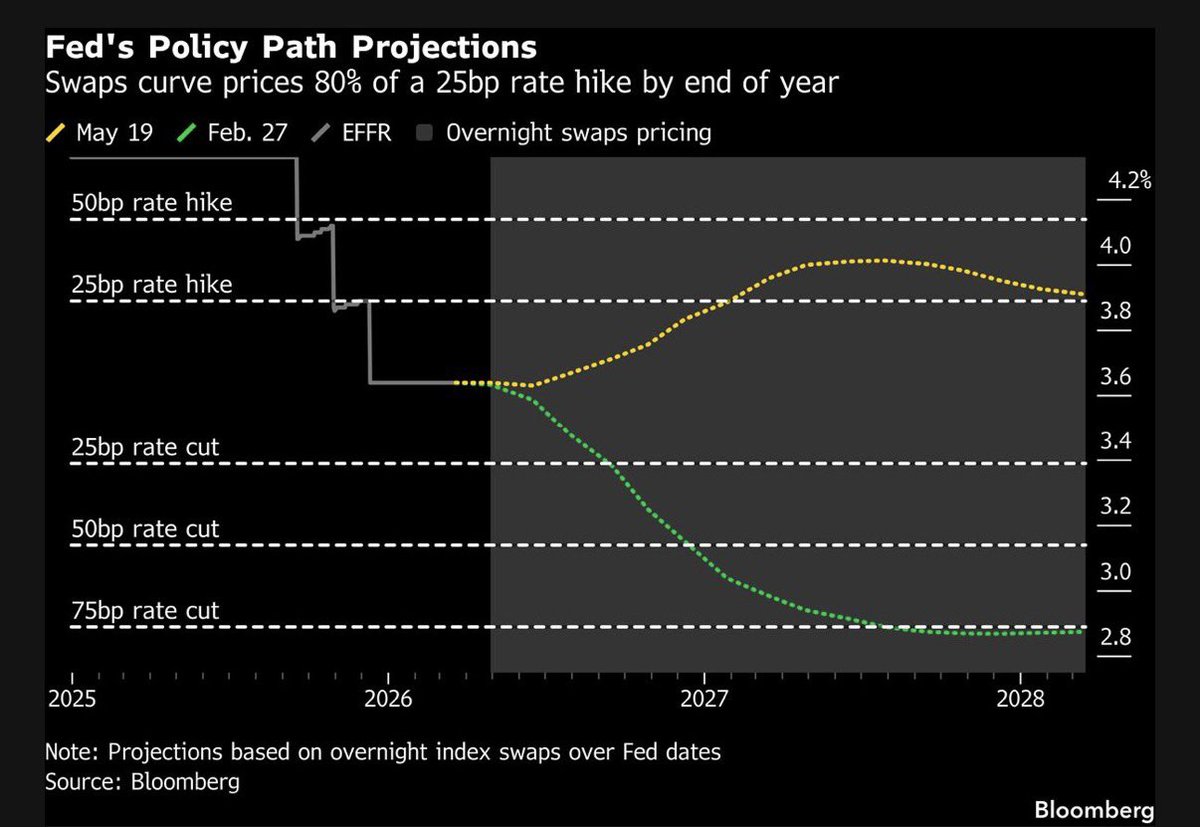
Odds of Fed rate hikes are rising.
So far, over the first five months of 2026, the CPI is up 2.52%. If this pace continues for all of 2026, the CPI will rise 6.2%, the most since 2022. But I think the second half of the year will see a much bigger rise, sending the full year above 7%, the highest rate since 1981.
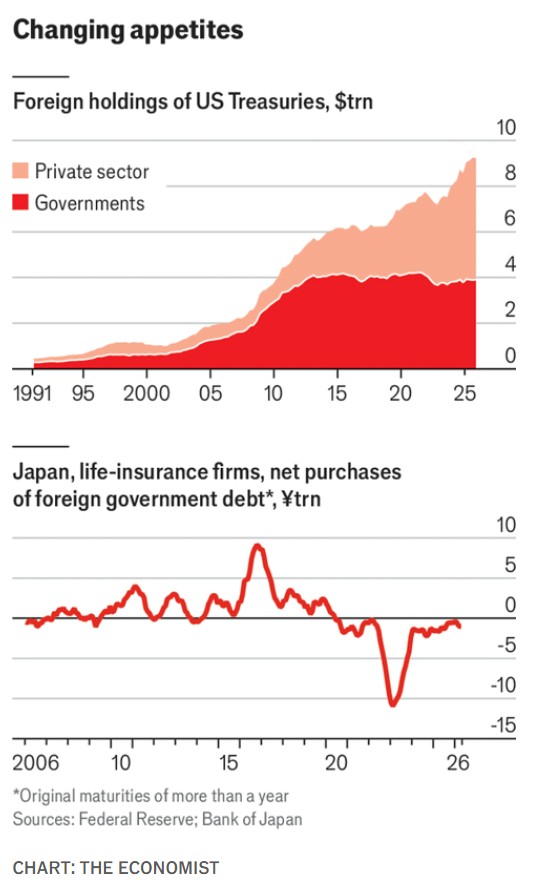
The Economist on key structural changes to the US Treasury market. It concludes that:
"The risk is not so much, or not chiefly, that America might default on its debt. Rather,...the fear is that the Treasury market might gradually forfeit its status as the guiding light of global finance. That would make it more expensive for America’s government to borrow. And since there is no good alternative to Treasuries, it would make the entire global financial system wobblier and riskier."
#economy #markets
Since Trump returned to office, 86% of net new payroll jobs have gone to women. Women now hold slightly more nonfarm payroll jobs than men — 50.02%.
The labor market has shifted. The question is whether our policies and politics have noticed.
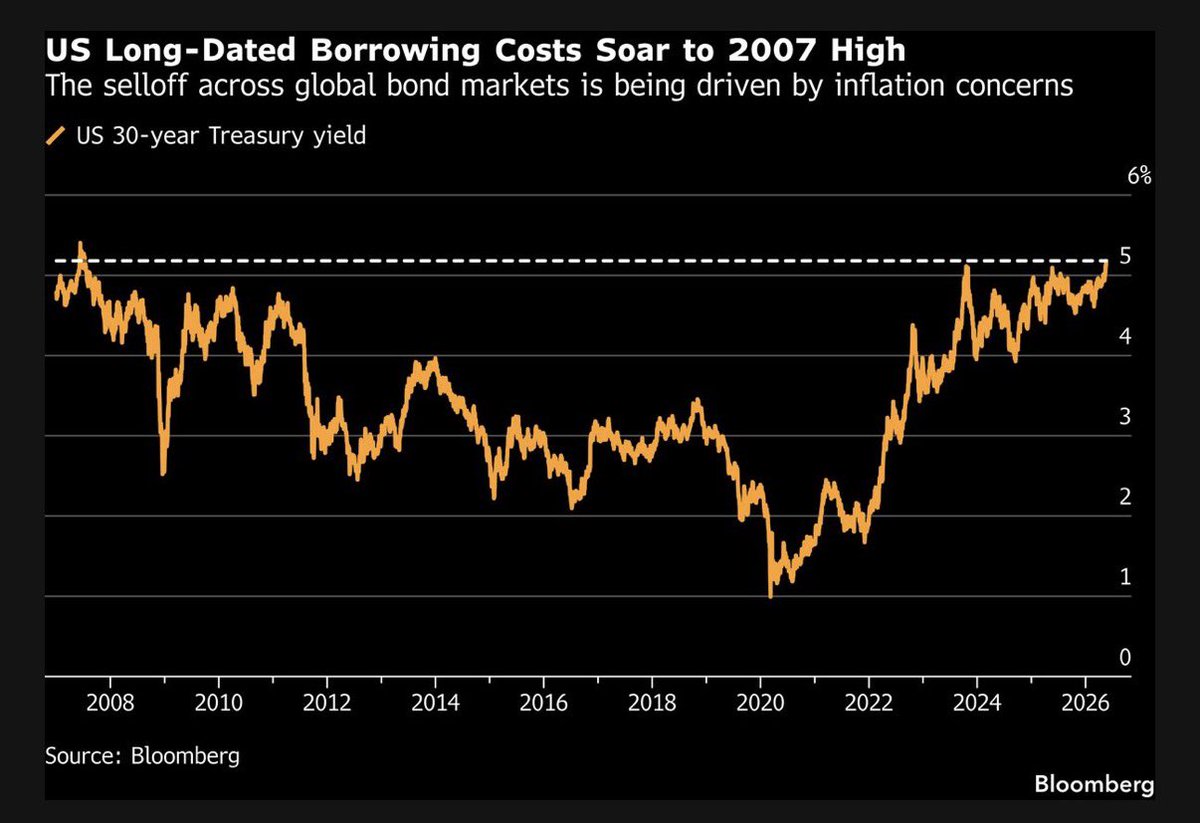
Bloomberg: "Yields on the US Treasury’s longest-dated bond rose to the highest level in almost two decades as investor concerns mount that accelerating inflation will force central bankers to raise interest rates."
#economy#markets#bonds
Ken Griffin, Founder and CEO of Citadel, on why a $2.50 Coke at McDonald's tells you everything about the U.S. economy:
For Griffin, the price of a single fast-food drink captures the story of the past six years.
"$2.50 for a Coke. And before the Biden administration, it was $0.99."
That jump is a window into something much bigger:
"The United States has endured prolonged and persistent inflation now for 6 years."
Griffin explains that these everyday price shocks carry a psychological weight far heavier than the numbers themselves:
"The rise of gasoline prices at the gas station, it's like a triggering event. It just brings back to all of us the fact that the purchasing power of the dollar has declined so precipitously for 6 years now."
The Coke is just one example. Eggs are another.
Griffin points to New York City prices in the range of "7, 8, 9 dollars for a dozen eggs", and notes that even though they've come down somewhat, they remain painfully elevated.
Each of these small, daily encounters with higher prices adds up to something larger. A creeping anxiety about the future:
"I think everybody in our country, when we see a price shock in any of our day-to-day commodities, gasoline for example, it's just deeply triggering. And I think that there's just a general apprehension of how much more purchasing power are we going to lose because of the economic policies that we're pursuing in Washington."
His message to policymakers is direct:
"It's very important that this administration and that the legislature continues to stay focused on how do we strengthen the purchasing power of the dollar? How do we make sure that Americans' paychecks go further?"
The takeaway: a $2.50 Coke isn't really about a Coke. It's about what the dollar in your pocket can no longer buy at the drive-thru, the gas pump, and the grocery aisle.
Until purchasing power is restored, that frustration will keep growing into something much harder to ignore.
The economic damage from the war with Iran is mounting. Just the surge in gasoline prices has cost Americans an estimated additional $21.3 billion since the start of the war over 6 weeks ago. Fortunately, cushioning the financial blow are bigger tax refunds associated with the deficit-financed tax cuts provided by the One Big Beautiful Bill Act. To date, those bigger refunds have totaled $47.1 billion.
Unfortunately, those refunds are set to tail off over the next few weeks, but it doesn’t look like gasoline prices will return to pre-war levels anytime soon. That’s even if the war ends soon, which looks iffy, to say the least. And this abstracts from what Americans will need to shell out for higher prices on everything from groceries to airfares in the coming weeks and months. The financial pain caused by the war and its fallout on consumer spending and the economy is set to intensify.
BREAKING: The Federal Reserve reported an operating loss of -$18.7 billion in 2025, marking its 3rd consecutive annual loss.
This brings the total 3-year loss to -$210.3 billion after the -$77.6 billion recorded in 2024 and -$114.0 billion in 2023.
The losses are primarily driven by the Fed paying out more in interest to banks and money market funds than it earns from its bond and MBS holdings.
Since the losses began in September 2022, the Fed has stopped remitting income to the Treasury Department, ending a streak that totaled +$1.36 trillion since 2008.
However, the Fed cannot become insolvent because it quite literally creates its own money.
Truly incredible.