Operador de Nodos Unity @UnityNodesIO , si quieres licencias Unity manda DM. Conecta a los desconectados World Mobile #WMTx y Minutes Network #MNTX 📶📡 🌏
UNO Holders - reminder for today.
Join us for the next Unetwork Node Operator Meetup:
📅 Today - September 8
⏰ 18:00 CET
📍 Unetwork Discord - UNO Holders Stage
We’ll share updates, discuss current priorities, and take questions directly from UNO holders.
Bring your own questions, questions from your ULOs, and anything you want clarity on.
Join the Unetwork Discord:
https://t.co/kdbvF0bcMi
See you there.
UNO, ULO, Emails, Licenses & KYC: How It Works
We’ve seen some questions about how accounts, email addresses, and licenses work across Unetwork, so here’s a simple guide.
If you are a UNO:
Your UNO account has its own email address and is used to manage your Node and its licenses.
If you are also operating as a ULO:
Your ULO account must use a different email address from your UNO account.
The same email address cannot be used for both a UNO and ULO account.
If you operate multiple ULO licenses:
You do not need a separate email address for every license.
A single ULO account can have multiple licenses attached to it, allowing you to manage multiple licenses under the same ULO email.
What about KYC?
Your UNO and ULO accounts are separate accounts, so each account must complete KYC separately.
You can complete KYC for up to two different Unetwork accounts, meaning you can verify both your UNO account and your separate ULO account.
So, the simplest way to remember it:
UNO + ULO = two accounts + two different emails + separate KYC
Multiple ULO licenses = one ULO account can manage them
You do not need a new email or a new account for every ULO license.
Keep your UNO and ULO accounts separate.
Keep your ULO licenses together.
Internal monitoring and independent observation see different things.
Telstra’s review of its July mobile outage found that gaps in visibility contributed to delays in identifying the underlying problem.
There’s a wider telecom lesson here.
Internal monitoring asks:
What does the network say is happening?
Independent observation asks:
What actually happened at the edge?
Did the service arrive?
Did it behave as expected?
What did the device experience?
As networks become more complex and automated, both views matter.
Unetwork creates independent observation points across devices operating on live networks, adding another layer of evidence from the physical edge.
Observability is stronger when the system being observed is not the only source of evidence.
Extended Telemetry enters production on September 7.
Action Required: Update Unetwork Before September 7
With the latest Unetwork builds now available, support for older app versions is coming to an end.
From Monday, September 7 at 00:00 UTC, versions earlier than 1.2.2 will no longer be supported.
If you are running an older version of the Unetwork or Unity app, please update before the deadline to avoid losing access to supported network services and tasks.
This applies across both iOS and Android.
September 7 will also mark the next stage of Unetwork Telemetry.
Extended Telemetry is already available and has been running in calibration mode. From September 7 at 00:00 UTC, calibration will end, Extended Telemetry will begin generating rewards, and the existing Telemetry task will be retired.
We’ll share a separate update with everything you need to know about Extended Telemetry before then.
Update now and make sure your device is ready for September 7.
🔗
Extended Telemetry has been available on Unetwork for several weeks and has been running in calibration mode.
From September 7 at 00:00 UTC, calibration ends, Extended Telemetry enters production, and eligible activity will begin generating rewards.
At the same time, the existing Telemetry task will be discontinued and removed.
Here’s what you need to know:
• Extended Telemetry is opt-in. You need to enable the task to participate.
• Your device location must match your ULO country to qualify for Extended Telemetry reward generation.
• Reward generation is capped at the equivalent of five qualifying devices per IP address.
If five eligible devices are operating on the same IP address, each can generate its applicable share based on uptime.
If more than five devices operate from the same IP, the total reward allocation available to that IP does not increase. Instead, that allocation is distributed across the participating devices based on uptime.
For example, 10 devices operating from a single IP address will share the same maximum reward allocation available to five qualifying devices.
This structure is designed to improve the quality and geographic diversity of the telemetry that Unetwork provides to customers, rather than simply increasing rewards by adding more devices to the same connection.
Before September 7:
Update to a supported version of Unetwork.
Opt in to Extended Telemetry.
Make sure your device location matches your ULO country.
Extended Telemetry reward generation begins September 7 at 00:00 UTC.
Unetwork 1.2.3 Is Now Live on iOS
The wait is over.
For the first time, the fully branded Unetwork app is now available on the Apple App Store, bringing iOS users onto the latest generation of the Unetwork platform.
Version 1.2.3 includes:
• The new Unetwork app and branding
• Improved security and device integrity
• Improved connectivity and reliability
• Extended Telemetry
• Access to additional Unetwork tasks
• The latest platform and performance improvements
This release brings iOS users onto the latest Unetwork platform and opens access to the growing range of services and tasks being introduced across the network.
A note on Entropy
Entropy is not currently available on iOS.
Entropy depends on devices continuously contributing fresh random data in the background. iOS places strict limits on background activity when an app is not open or the device is inactive, which means we cannot currently rely on iPhones to contribute entropy consistently.
We may introduce a limited form of Entropy contribution for iOS in the future, but it would not currently be able to contribute with the same frequency or reliability.
If you use Unetwork on iOS, update to version 1.2.3 now.
A major step forward for the Unetwork app and our iOS community.
Five @Starlink mini’s as backhaul, propagated through community owned AirNodes to people in rural Colombia who’d been disconnected by the devastating earthquake. Now they’re reconnected.
Satellites + the sharing economy reach the places towers never will. Legacy operators simply can’t move this fast.
Thank you @WorldMobilers , @elonmusk@WorldMobileTeam@Minutes_Network, @ChristianRees, @AlvaroUribeVel and everybody else that helped get Cali back online. Together, we’re unstoppable.
We’ve been working through the KYC issues raised by users who completed ID verification but have been unable to complete address verification.
Sumsub, our new KYC provider, is now live.
Already fully verified through ShuftiPro? Nothing changes.
If you successfully completed both ID and address verification through ShuftiPro, your KYC remains valid. You do not need to verify again or take any action.
Completed ID but still need to verify your address? You can now complete verification through the new Sumsub flow.
Because you are moving to a new provider, Sumsub will ask you to complete ID verification again before completing address verification.
If you previously reached the maximum of three verification attempts and were unable to try again, your attempt limit has now been reset. You can start again with a fresh set of attempts.
Sumsub also supports identity documents that include your address, which can make the process simpler depending on the documents you have available.
This gives users who were previously unable to complete address verification a new path forward.
If that’s you, you can now return to Unetwork and complete your KYC through Sumsub.
See the Commercial Side of Unetwork
The new Unetwork for Business page is now live.
Explore Unetwork for Business: https://t.co/Z61USXqAro
As a community member, you see one side of Unetwork every day: devices connecting, tasks becoming available, and work being completed across the network.
Behind those tasks is another important part of what we do.
We take Unetwork’s capabilities directly to market, showing businesses how the network can solve specific commercial problems. Now, the Business page lets the community see how we present those capabilities to clients.
It explains what individual Unetwork tasks deliver from a client’s perspective, the problems they are designed to address, and how we position those capabilities to businesses that may want to use the network.
And that proposition is backed by substantial physical reach.
Over the last 30 days:
• 58K active devices
• 185 countries
• 3,745 ASNs
• 11M observations per day
• 366K unique public IPs
For businesses working across telecom, fraud, risk, identity, research, and network intelligence, that means access to distributed physical devices operating across live networks and real-world markets.
For the community, the Business page is a window into one side of the work already happening around Unetwork: how the tasks you see on the platform translate into services, use cases, and value for commercial partners.
We’re Updating the Unetwork KYC Experience
More choice over when you verify. KYB now available for businesses. A better Unetwork experience.
Already completed KYC? This update is not for you.
If you have already successfully completed KYC through ShuftiPro, your verification remains valid. You do not need to verify again or take any action.
With the next Unetwork app update, we’re changing the KYC experience to give users more choice and clearer reminders along the way.
If you haven’t completed KYC yet, you can choose to do it during onboarding.
If you decide not to verify straight away, you’ll receive reminders, so you know when KYC is coming up and when it becomes required.
KYC will be required when:
• Your rewards reach 5 UP
• You make a withdrawal
• You opt in to certain tasks that require KYC
Individual KYC verifications will also move to Sumsub, our new KYC provider.
We’re also adding KYB verification for businesses, which will be provided through ShuftiPro.
These changes will go live this week with the next Unetwork app build.
AI agents are beginning to interact directly with telecom infrastructure.
Standardized network APIs are making telecom capabilities accessible to software, allowing agents to discover network services, access network intelligence, and coordinate actions across infrastructure.
This is an important shift.
But it only solves part of the problem.
APIs allow AI agents to ask networks what they already know.
What happens when the information an agent needs does not exist yet?
It has to be measured.
A call has to be placed.
A route has to be checked.
An OTP has to be tested.
A handset on a particular carrier, in a particular market, has to observe what actually happens.
This is where distributed physical infrastructure becomes much more interesting.
An AI agent should be able to identify a knowledge gap, request a task from the physical world, and receive trusted evidence back.
That could mean asking a device to test connectivity on a particular carrier, verify whether an OTP arrived, observe what appeared on a handset, measure network conditions, or perform another real-world telecom task.
This is an important direction for Unetwork.
A distributed network of smartphones becomes more than a source of data. It becomes infrastructure that software can ask to go and find something out.
APIs allow AI agents to ask networks what they already know.
Unetwork can allow AI agents to ask the physical world to go and find something out.
That distinction matters.
The next generation of AI will need more than access to databases, models, and APIs.
It will need infrastructure capable of creating trusted, real-world knowledge on demand.
The internet is entering an era where generating activity is easy. Proving where it came from is becoming much more valuable.
Google is extending developer verification across Android and increasingly using hardware-backed signals to distinguish genuine devices from emulators and risky environments.
Telecom operators are exposing network-verified identity and SIM signals through APIs to help businesses establish trust.
A pattern is emerging.
As software and AI generate more digital interactions, infrastructure needs stronger ways to establish provenance.
Was this a genuine device?
Was it operating in the environment it claims?
Did an event actually occur at the physical edge?
For distributed device networks, this changes what scale means.
Millions of synthetic interactions are easy to create. Trusted observations from verified physical devices are considerably harder.
That is why device attestation and network integrity matter to Unetwork.
Whether a device is verifying connectivity, contributing telemetry, completing research or performing another physical task, the commercial value begins with confidence in the endpoint producing the result.
The next generation of distributed infrastructure will be measured by more than how many devices it can reach.
It will be measured by how much the world can trust what those devices report.
Verify the Licences Attached to a Unetwork Node Before You Trade
With Unetwork Node Software Licences now tradable on OpenSea, we’ve seen an important question from the community:
How can I confirm the number of Operator Licenses attached to a Node before I trade it?
You can verify this independently.
OpenSea currently displays licence data as a metadata trait, but links within traits are not clickable on the platform. This means you may see the licence data on OpenSea without being able to open the underlying link directly.
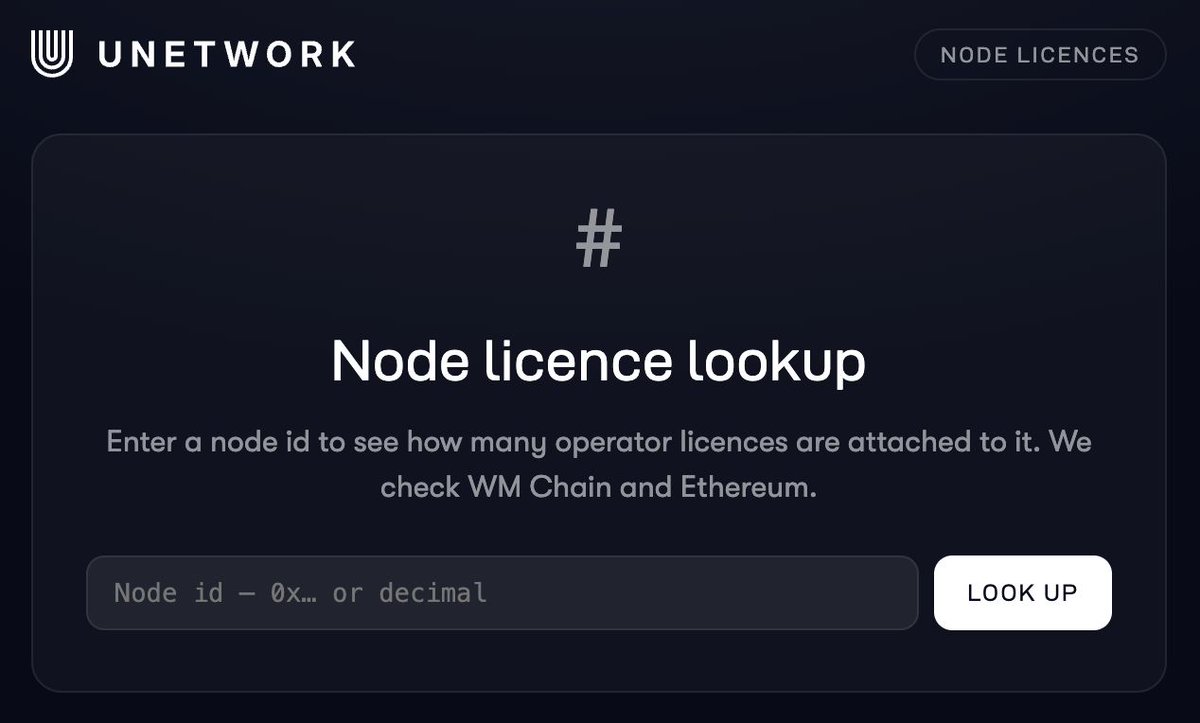
The simplest and recommended way to check is through the Unetwork Node Licence Lookup:
https://t.co/dfjriamEM8
Enter either the Node Token ID or Node hex ID and select LOOK UP.
The lookup checks both World Mobile Chain and Ethereum and shows:
• The exact number of Operator Licences currently attached to the Node
• The Node ID
• The network the Node is on
• The current owner
This gives buyers and sellers a simple way to independently verify the licence count for a Node before completing a trade.
Before trading a Unetwork Node, check the Node ID and verify the licences attached to it.
A New Kind of Task Is Live on Unetwork
Surveys are now live on Unetwork.
Our first Survey customer approached us because of something the Unetwork platform already has at scale: real devices, operated by real people, across real-world locations around the globe.
That geographic reach has obvious value in telecoms.
But it is also highly valuable far beyond telecoms.
Surveys are an interesting first experiment in opening the Unetwork edge network to a much broader range of commercial tasks - from research and data collection to verification, local market intelligence and other real-world use cases.
The important part is not simply that Surveys are live.
It’s what they represent.
The edge network we have built is capable of supporting many different kinds of customer demand.
Telecom remains at the core of Unetwork.
Surveys show how the same global network of real devices in real locations can also create value across a much broader range of commercial use cases.
Survey Task Explained
Surveys are now live as a new task type on Unetwork.
Here’s what you need to know about availability, participation, potential rewards and how the validation process works. ↓
Four terms. One rule: the rate you lock is the rate you get.
WMTx Locked Staking is live on Base and Cardano. Pick 3, 6, 9 or 12 months and your rate is fixed onchain the moment you stake.
No minimum. No maximum. It does not auto-renew, so you choose what happens at the end.
How long would you lock?
PayPal Payouts Are Now Available
Following community suggestions, Unetwork has added PayPal as a new payout option for network rewards.
PayPal joins the existing fiat and crypto payout options, giving users more choice in how they receive their rewards.
We’re also introducing automatically generated invoices across all three payout methods - PayPal, fiat, and crypto.
Invoices will be available to download from the platform, providing users with a clear record of their payouts that can be used for accounting, bookkeeping, or tax purposes.
And there’s more to come.
The team is already working on additional payout options for future releases, continuing to expand the flexibility and accessibility of the Unetwork reward system.
More choice. Better records. A better Unetwork experience.