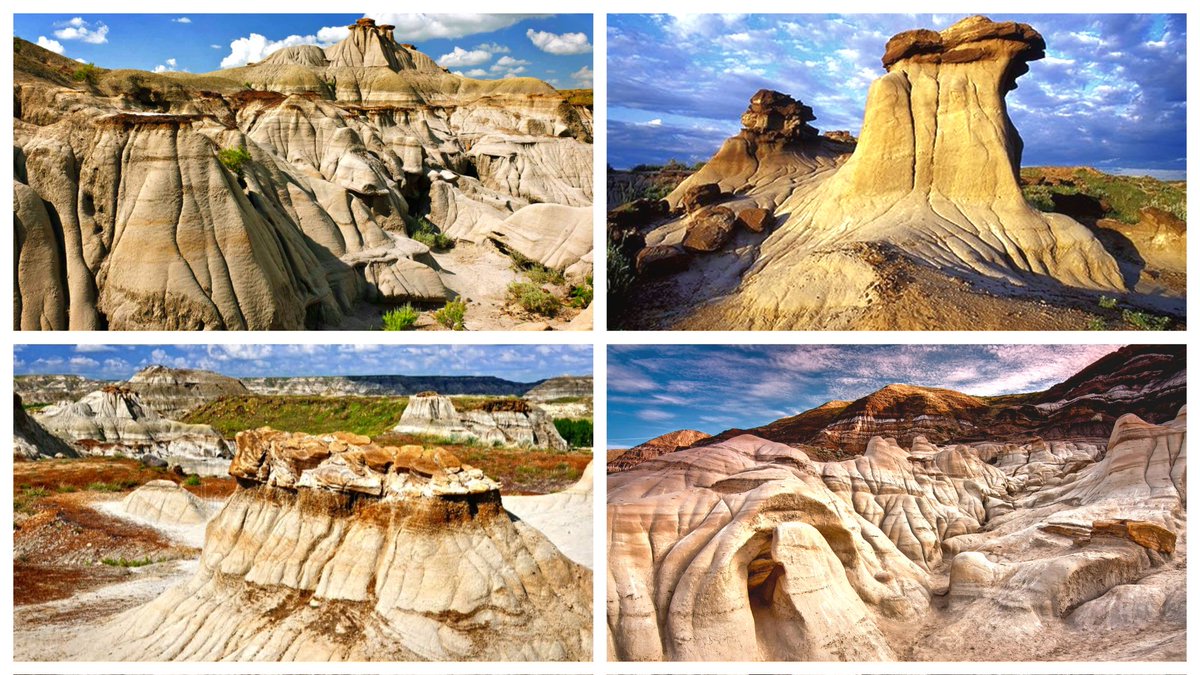
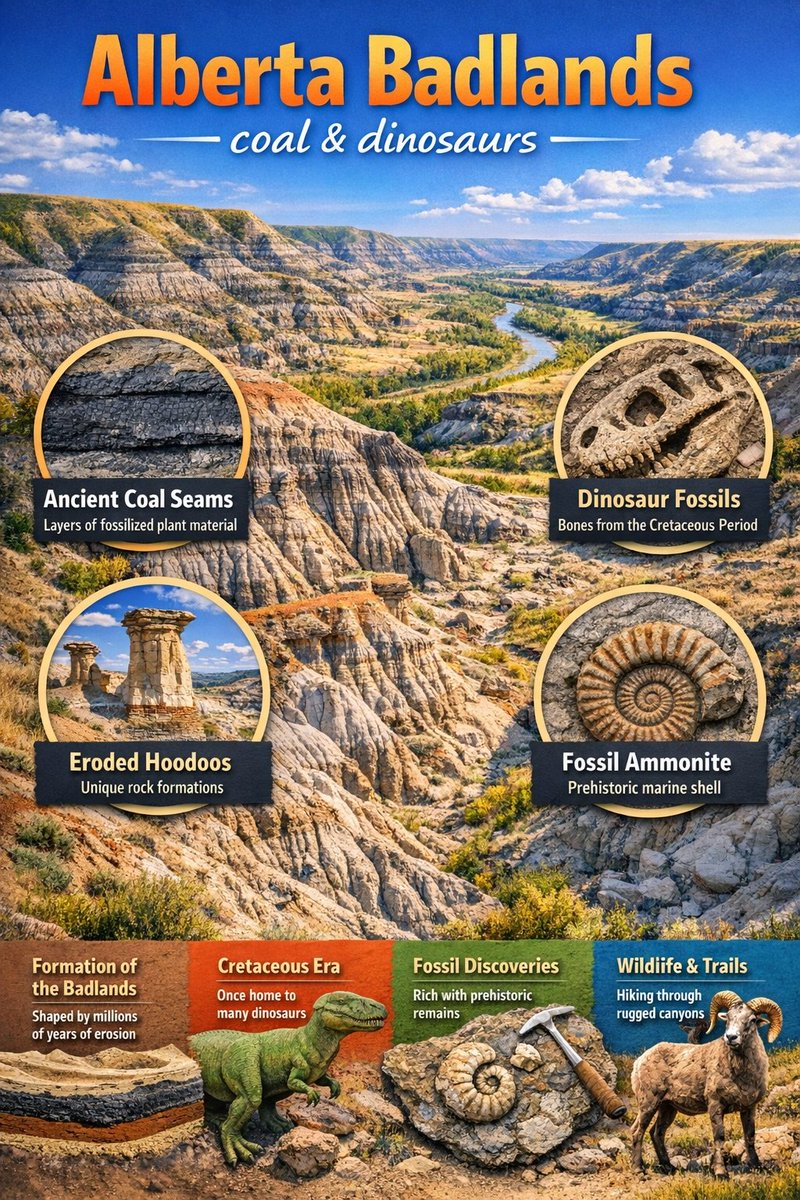
🟥 ⛏️ The Alberta Badlands are a living archive of Earth’s deep time, where coal seams, dinosaur fossils, and eroded hoodoos reveal the province’s ancient story.
🎞 @milosh9k
🔁 ❤️ - Greatly Appreciated
Beneath the sculpted canyons of Badlands Provincial Park, layers of sandstone and shale record the rise and retreat of inland seas.
The Badlands were lush Cretaceous forests that fed coal formation and the fossilized remains of creatures that once roamed the floodplains.
Each stratum is a chapter in Alberta’s geological timeline: from marine sediments laid down 75 million years ago to the erosional artistry of the last Ice Age that carved today’s surreal landscape.
The mineralogy here is equally rich, iron oxides tint the rocks red and ochre, while carbon-rich seams mark ancient swamps compressed into coal.
Paleontologists still uncover bones and shells that bridge land and sea, connecting Alberta’s Badlands to the global story of evolution and climate change.
Standing among the hoodoos, you’re not just looking at stone, you’re reading the memory of the planet itself.
#GeologyOfAlberta
https://t.co/bgohrpIlNR
🟥 ⛏️ Yant Flat, Utah, often called the Candy Cliffs, is a geological masterpiece sculpted by time, chemistry, and the forces of erosion. The cliffs are part of the Navajo Sandstone formation.
🎞 Please visit: @Milosh9k
🔁 ❤️ - Greatly Appreciated
Deposited roughly 190 million years ago during the Jurassic Period when vast desert dunes blanketed the region.
Over millions of years, these dunes were compressed into stone, their windblown layers preserved as sweeping cross-bedded patterns that ripple across the landscape like frozen waves.
The vivid palette of reds, oranges, whites, and purples comes from iron oxides, manganese, and calcium carbonate, each mineral contributing to the swirling coloration that earned the site its nickname.
Iron oxidation produces warm reds and oranges.
Manganese adds subtle purples; calcium carbonate forms the pale streaks that trace ancient dune boundaries.
The chemistry of these minerals, interacting with groundwater and oxygen, created the marbled appearance that makes Yant Flat resemble a natural painting.
Geologically, the area’s undulating slickrock and “brain rock” textures formed through uplift and erosion.
As the Colorado Plateau rose, fractures opened in the sandstone, allowing water to carve intricate channels and domes.
The result is a landscape that feels both alien and organic, an enduring record of desert winds, mineral reactions, and tectonic motion.
#GeologyOfYantFlat
https://t.co/ulMLiFrOFL
🟥 ⛏️ Havasu Creek is one of the world’s most active modern travertine-forming systems. Groundwater moving through Paleozoic limestone and dolostone aquifers dissolves calcium carbonate underground.
🎞 Please visit: @milosh9k
🔁 ❤️ Greatly Appreciated
It then releases carbon dioxide as it emerges into open air.
This rapid degassing forces calcite and aragonite minerals to precipitate, building terraces, dams, and ledges layer by layer.
Iron oxide staining from surrounding canyon rocks adds warm red and orange tones that contrast with the creek’s vivid turquoise water.
Cyanobacteria and algae also help trap carbonate sediments, accelerating mineral deposition and creating the constantly evolving travertine landscape seen today.
#Mineralogy
U.S. Geological Survey
https://t.co/V5vafUFdhu
🟥 ⛏️ Canyon de Chelly National Monument preserves one of the most spectacular erosional landscapes on the Colorado Plateau.
🎞 Please visit: @milosh9k
🔁 ❤️ Greatly Appreciated
Where sheer sandstone walls, towering spires, and deeply incised canyon systems record more than 200 million years of geologic history.
The canyon cuts through the Late Triassic Chinle Formation, a sequence of fluvial sandstones, siltstones, mudstones, and volcanic ash deposits laid down by ancient river systems and floodplains.
Iron oxide minerals such as hematite and limonite stain the cliffs with vivid red, orange, and brown colors, while quartz-rich sandstone layers resist erosion and form dramatic vertical walls like Spider Rock.
Spider Rock itself rises roughly 750 to 800 feet above the canyon floor and was sculpted by differential erosion along natural fractures and joints in the sandstone.
Seasonal water flow, freeze-thaw weathering, flash floods, and chemical alteration gradually widened fractures and removed softer sediments over millions of years, isolating resistant rock columns and alcoves such as Mummy Cave.
The canyon also preserves evidence of ancient climates, tectonic uplift of the Colorado Plateau, and long-term sediment transport across the American Southwest.
Today, Canyon de Chelly remains an extraordinary natural archive of sedimentology, mineral chemistry, erosion mechanics, and desert geomorphology.
#CanyonDeChelly
National Park Service – Canyon de Chelly National Monument
https://t.co/qYc8DUN2hK
@NatlParkService