In 2022, I convinced myself that buying a heavy vintage CRT monitor from eBay would give my artwork a truly authentic retro feel.
I spent three weeks bidding, paid four times the item price just for international shipping, and tracked the cargo ship across the ocean every single morning.
When the massive forty kilogram wooden crate finally arrived, my friend @Hosseinp77 and I set it up on my desk with pure excitement.
I flipped the power switch, the screen flickered bright green for one second, made a loud pop sound, and instantly blew out the circuit breaker in my entire apartment.
Writing this downbad confession for @RallyOnChain reminds me how far down the rabbit hole we go when we mistake extreme cope for creative commitment.
What is your most downbad story from crypto, tech, or life that you are still embarrassed to admit today?
Before the timeline goes dark forever, I want to leave behind one small secret that nobody ever noticed in my work.
In every single piece I have ever published, I hid one specific hex color code in a corner pixel or subtle background shade.
It was a six digit code representing my first studio room, a personal watermark that nobody ever asked about.
We spend so much time building loud brand identities online, but the most meaningful details are often the quiet easter eggs we leave for ourselves.
Writing this final reflection for @RallyOnChain makes me realize that true creative legacy is not about viral reach, it is about the quiet personal intent behind the work.
If this timeline went dark today and you had one last tweet left, what is the single message or piece of work you would leave behind?
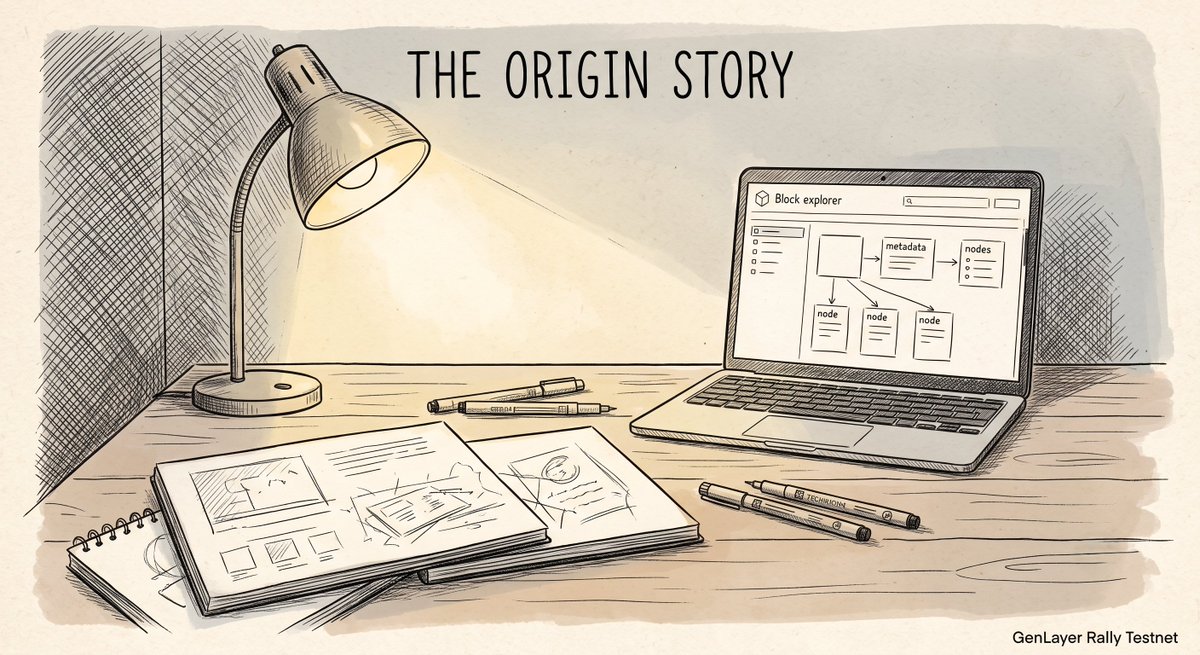
Before I ever touched a wallet, I was just a creator looking for one simple answer: how to prove ownership of a digital piece without asking a middleman for permission.
I remember sitting at my desk late at night, trying to put my first work on chain.
I spent hours wrestling with raw metadata, broken IPFS pinning links, and contract prompts that looked completely alien.
When the transaction finally confirmed and I saw my work tied directly to my wallet on the block explorer, all that frustration vanished.
No gallery taking a cut, no platform holding the keys, just direct proof of creation.
Writing this origin story for @RallyOnChain brought back that exact feeling of raw, messy discovery.
What was the first actual creation or project that pulled you into this space?
Early in my creative work, the hardest client disputes were never about whether a file was delivered.
They were about whether the output matched the actual spirit of the agreement.
Computers are great at checking binary boxes, but terrible at reading intent.
As AI agents prepare to manage what ARK Invest projects to be a $9 trillion economy by 2030, execution is solved, but disagreement is not.
Traditional civil courts average 657 days worldwide to settle disputes, a pace that completely breaks machine speed software.
That missing piece is why reading The Compass from @GenLayer blew me away.
It introduces the 7th layer of trust: decentralized AI adjudication.
Instead of forcing rigid identical outputs, it uses the Equivalence Principle to reach consensus on true semantic meaning.
Bitcoin automated money. Ethereum automated logic. GenLayer automates judgment.
Open the quoted tweet and read The Compass to see how trust gets rebuilt for the agentic era.
If an AI agent makes a mistake on an open ended contract, would you prefer a human judge, a single tech company AI, or a decentralized consensus network to decide the outcome?
Beginner's luck is dangerous. After a lucky 300% profit on wink/usdt in 2021, I felt like a genius until the market humbled me. I learned that chasing pumps is unsustainable; real longevity comes from building and quality, which led me to @RallyOnChain. What’s your origin story?
Just read this from @courtofinternet :
https://t.co/3XwBnbW618
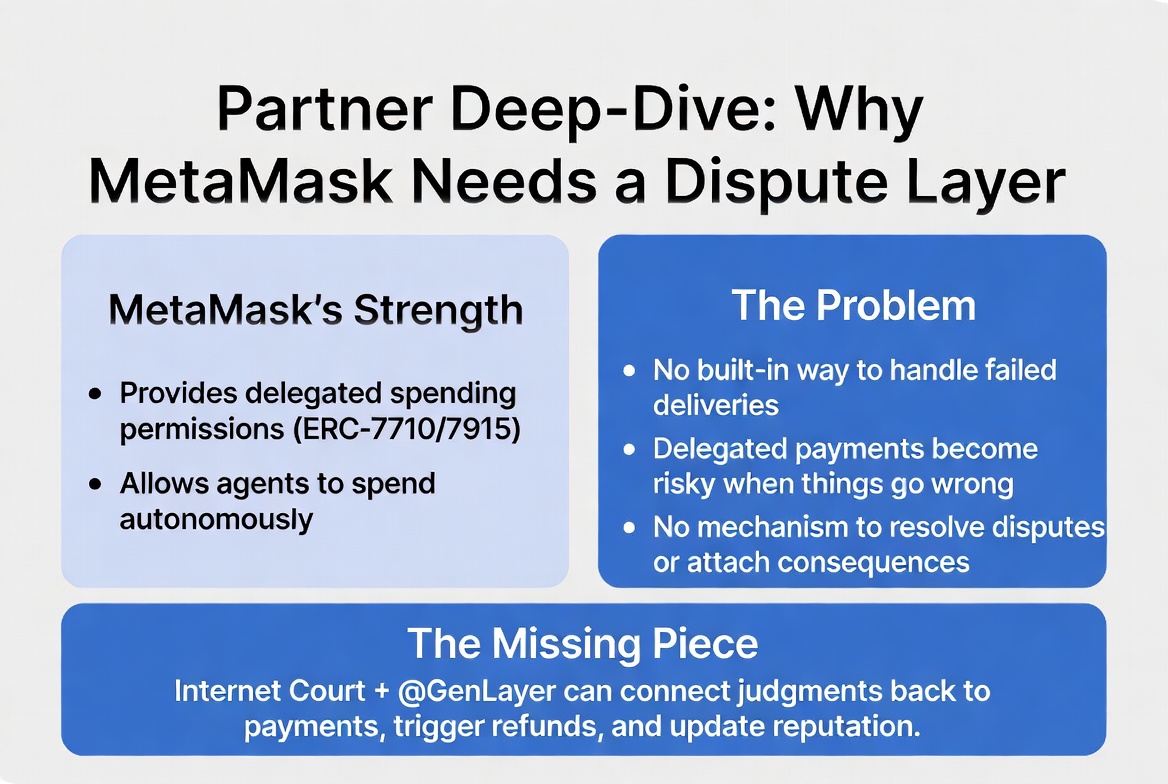
I wanted to do a Partner Deep-Dive on MetaMask.
MetaMask has been building delegated permissions (ERC-7710/7715) so agents can spend on behalf of users without needing approval every time. That part is actually really useful for agentic commerce.
The issue is what happens after the payment goes through. If the other agent doesn’t deliver what was promised, MetaMask doesn’t really have a way to deal with it. There’s no built-in process to figure out who’s at fault or to do anything about it. The permissions work fine when everything goes right, but when there’s a disagreement, it kind of stops there.
This is why I think MetaMask’s piece of the stack needs something like Internet Court. Right now, you can give an agent spending power, but if the deal goes bad, there’s no clean way to resolve it or attach any real consequence. The dispute just hangs there.
What stands out to me is that Internet Court could actually connect back to these permissions. If @GenLayer gives a judgment, it could trigger things like a partial refund or update reputation in a way that actually affects the original transaction. Without that, delegated spending always carries this risk that people will be hesitant to use it for anything serious.
I don’t think MetaMask’s work is incomplete on its own, but without a dispute layer, it’s hard to see how agentic payments can really scale with trust. Agents need to be able to spend knowing that if something goes wrong, there’s actually a system to handle it.
That’s the part I think is still missing.
@courtofinternet@GenLayer@MetaMask
A small house with an orange roof, lost in the mist and the smell of the garden trees. Sometimes I just want to leave all the world's noise behind and drown in this silence. This is what true peace is... 🏡🍂 #Nature
@amirhosseinpl77 Yeah, good eye! That pot is also part of this cozy atmosphere. To be honest, I don't know exactly where it is, but it seems to be somewhere in the North. Thanks for noticing! 😅 I actually just noticed the pot too.
The view is epic, but that backpack and camera have their own story! Who else, like me, must arrange their gear for the perfect shot before they even untie their boots? 😂📸 #PersonalVibes
@amirhp771 Most founders only realize this bottleneck post token launch when the initial hype fades and they are left with zero organic retention despite having perfect technical documentation.
Neuralink has solved through-dura electrode implantation!
This is a very big deal, as it greatly improves the safety and ease of interfacing with the brain.
@amirhp771 You can fork a repository overnight, but you can never fork a distributed network of aligned creators who actually understand the protocol. That is why code without distribution is just dead data on a ledger.
@amirhp771 Cutting down the approval bottlenecks is a massive upgrade. Most protocols make you feel like you are executing a complex smart contract audit just to deposit a single asset. Having a three click flow changes the retention dynamic.