Voting for the ASCO Election is now open. I am honored to be running as one of the candidates for the ASCO Nominating Committee. Visit https://t.co/4MzXWlDLiy to learn more about the candidates and place your vote!
Congratulations to @dradityabardia who led the lidERA study that resulted in the approval of giredestrant for the adjuvant treatment of HR-positive breast cancer. @UCLAHealthJCCC@DOM_UCLA@UCLAHealth Fewer patients stopped giredestrant because of side effects compared to standard endocrine therapy (5.3% vs. 8.2%). Great news for our patients.
Based off lidERA, Giredestrant (oral SERD) is now @FDA ✅ in adj #BreastCancer: PhIII, vs. AI/Tamox in HR+ early Breast Ca:
- 3yr IDFS in
a). Premenopausal: 94% vs. 91.5% (0.65)
b). Postmenopausal: 91.3% vs. 88.3% (HR: 0.74)
- Less discontinuation rate
#bcsm#OncTwitter
Excited for our new @AmericanCancer grant on T-DXd dosing in older adults with breast cancer.
Fewer than 15% of patients in the pivotal trials were 70+. With @FlatironHealth data, we will ask whether a lower starting dose helps older adults stay on treatment safely without losing benefit.
Thank you to co-investigators @dradityabardia, David Elashoff, Tahmineh Romero-Kalbasi, and Arman Niknafs, and to @JaniceTNBCmets for being the patient voice guiding this work.
https://t.co/09eKYycpx8
Still have not figured out how to be in two places at once. Sad to miss this one while at TRIO-US in Lake Arrowhead. What a lineup on breast and gyn cancers.
Outstanding talk on cancer and aging by @minasedrakmd at the @UCLAHealthJCCC TRIO-US research conference, with special shoutouts to @JingranJi and @NikitaBacligMD!
Very important topic on how to improve quality of life for cancer survivors.
Dennis Slamon at the TRIO-US conference at Lake Arrowhead, sharing his work to discover better and safer therapies in breast cancer and beyond. His bench-to-bedside approach is remarkable. Talk about impact!@UCLAHealthJCCC
We are hiring a Clinical Research Supervisor at UCLA to lead our team studying how cancer and its treatment can accelerate aging.
5+ years of clinical research experience. On site in Los Angeles. $88.9K to $190.3K, based on experience.
https://t.co/ygJg05MmVc
Eight years ago today, we lost Arti Hurria in a tragic car accident. Mentor, teacher, and friend.
When I took over her patients, every single one told me they were her favorite. Here she is celebrating @vani_katheria’s birthday. She always made time for people. And she always made people feel like they belong.
Thank you, Arti.
Outstanding presentation by @JordynSilvs at the @UCLAHealthJCCC Arrowhead Research Conference. A first year faculty member, Jordyn, delivered such a comprehensive review of the current and ongoing progress in Gyn Onc. So proud of you!
So proud of @NikitaBacligMD for her plenary on healthcare time burden in metastatic kidney cancer. #SIOG2026 I wish I could have been in the room to see it. Watching her enter and grow into our field of #GeriOnc has been one of the best parts of my work. Older adults with cancer are lucky to have her asking these questions. So proud of you, Nikita.
Some nights I wonder whether I did any one thing well that day, or whether I was fully there for any of it.
Years ago I read a book called The ONE Thing. It asks one question.
“What's the ONE thing I can do such that by doing it everything else will be easier or unnecessary?” @garykeller@jaypapasan@the1thingbook
I think about that question most when I am being pulled in every direction at once.
Anyone who practices medicine knows the feeling. The pager goes off in the middle of a visit. There are abnormal labs to act on, patients waiting for a call back, an inbox that never empties, an IRB query, manuscript revisions, and a grant resubmission due next week. We move from one to the next and rarely finish anything the way we want to.
For me, many weeks also mean flying from one city to the next. When I am home, I am moving from the office to clinic to the lab, then to a soccer game, a birthday party, or a dance competition.
Across medicine, the things that are easiest to count are RVUs, papers, and grants. The things that matter most are often the hardest to count. Listening to a patient long enough to hear what they actually need. Helping a trainee find their footing, then watching them take the first author spot. Spending months getting a trial open and enrolling patients one conversation at a time.
I have not figured out my one thing. But I have started asking a simpler question at the end of the day. What did I do today that I would still do if no one were counting?
The answer is almost always a person. A patient who finally told me what was really wrong. A trainee who left a meeting a little more sure of themselves. Maybe that is where the one thing lives.
This is a photo of my daughter on her first birthday. She turned one almost nine years ago, but it feels like last month. Time does not wait for us to figure out what matters, which is why the question is worth asking now.
What would you still do if no one were counting?
Thank you for sharing! Grateful to @NCIDirector@theNCI for this new R01! Many older adults struggle to regain strength after transplant. We hope this work helps them recover faster and live well. Grateful for my Co-PIs @ArmenianSaro and Kirsten Ness. Both are helping bring concepts from Pediatrics Oncology to #GeriOnc.
Mina Sedrak, MD, MS, has received a grant from the #NIH to improve physical recovery and reduce frailty in older adults following hematopoietic cell transplantation. https://t.co/7Te5F8qVVk #ShopTalk
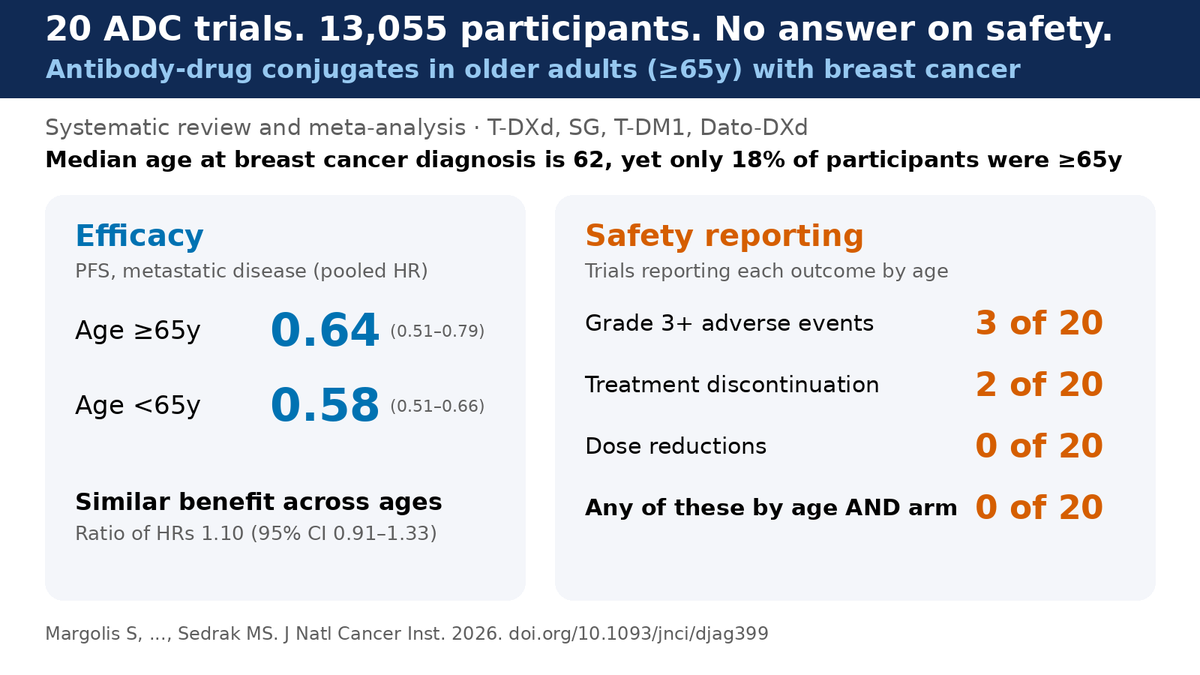
Proud to contribute to this work in #JNCI! Across 20 breast cancer ADC trials, PFS benefits were similar by age in metastatic disease, yet none reported key safety outcomes by both age and treatment arm. We need better data to guide care for older adults. #GeriOnc
20 randomized ADC trials. More than 13,000 participants. Not one told us whether ADCs are as safe and tolerable for older adults (≥65y) with breast cancer.
Benefit was similar across ages. But no trial reported toxicity by both age and treatment arm.
So proud of @sammargolis_ , a 3rd-year med student who led this, with @hoperugo and @dradityabardia in @JNCI_Now
https://t.co/cL7Zfi0l5D
Beyond excited to recruit @VivekSubbiah to @nyulangone@Perlmutter_CC as the new director of our Early Phase Drug Development Program and the Rare Cancer Program.
Congratulate Vivek when you see him at #ESMO26. Welcome to NYC!
@JohnPLeonardMD
https://t.co/sJKbZI0PDc
What a pleasure to sit down with @stolaney1@DanaFarber who has shifted so many paradigms in #breastcancer. Listen to our #ASCODailyNews podcast below that spans #DESTINY-Breast09 #ASCENT-03 & 04, weaving in multiple management pearls along the way!
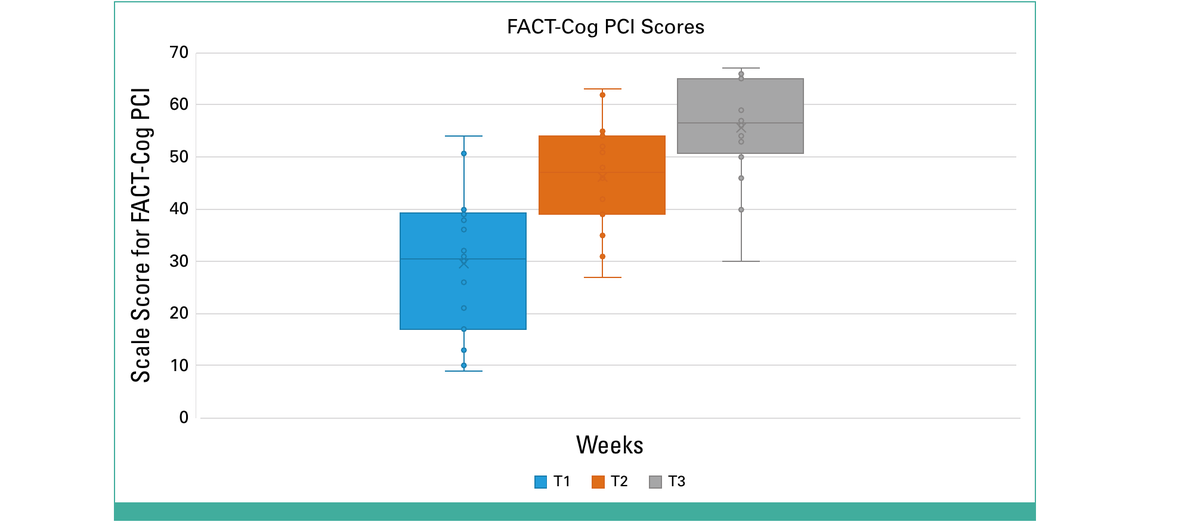
“Chemo brain” is one of the most common things my patients ask me about. We still have no proven drug to treat it.
In our small phase II trial, breast cancer survivors with cognitive complaints took oxaloacetate for 8 weeks. Every participant who completed the study reported improvement in cognition, along with less fatigue and better physical function.
It’s an early signal, not an answer. A randomized, placebo-controlled trial is the next step.
Led by Dr. Patti Ganz, with thanks to @BCRFcure. Out now in @JCOOA_ASCO.
https://t.co/elZeSgr8C6 #bcsm
At #ASCOQLTY26, my talk was titled "Caring for Older Adults With Cancer."
I crossed out "Older Adults."
What we learn caring for older adults, like checking function, asking what matters most, and fitting treatment to the person, makes care better for all of our patients.
Grateful to share the session with @itsnot_pink, @crisbergerot, Christina Minami, Thejal Seikumar, Angela Fraco, and Daniel Roberts.