Maybe you have already seen this but found this to be such an interesting paper from @tigerstatdoc, @pnatarajanmd and @g_parmigiani
Bayesian model of how diseases unfold together over a lifetime
🧵Thread below on what I found interesting
Tune in tomorrow at 12pm Eastern for another live recording of our podcast!
@DBatesSafety and Dr. Luciana D’Adderio will talk with hosts @BenMazer and @sammargolis_ about the best ways to improve diagnosis through artificial intelligence.
https://t.co/kKgDx8vOGG
Tune in tomorrow at 12pm Eastern for another live recording of our podcast!
@DBatesSafety and Dr. Luciana D’Adderio will talk with hosts @BenMazer and @sammargolis_ about the best ways to improve diagnosis through artificial intelligence.
https://t.co/kKgDx8vOGG
@cormachayden_@jacobmhands respect your work but “Oasis’s first publication in a leading medical journal” wildly overstates what happened. your testing quoted in Medscape Medical News is good but this is journalistic coverage of commissioned lab results, not a publication in an medical journal
Excited for this! If there’s anything you’d like to see more of from @npjDigitalMed or anyone you think we should have on the podcast send ideas my way.
We’re excited to welcome Sam Margolis (@sammargolis_) as a Fellow at npj Digital Medicine!
Sam is a medical AI researcher, Sarnoff Fellow at Stanford, and MD candidate at UCLA. His research focuses on evaluating and building AI systems for medicine, with work spanning healthcare AI and cardiovascular medicine.
At npj Digital Medicine, Sam will help expand how we communicate new research through podcasts, author conversations, and other new formats across digital medicine.
We’re excited to welcome Sam Margolis (@sammargolis_) as a Fellow at npj Digital Medicine!
Sam is a medical AI researcher, Sarnoff Fellow at Stanford, and MD candidate at UCLA. His research focuses on evaluating and building AI systems for medicine, with work spanning healthcare AI and cardiovascular medicine.
At npj Digital Medicine, Sam will help expand how we communicate new research through podcasts, author conversations, and other new formats across digital medicine.
in the first chapter of healthcare AI, the battleground was access to longitudinal clinical data.
in this next phase, it will be access to biological specimens: tissue, blood, synovial fluid, and other samples containing 1,000× more information, linked to clinical context and longitudinal outcomes.
the winners will be those who can access, assay, and interpret these specimens at the lowest cost and highest resolution.
in the first chapter of healthcare AI, the battleground was access to longitudinal clinical data.
in this next phase, it will be access to biological specimens: tissue, blood, synovial fluid, and other samples containing 1,000× more information, linked to clinical context and longitudinal outcomes.
the winners will be those who can access, assay, and interpret these specimens at the lowest cost and highest resolution.
I must be among an extremely small group of people (n=1?) that have both 1) trained a frontier LLM and 2) designed and synthesized custom viruses in a lab with my own two hands.
And I think that the takes on AI killing us all by creating dangerous viruses is total bogus.
This week on The Digital Pulse, we sat down with @tdazad, @suchisaria, and @HealthPrivacy to ask what Henrietta Lacks can teach us about medical AI.
We got into why HIPAA may not be enough for the era of generative AI, whether meaningful informed consent is possible at the scale modern AI requires, what patients should know about where their data goes, and who should decide when health data can be commercialized.
And whether the answer is more consent—or more transparency.
Timestamps:
00:00 Intro
01:22 Ethics and privacy concerns
02:49 What Henrietta Lacks can teach us about AI
06:21 Is HIPAA enough?
10:14 Data brokers and where health data comes from
11:30 Patient data and AI
15:35 The limits of informed consent
17:15 What real data transparency could look like
22:52 Can transparency work at the bedside?
25:05 Commercialization and ethics boards
28:51 Independent vs. university ethics boards
32:28 Building a clinical intelligence platform
37:03 Tech mindset vs. regulation
40:00 The cost of bureaucracy
42:11 Closing thoughts
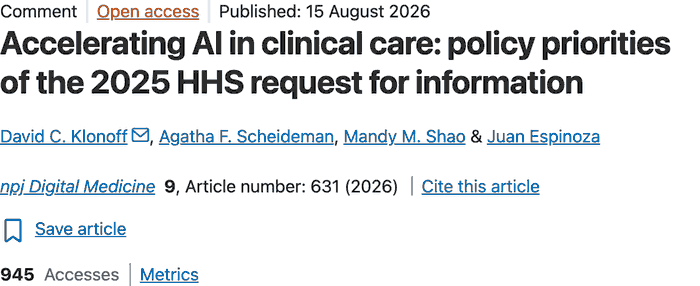
A Comment reads the HHS request for information on accelerating AI in clinical care, using diabetes as the exemplar across CGM, automated insulin delivery and decision support.
Comments on that RFI closed in February. Klonoff & Espinoza
An ECG foundation model fine-tuned against coronary CT angiography to predict vessel-specific stenosis.
Combined with guideline pre-test probability it improved rule-out and shrank the gray zone. Xiao & Hong, Peking University
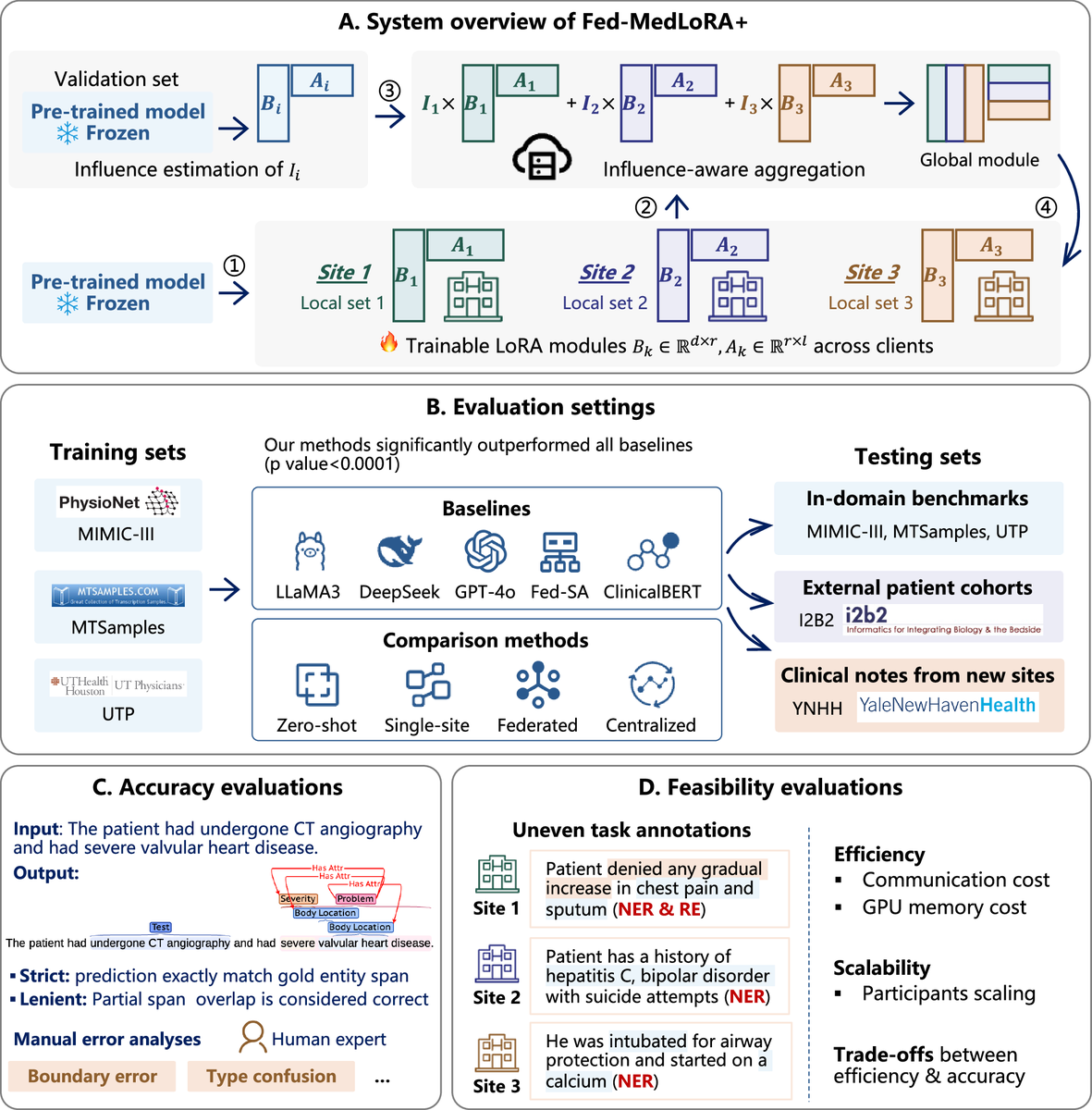
Most medical LLMs are tuned on one institution's data because governance blocks sharing, then generalise poorly elsewhere.
@qingyu_qc's group send low-rank adapters instead of model weights. Five cohorts, 42,198 entities, 41,570 relations.
Introducing Atlas:
The world's first multimodal world model that generates image and video frames with pixel-perfect camera control and reconstructs them in 3D.
Model the world, move the camera, and simulate space & time.
(1/2) "Everything’s going to change.” Meet the Model Hardware Standard: Begun as a collaboration between our Janelia Research Campus & @AnthropicAI, MHS allows AI agents to safely operate physical equipment in scientific research & advanced manufacturing: https://t.co/OWXXb0xD7W
A Matters Arising and its reply, published together.
The critique: deployed surgical AI sits inside commercial platforms that evidence synthesis doesn't capture. A structural validation gap.
Carstens & @fionakolbinger reply with three priorities.