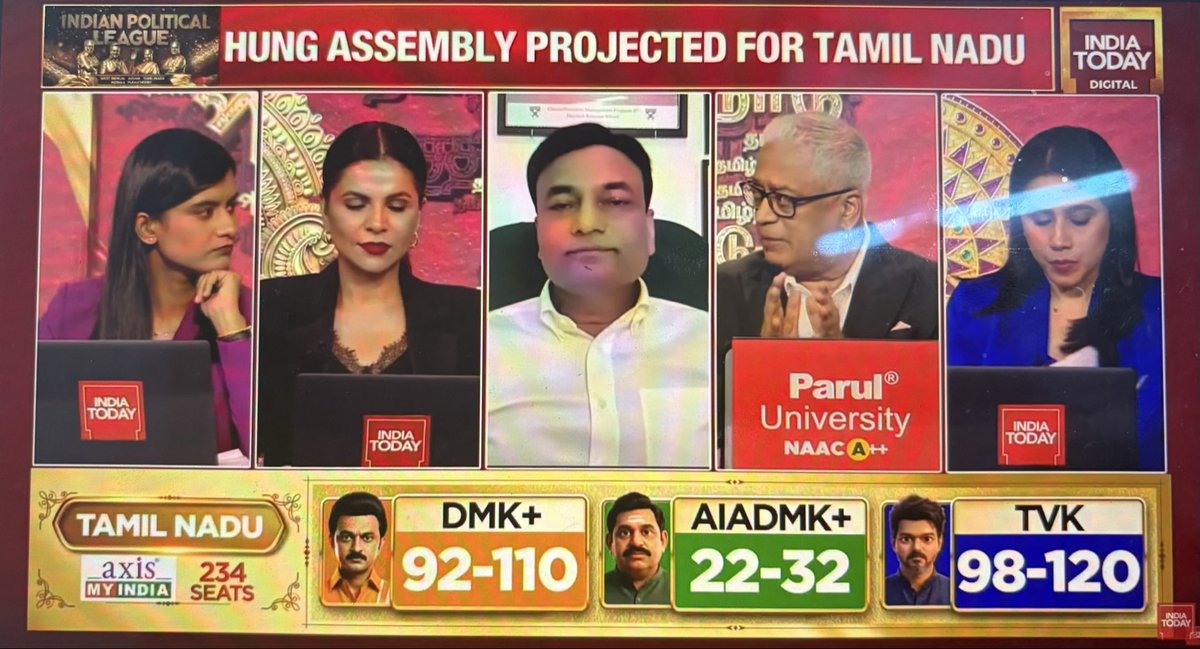
Experts say AI can solve every problem and even replace the human brain. But when it comes to real-time political crises in Tamil Nadu — where negotiation, communication, alliances, emotions, and ego matter more than algorithms — even AI would probably say, “Server busy, try again later.”
#tamilnadu #TVKVijay
SR Bommai Case Judgement
Majority must be proved on the Assembly floor.
President’s Rule can be reviewed by courts.
Article 356 cannot be misused for political reasons.
Federalism and secularism are part of the Constitution’s basic structure.
#tamilnadu
Tamil Nadu’s election results underline a clear shift in political dynamics, especially around what is often called the “3Cs” — Cash, Cadre, and Caste.
#TVK has disrupted this traditional model in a striking way. By amplifying a strong single-leader image and effectively popularising the whistle symbol, the party managed to cut through entrenched electoral machinery. This kind of personality-driven mobilisation appears to have offset the usual dependence on money power and ground networks.
For #DMK, the loss in Kolathur is not just electoral—it’s psychological. Cadres may find it difficult to reconcile a symbolic stronghold slipping away, which could have deeper implications for internal morale and future mobilisation.
#Congress, on the other hand, seems to have made a strategic misstep. By not aligning with TVK at a time when a new political force was gaining traction, it missed an opportunity to expand its relevance and rebuild its base in the state.
#NTK’s approach also appears to have backfired. Instead of capitalising on anti-incumbency and systemic corruption—issues with broader appeal—the party leaned heavily into aggressive positioning against a new entrant. That likely limited its ability to widen voter acceptance.
#AIADMK had perhaps the biggest missed opportunity. Despite a favourable environment to re-emerge as a ruling alternative, its alignment choices—especially prioritising a limited electoral gain—seem to have diluted its independent positioning and broader appeal.
Overall, this election signals a move away from traditional electoral arithmetic toward narrative-driven politics, where perception, symbolism, and leadership projection can decisively reshape outcomes.
Tamil Nadu voter turnout as on 1pm:
TN: 56.81% (↑ ~17%)
Chennai: 54.58%
Coimbatore: 58.24%
Trichy: 57.66%
Madurai: 54.75%
Salem: 61.42% 🔥
Tirupur: 62.97% 🔥
Rural & industrial belts leading the charge, urban Chennai still catching up. Strong democratic participation overall across the state.
#TamilnaduLegislativeAssemblyelection2026 #tnelections
Chennai voters showing a clear shift 📈
🗳️ 2021 (11 AM): ~22–26%
🗳️ 2026 (11 AM): 31–39%
An 8–12% jump in early turnout — strong sign of rising urban participation. Still behind rural TN, but momentum is clearly building.
#TamilNaduElections#Chennai#VoterTurnout
People are ready to vote, but the system isn’t ready for the people. Poor traffic management and lack of proper transportation are blocking democracy in action. If citizens are willing, the system must ensure access.
Extend the polling hours
@TNelectionsCEO#tamilnadu#tn2026 #2026TNelections