Excited to reach 3,000 followers! Thanks to all of you for your support. ❤️
I've updated my pinned tweet to reflect my current trading process so that you can better understand my trade ideas. Let me know if you have any questions/comments!
https://t.co/rdHRogqkSX
Sonu, what are your best guess probabilities for PPI? Claude has been fairly good at this and thinks the base case is a much cooler headline than Sep but still firm core, which keeps a Dec hike locked in and leaves the 25-versus-50 debate open, with the equity reaction asymmetric to the hawkish side
CRWV beats, NVDA rebounds
Hot October CPI (headline +0.4% m/m, core +0.3%) sealed a December Fed hike and opened the door to a 50 bp move, sending yields sharply higher yesterday (2-year +18 bp). Tech and AI infrastructure are rebounding hard in premarket anyway, led by a solid $CRWV print and relief bounce in $NVDA after two days of scandal-driven selling. Macro remains the overarching risk for multiples; AI demand narratives are still powering selective strength.
Macro: CPI Seals December Hike, 50 bp Now in Play
October CPI came in hotter than expected (0.4% headline vs. 0.3% consensus; core 0.3% for the third straight month). Shelter and broadening price pressures offset some energy moderation. Fed Governor Waller said a 0.3% core print would prompt him to consider a 50 bp hike at the Dec. 8-9 meeting. Other officials (Logan, Goolsbee) flagged the need for faster or additional tightening. Markets now price a December hike as nearly certain, with a small probability of 50 bp and three quarter-point moves by mid-2027. Two-year yields spiked; bonds remain under pressure. Higher-for-longer is the base case until data softens. This is the dominant headwind for duration-sensitive growth names even as select AI stories hold up.
AI Infrastructure / Neoclouds: $CRWV Delivers the Print the Group Needed
$CRWV reported Q3 revenue of $3.66B (+168% YoY), ahead of ~$3.55B consensus, with adjusted loss narrower than expected. Backlog hit a record $132.5B (+138% YoY). Management raised 2026 revenue guidance to $13.0–13.3B (from prior range) and lifted adjusted operating income guidance; exit ARR targeted at $20–21B. They highlighted ~$9B in customer prepayments/deposits expected over the next three months and said they do not plan additional parent-level unsecured debt through 2027. Interest costs remain heavy (~$846M in the quarter) and the path to adjusted profitability is still H1 2028, but the demand and financing signals eased the worst leverage fears. Stock is up 13–16% in premarket, lifting peers ($NBIS +12–14%, $IREN, others). FinTwit commentary notes demand is real and the report is a needed positive for the AI infra complex after recent drawdowns, while cost of capital and debt remain the open risks. $NBIS reports tomorrow before the open (high bar after the Microsoft contract progress and ongoing funding questions).
$NVDA: Rebound After Scandal, but Baird Downgrades on 2027 Visibility
Shares are rebounding ~5% in premarket after two days of sharp declines tied to CEO Jensen Huang’s personal matter (alleged affair with a woman linked to Chinese intelligence). Board retained Wachtell, Lipton, Rosen & Katz for an independent investigation into any national security or secrets risks. Baird cut the stock to Neutral from Outperform and slashed PT to $200 from $500, citing limited visibility on 2027 data-center demand, supply constraints, potential regulation, and uncertainty around Huang’s tenure. The firm sees hyperscaler AI capex growth possibly slowing below 40% in 2027 and deferred 2027 DC forecasts. Other firms have trimmed targets recently. Near-term earnings (Nov. 17) remain the key catalyst; the stock is volatile on both the personal headlines and the AI spending debate. Most Street ratings remain positive, but this is a clear caution flag from one firm.
Other Analyst Actions
$AAPL upgraded to Buy from Hold at China Renaissance (PT $425).
$AKAM downgraded to In-Line from Outperform at Evercore ISI (PT cut sharply to $90 from $150).
$RIOT downgraded to Market Perform from Outperform at KBW.
$LIF cut to Neutral from Buy at BofA; $MAA to Equal-Weight from Overweight at Morgan Stanley.
These are secondary to the macro and AI prints but worth tracking for individual setups.
Premarket Movers & Other Earnings
Notable gainers on volume include $CRWV (earnings), $NBIS (sympathy), semis-linked names and leveraged ETFs ($SOXL strong), plus $FOSL (+20%+ range) after results that showed a profitability turnaround and raised 2026 outlook. $SATL also higher on its print (record revenue). Losers are mostly low-float/speculative names with no major institutional catalysts. Broader tech futures are green despite the Fed backdrop. Upcoming: $CSCO and $AMAT report tomorrow after the close (dense AI infrastructure stretch); $NVDA next week.
Themes
AI demand narrative is intact and getting a boost from $CRWV’s backlog and prepayments, supporting neoclouds, optics, and memory/storage on a relative basis even as rates pressure multiples. Memory and HBM tightness remains a constructive backdrop for $MU/$SNDK-type names when the group is risk-on. Higher rates and any further Fed hawkishness are the main drawdown risk for the broader complex. No major new regulatory or agency bombs this morning beyond the Fed reaction.
NFA / DYOR. This is a summary of publicly reported news and market moves for informational purposes only; not investment advice.
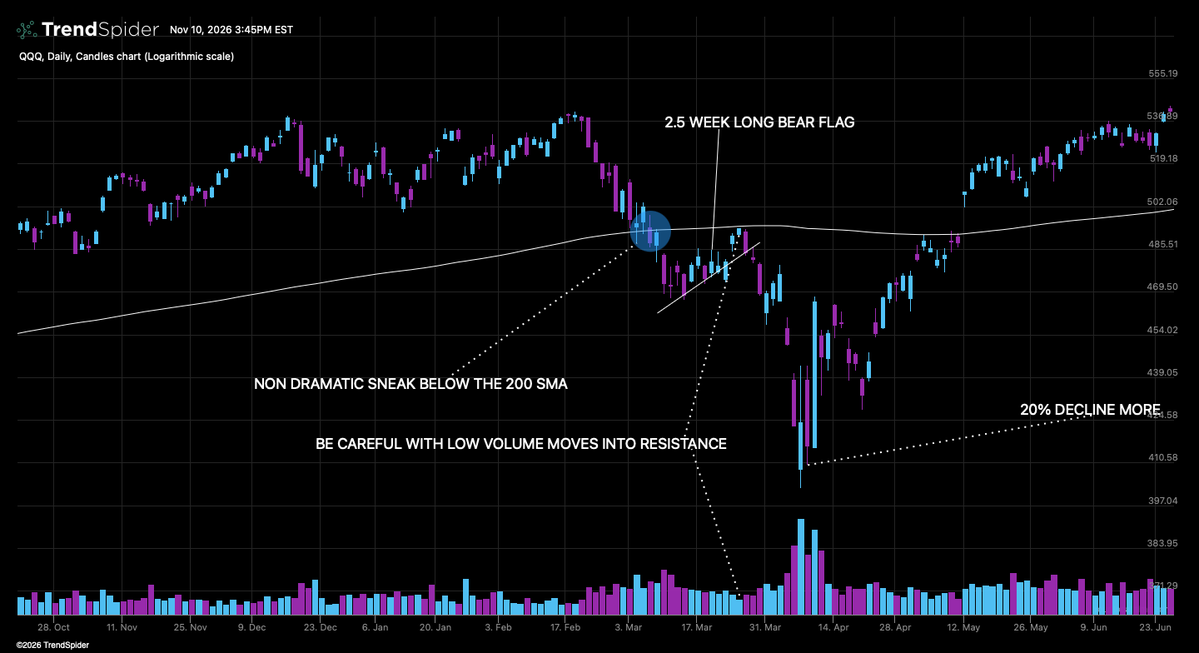
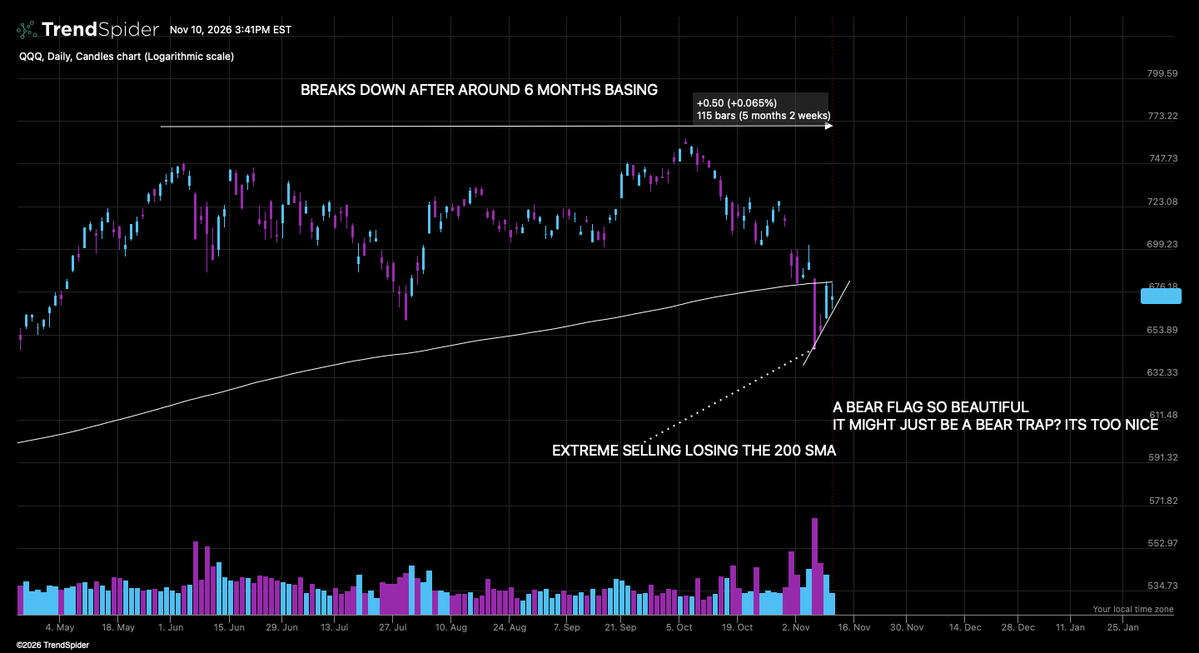
Here's some interesting historical 200 SMA tests/breakdowns/reclaims in the $QQQ
The take home message is that it can be confusing and trappy as hell before the real trend comes.
I usually say trust very little around the 200 SMA, and I say that for a reason, that's what history tells us.
Also the longer we stay under it, the worse, historically. So lets see if bulls can pop above it and invalidate this bear flag that's too perfect too short for me
@deltaoptrader Yes, closing above the Thursday daily bar / 200DMA on volume would be a bullish sign. Or a successful retest of last week's low could also help. On the other hand, if that low breaks, that would be bad.
Hot CPI Resets Higher-for-Longer. $NVDA Keeps Selling
Wall Street closed lower as hotter-than-expected October inflation reinforced December hike bets and pushed Treasury yields higher, partially reversing Monday’s broad rebound. Tech and rate-sensitive pockets led the decline under the weight of $NVDA and rising yields; breadth was mixed and oil’s continued slide provided only limited offset.
Story of the Day: Hot CPI and the Rate Path
October CPI rose 0.4% month-over-month (vs. 0.3% expected) after September’s 0.6% jump; core CPI rose 0.3% (vs. 0.2% expected) for a third straight month at that pace. BLS did not publish year-over-year figures because last year’s government shutdown left the comparison base unavailable. Shelter accounted for a large share of the headline increase, with food (+0.5%) and energy also contributing.
Traders now price roughly a 99% chance of a December hike. Fed Governor Waller has floated openness to a larger move if core stays elevated near 0.3%. The 10-year yield spiked toward ~4.99–5.02% from ~4.88–4.89% the prior day. This is a straightforward rates reset rather than a growth scare: stocks absorbed the print without a disorderly break, but housing, real estate, and duration-sensitive names remain under pressure if yields hold near 5%.
$NVDA: Governance Overhang Dominates the Tape
$NVDA fell ~5.5% to ~$168.89, extending Monday’s decline and producing a large two-day market-cap hit (in the hundreds of billions). The board retained Wachtell, Lipton (led by former acting U.S. Attorney Joon Kim) for an independent investigation into CEO Jensen Huang’s relationship with Alice Huang, a business executive U.S. intelligence has linked to Chinese intelligence activity and Megaspeed. Additional reporting indicated the relationship facilitated substantial chip shipments to Chinese firms. The FBI is examining the matter separately; securities suits have been filed; and political commentary (including from Trump) has kept the story live.
The semiconductor bid was selective. $AVGO rose ~3.9% while $NVDA lagged, consistent with the market distinguishing company-specific governance/geopolitical risk from broader AI demand. Most analysts still see Huang remaining in place, but the investigation and any further disclosures on export controls, customer relationships, or board process are the near-term catalysts. The AI complex is bifurcating between the leader’s idiosyncratic overhang and peers.
Anthropic IPO Sets the Valuation Bar
Anthropic launched its roadshow with a $70–$78 price range for 825 million Class A shares, implying up to ~$1.4 trillion fully diluted and raising as much as ~$64.4 billion in the IPO. A concurrent $26 billion private placement at the IPO price includes commitments from Google, Nvidia, AMD, Broadcom, Micron, Microsoft, and TSMC. The company expects to price around November 18 and begin trading on Nasdaq under $ANT around November 19, with a higher-than-typical retail allocation targeted. Run-rate revenue has been cited near $81 billion.
This is a direct test of AI sentiment amid the $NVDA noise, higher rates, and recent tech volatility. Separately, Anthropic’s workplace tools announcement (Claude Sheets, Whiteboards, Data) pressured $MSFT (~–2.2%), illustrating competitive friction even as the IPO process advances. Cornerstone chip and cloud investors writing large checks is supportive of the ecosystem, but the absolute valuation and lock-up dynamics will be watched closely.
$CRWV : Demand Holds, Financing Remains the Debate
CoreWeave reported Q3 revenue of $3.66 billion (vs. ~$3.55 billion expected), up 168% year-over-year, with adjusted operating income of $379 million and double-digit adjusted operating margins a quarter ahead of plan. The company raised full-year 2026 revenue guidance to $13.0–13.3 billion and pointed to a revenue backlog of ~$132.5 billion, active power above 1.7 GW, and substantial customer prepayments. Management called it a breakout quarter on sequential growth and margin progress.
This supports the durability-of-AI-infrastructure narrative. The counter remains the balance sheet: elevated debt (previously reported above $50 billion), high interest expense relative to operating income, and heavy capex intensity. Credit spreads and the path to free-cash-flow conversion are the metrics that will determine whether the print sustains a multi-day move or remains a one-day relief. After-hours reaction was mixed.
Other Catalysts and Tape Notes
• Earnings color was mixed. TransDigm beat and guided; some quantum names and consumer names (e.g., On Holding) saw softer reactions.
• Oil continued to ease on reduced Iran escalation risk, helping energy sentiment at the margin but not enough to offset the rates impulse. Housing-related names lagged with the yield move.
What Matters Next
• Yield follow-through and any incremental $NVDA investigation headlines (or lack thereof) will set the tone.
• Anthropic roadshow feedback and the broader AI financing narrative ($CRWV call details on utilization, capex funding, and backlog conversion) are the key company tests.
• Rate-sensitive sectors remain the clearest expression of the CPI print. A sustained move above ~5% on the 10-year keeps the pressure on multiples even if earnings estimates hold.
NFA / DYOR. This is market commentary based on public information for informational purposes only and is not investment advice, a recommendation, or a solicitation to buy or sell any security. Markets move quickly and opinions can change.
Inflation once again came in 🔥 than expected.
@sonusvarghese has said all year that inflation would remain hot and as a result yields would likely stay higher than most expected.
Here are his latest thoughts 👇 👇
https://t.co/IAd6qo4UHj
MASSIVE MISCONCEPTION 🧵
People were positioned for a deceleration due to AI line items and were praying for a hold in December
The larger macro picture was saying the opposite
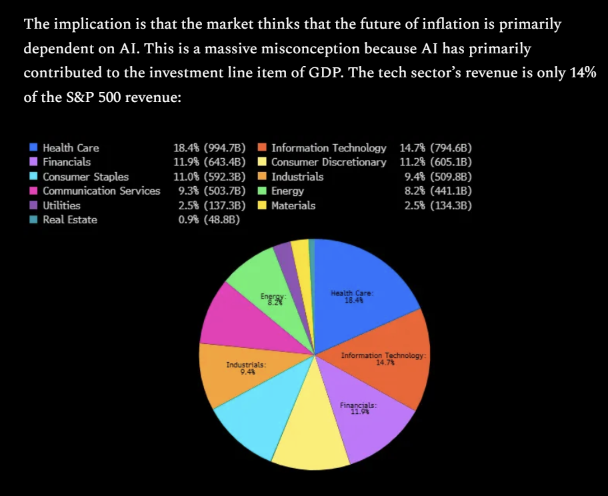
This was from the note yesterday that I sent out on the website: "The implication is that the market thinks that the future of inflation is primarily dependent on AI. This is a massive misconception because AI has primarily contributed to the investment line item of GDP. The tech sector’s revenue is only 14% of the S&P 500 revenue"
This is where things can start to get a bit risky for dispersion desks.
A lot of the single names that have delivered attractive delta and vol moves may have already exhausted much of that opportunity. These names are down significantly, and their vols are already jacked.
Meanwhile, index spot and vol moves have remained relatively subdued.
The risk is that those battered names begin to see smaller incremental moves in spot and vol, which becomes increasingly plausible after moves of this magnitude, just as the index starts to catch up.
Still a lot to play out into year end! Let’s see.
TIL that Bard gives great book summaries. Of course not an excuse to skip the book, but better than trying to infer from Amazon reviews whether you should read it or not.
Here's the summary for:
The Hour Between Dog and Wolf by John Coates: Summary
John Coates, a former Wall Street trader turned neuroscientist, explores the biological and environmental factors that influence risk-taking behavior, specifically within the high-pressure world of finance.
Key points explored in the book:
* The role of hormones: Coates identifies testosterone and cortisol as key players in risk-taking. Testosterone increases confidence and risk-taking propensity, while cortisol triggers fear and risk aversion.
* The influence of stress: Chronic stress impairs judgment, damages health, and can lead to poor financial decisions.
* The importance of "gut feelings": These intuitive hunches are often based on unconscious bodily signals, influenced by hormones and past experiences.
* The impact of environment: Social hierarchies, group dynamics, and even the time of day can influence risk-taking behavior.
* How to improve decision-making: Coates suggests various strategies, including mindfulness practices, meditation, and biofeedback, to manage stress and enhance decision-making in high-risk situations.
The book draws on various sources, including:
* Coates' personal experience as a trader
*Scientific research on neurobiology, psychology, and economics
*Historical and anecdotal accounts of financial crashes and booms
Overall, "The Hour Between Dog and Wolf" offers a fascinating and insightful look at the interplay between biology, environment, and human behavior in the context of risk-taking and financial decision-making. It provides valuable insights not only for traders and investors but also for anyone interested in understanding the psychology of risk and making better decisions under pressure.
Additionally, some key takeaways from the book include:
* Financial markets are not solely driven by rational economic factors.
* Our bodies play a significant role in shaping our financial decisions.
* We can learn to manage our stress and emotions to make better choices.
* Understanding the biology of risk-taking can help us become more resilient and successful in the face of uncertainty.
Get the book here: https://t.co/OQ5wpS6pkX
(Amazon Associate Link)