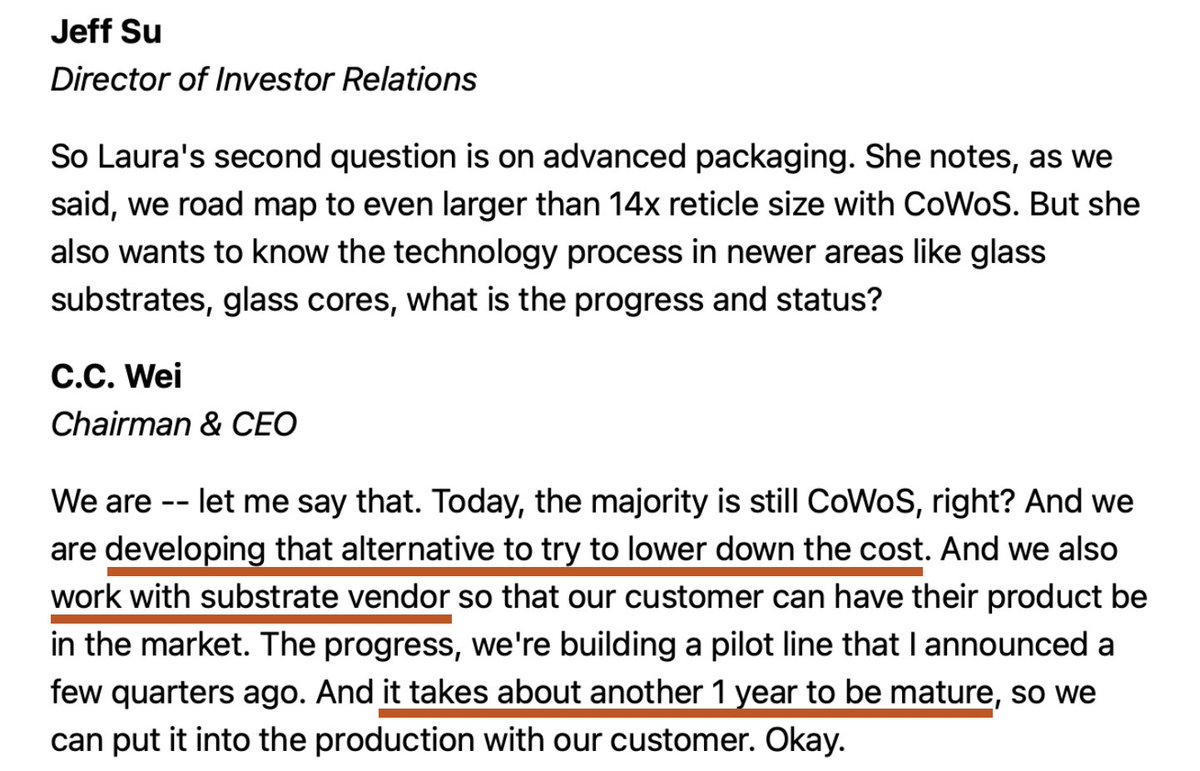
A few quick thoughts on what TSMC said about CoPoS during its Q2 2026 earnings call (screenshot from the transcript). The devil is in the details:
1. The phrase "alternative to try to lower down the cost" refers to the glass carrier. That's the CoP part.
2. "Work with substrate vendor" refers to the glass core substrate (GCS). That's the oS part.
3. Pay close attention to this phrase: "takes about another 1 year to be mature." It refers to the pilot line mentioned earlier. For a new technology, a mature pilot line and a mature mass-production line are two completely different things.
4. When TSMC says the pilot line will mature in about a year, this fully validates my earlier prediction that "the 510x515mm format will be used for pre-mass-production simulation in 2H27." For oS/GCS, "mature" means being able to start simulating with the final 510x515mm glass format on the pilot line, instead of the current 250x250mm.
5. Following from point 4, most companies currently involved in the oS/GCS supply chain may not be among the suppliers ultimately selected for mass production (not to mention companies that are only part of the market narrative and have no actual involvement). This is important to keep in mind when looking for investment opportunities at this stage, especially among equipment and materials suppliers.
6. TSMC's answer was brief, but it covered both CoP and oS. It did not mention a glass interposer at all, consistent with my earlier point that CoPoS does not use one.
7. Compared with what TSMC shared at its Japan symposium in June, the only new information in the Q2 2026 earnings call was that the pilot line is expected to reach maturity in 2H27. That said, I think the market was probably already expecting something close to this timeline. Now that TSMC has mentioned it, Ibiden and Innolux may also discuss the same timeline in their upcoming earnings calls.
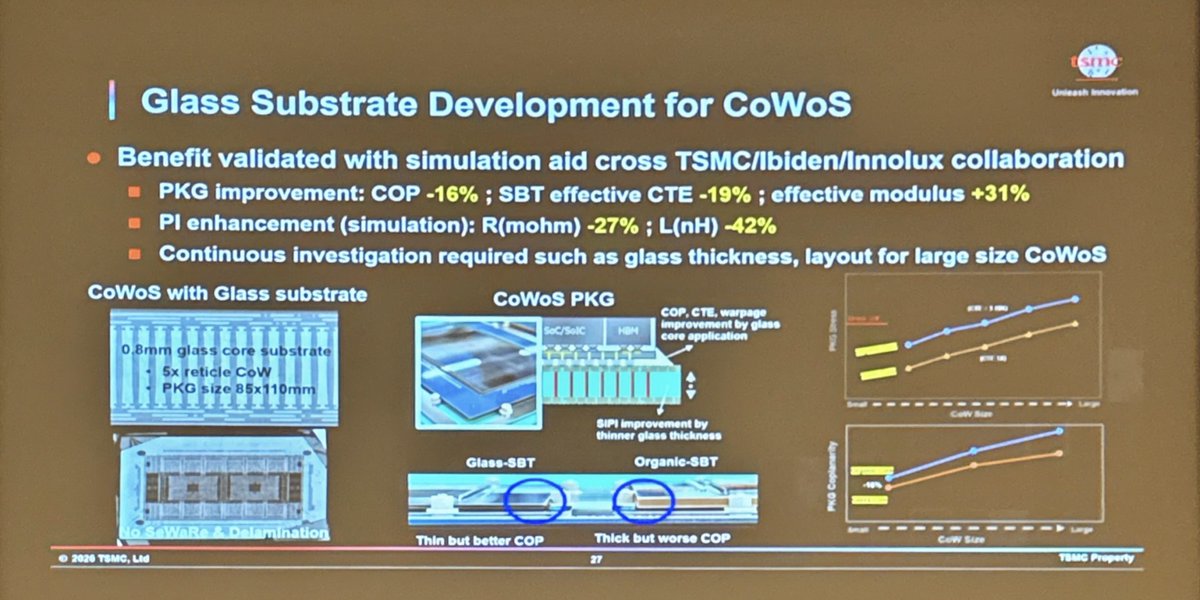
Breaking down TSMC's glass core substrate slide
On June 11, at JPCA Show 2026 in Japan, TSMC gave a roughly 40-slide presentation titled "Advanced Packaging Technology Essential to the Evolution of AI" (AIの進化に不可欠な先端パッケージング技術). One slide from the deck, titled "Glass Substrate Development for CoWoS," has since leaked online and widespread attention.
Here's a closer read of that slide (see attached image). I'll skip the technical background that is already widely available. One thing to flag: the "COP" on the slide does not stand for Chip-on-Package. It means Coplanarity.
▌ Key conclusions:
1. TSMC has officially announced a partnership with Ibiden and Innolux to develop a glass core substrate. The structure is a three-layer design, a glass core sandwiched between two ABF build-up layers. This is the "oS" in CoPoS.
2. The market underestimates how important the glass core substrate is. It's a must-have capability for TSMC. In other words, within CoPoS the "oS" matters more than the "CoP", which is also why, when it was tested, it was paired with the existing CoW rather than with CoP.
3. The glass core substrate costs several times more per unit than existing ABF substrates. The glass processed by Innolux is very expensive per unit and is the single most critical material. Besides Nvidia, two US-based customers have also expressed strong interest.
▌ Industry checks tied to this slide:
1. The glass core substrate shown on the slide is cut from a full-size 250×250mm one. The ABF build-up layers mainly use Ajinomoto's GL107, mixed with ABF-GCP, and were tested at 24–28 layers, which is the mainstream ABF spec for AI chips in 2027–2028.
2. The CoW used in TSMC's experiment is a test vehicle. It is sufficient to validate the most challenging mechanical-structure issues that arise when working with composite materials. Good results mean TSMC, Ibiden, and Innolux have together broken through the critical technical bottleneck.
3. Ibiden currently handles cutting the 250×250mm glass core substrate. When the 510×515mm format is used for pre-mass-production simulation in 2H27, if Ibiden still wants to reduce production complexity to protect its ultra-high gross margins, it may hand the cutting over to Innolux, which is more familiar with the properties of glass.
▌ The leaked slide shows the validation results of pairing CoW with the "oS" in CoPoS, i.e., the glass core substrate (labeled "glass-SBT" on the slide). This addresses the "Substrate mechanical and electrical Dilemma" raised on the previous slide, and it strongly underscores how important the "oS" is within CoPoS.
1. Within CoPoS, what CoP solves is production efficiency / cutting economics, which ties to cost and price. What the oS solves is warpage and durability, which determines whether the chip can be made at all, and whether it can work.
2. CoP and oS complement each other well when integrated, but looking out over the next few years their technical roles still differ. CoP is a very-nice-to-have optimization, and going without it simply means a more expensive chip. But the oS is a must-have. Without it, even being able to make a usable chip is in doubt.
3. Comparing their roles isn't about elevating oS at the expense of CoP. It comes down to the practical question of which technical piece customers are willing to pay for. Details below.
▌ The real gold here is the power integrity (PI) improvement shown on the slide. This matters a great deal to customers, and it means that once glass core substrate production stabilizes, TSMC's profitability and competitive edge should rise in tandem.
1. How it works: the glass core substrate is thin → the vertical conduction path through TGV (through-glass vias) is short → conduction-path resistance (R) and loop inductance (L) both drop → PI improves.
2. Why it matters to customers: better PI → more stable power delivery → frees up power headroom → room to integrate more transistors, or to push clock speeds higher → more AI compute.
3. For customers, production efficiency is TSMC's basic responsibility, so they won't pay extra for it. But gains in AI compute translate directly into the customer's own competitiveness and profit, so customers are willing to pay for that. This is why Nvidia is so positive on the glass core substrate.
4. For TSMC, the glass core substrate raises yield and lowers cost while also boosting both the compute and the selling price of AI chips. It's both a cost-cutting tool and a pricing lever, a plus for profitability and competitiveness alike.
5. Substrate cost currently accounts for a low single-digit percentage of an AI chip's BOM, while losses from packaging yield run roughly 5–10× the substrate cost. So even if the glass core substrate ends up costing several times more than today's, its share of the BOM stays low, and it can cut the losses from packaging yield. The high unit price is therefore not expected to dampen customers' willingness to adopt it.
▌ In the Q&A after the presentation, an audience member asked about TGV details for the glass core substrate. TSMC declined to answer on the spot, because TGV is the key technology behind the glass core substrate, and the core know-how currently sits with TSMC and Innolux. By contrast, when another attendee asked about integrating IVR, eDTC, and LSI, TSMC answered at length.
▌ According to industry checks, if all goes well, TSMC is aiming to start mass production of the glass core substrate in 4Q28–1Q29, to match the cadence of Nvidia's AI chip iterations. As a side note: the Ibiden earnings presentation slide that many people have been circulating lists the glass core substrate timeline as CY30. My read is this: Ibiden, which has always been conservative and cautious in public, has now formally put the glass core substrate on its roadmap, which further confirms the long-term trend for this technology. That said, some other details on Ibiden's slide don't fully line up with what's known in the market. For example, its reticle timeline is off from TSMC's public claims by about a generation, and the Rubin Ultra substrate size is clearly larger than the 90×90 it marked for CY26–27. It's a reminder to always cross-check across multiple sources when forecasting the future.
In the fast-moving tech industry, can data from industry checks go six months without an update and still track a company’s guidance more closely than market consensus? That’s rare, but here’s one example where the research held up, with a little luck on my side.
ASML's latest Q2 2026 results further validate several predictions I made six months ago (in January). The most important of them, and the easiest to verify with hard numbers, is the EUV shipment outlook.
EUV is different from consumer electronics, where forecasts shift constantly. Strong AI demand and the difficulty of expanding upstream capacity mean that my EUV shipment estimates, based on capacity changes at the key supplier Carl Zeiss SMT, have stayed closer to the company's guidance than the market consensus over the past six months, even without any updates.
ASML's 2026 / 2027 EUV shipments:
1. In January, I forecast 2026 / 2027 shipments of 67 / 80-85 units, and noted that 2027 EUV was already sold out. At the time, the market consensus for 2026 shipments was just 53-55 units.
2. In its Q1 2026 results in April, ASML gave shipment guidance of at least 60 / 80 units for 2026 / 2027. Notably, the first time the company offered guidance as far out as 2027, the number already fell within my January forecast range.
3. In its latest Q2 2026 results in July, ASML raised the 2026 / 2027 numbers to about 65 units (excluding High-NA) / about 85 units (implied by the company's guidance), and noted that nearly all the EUV orders it needs for 2027 are already in, bringing the outlook even closer to my January forecast of 67 units for 2026 and "sold out" for 2027. Worth noting: even though more bullish expectations of around 90 units or more for 2027 had surfaced ahead of the Q2 2026 results, the outlook the company ultimately provided (about 85 units) still landed at the upper end of my January forecast range.
My latest supply-chain surveys indicate that Carl Zeiss SMT will significantly expand its EUV and higher-ASP immersion DUV optical system capacity by 20-25% YoY and 40-50% YoY, respectively, in 2027 to meet robust demand from ASML. Coupled with stronger-than-expected shipment outlooks for 2026, ASML's revenue is projected to reach €38–40bn in 2026 and €45–47bn in 2027, outperforming market consensus of ~€34–36bn and ~€41–43bn.
Key drivers behind the upside vs. consensus are as follows:
1. 2026 Growth Drivers:
➢ EUV and DUV shipments are estimated at 67 and 355 units, surpassing consensus of 53–55 and 310–320 units.
➢ Driven by strong 2nm demand, TSMC has upwardly revised its 2026 EUV orders twice: from an initial 22 units to 25 units last October, and currently to 28 units.
➢ To capture robust demand from Chinese memory makers, ASML plans to launch a new immersion DUV model NXT:1965i in 4Q26. As a down-spec version of the 1980i series, it complies with U.S. export controls while addressing Chinese clients' needs, serving as a key growth driver for 4Q26 and 2027.
2. 2027 Growth Drivers:
➢ 2027 capacity for both EUV and immersion DUV is currently fully booked thanks to the strong demand; further shipment upside will hinge on ASML’s supply-side improvements.
➢ Based on Zeiss SMT’s expansion, ASML’s 2027 shipments are projected to reach 80–85 EUV systems and 380–400 DUV systems.
➢ Boosted by the new 1965i launch, China’s procurement of high-ASP immersion DUV is expected to grow ~40% YoY in 2027.
3. Additional Upside Potential to Monitor:
➢ Potential ASP hikes for EUV and DUV systems amid prolonged supply tightness.
➢ Ongoing upward revisions for the new 1965i model from Chinese memory suppliers.
➢ Potential Intel Upside: The above estimates exclude incremental EUV demand from Intel. Although Intel has not officially placed orders (explaining its previously lower-than-expected Capex guidance), it has entered discussions with ASML for additional bookings. Intel's incremental EUV demand is projected at 20–30 systems over 2026–2027, of which 3–5 are High-NA EUV.
I rarely make public calls on stock price trends (industry research and stock price forecasting are two entirely different things). One recent exception came ahead of WWDC26, when I said I was positive on Apple's share-price trend in 2H26 and added: "...regardless of what Apple says at WWDC26, as long as this core bull narrative stays intact, Apple's positive 2H26 share-price trend is unlikely to change."
After weathering a pullback triggered by the post-WWDC26 sell-the-news reaction and Apple's product price hikes, Apple shares still reached an intraday all-time high despite recent market volatility, consistent with the trend I forecast a month ago.
WWDC26 won't change Apple's positive 2H26 share-price trend, but it will test the staying power of the bull narrative
‒‒
1. Apple's core bull narrative right now is an almost intuitive market consensus that few people push back on: "Even if Apple is temporarily behind on AI, it will ultimately catch up and come out ahead."
2. Based on my latest supply-chain checks, I believe Apple's business momentum will remain strong through year-end, which should further reinforce the narrative into something like: "If Apple is doing this well without AI, just imagine once it has AI."
3. So regardless of what Apple says at WWDC26, as long as this core bull narrative stays intact, Apple's positive 2H26 share-price trend is unlikely to change.
4. That core bull narrative has its weak spots, but I think it has a good chance of holding at least through end-2026. How much longer it can last is what makes WWDC26 genuinely worth watching.
5. The key takeaway from WWDC26 will not be the short-term share-price reaction after the event. It will be whether Apple, using the same Gemini, can deliver better AI applications, agentic workflows, and on-device & cloud hybrid experiences than Google.
6. If the answer is yes, it would help extend Apple's core bull narrative. If the answer is no, it would suggest that Gemini sets the ceiling for Apple's AI experience. The stock may not necessarily turn bearish, but the "Apple will ultimately come out ahead" narrative would start to face growing scrutiny.
WWDC26 不影響 Apple 2H26 股價正向趨勢,但將揭露多頭敘事的續航力
‒‒
1. Apple 目前的多頭核心敘事,是一個近乎直覺、沒什麼人反駁的市場共識:「即使 Apple 在 AI 進度上暫時落後,最終仍能後來居上」。
2. 根據最新的供應鏈調查,我認為 Apple 的業績將會好到今年底,而這會進一步強化多頭核心敘事成為:「Apple 沒有 AI 都這麼好,有了 AI 還得了!」
3. 因此,無論 Apple 在 WWDC26 上講什麼,只要這個多頭核心敘事沒有被破壞,Apple 2H26 的股價正向趨勢就不易改變。
4. 上述多頭核心敘事並非沒有破綻,但我認為至少有機會維持到 2026 年底。至於能維持多久,就是這次 WWDC26 真正值得觀察的地方。
5. 這次 WWDC26 的重點,不在於發表會結束後的短線股價反應,而是:同樣使用 Gemini,Apple 能否做出比 Google 更好的 AI 應用、agentic workflow、裝置端與雲端混合體驗。
6. 如果答案是肯定的,將有利於延長 Apple 的多頭核心敘事;如果答案是否定的,意味著「Gemini 決定了 Apple AI 體驗的上限」,則股價雖未必會轉空,但「Apple 終究會後來居上」的多頭核心敘事,將開始被更多人重新檢視。
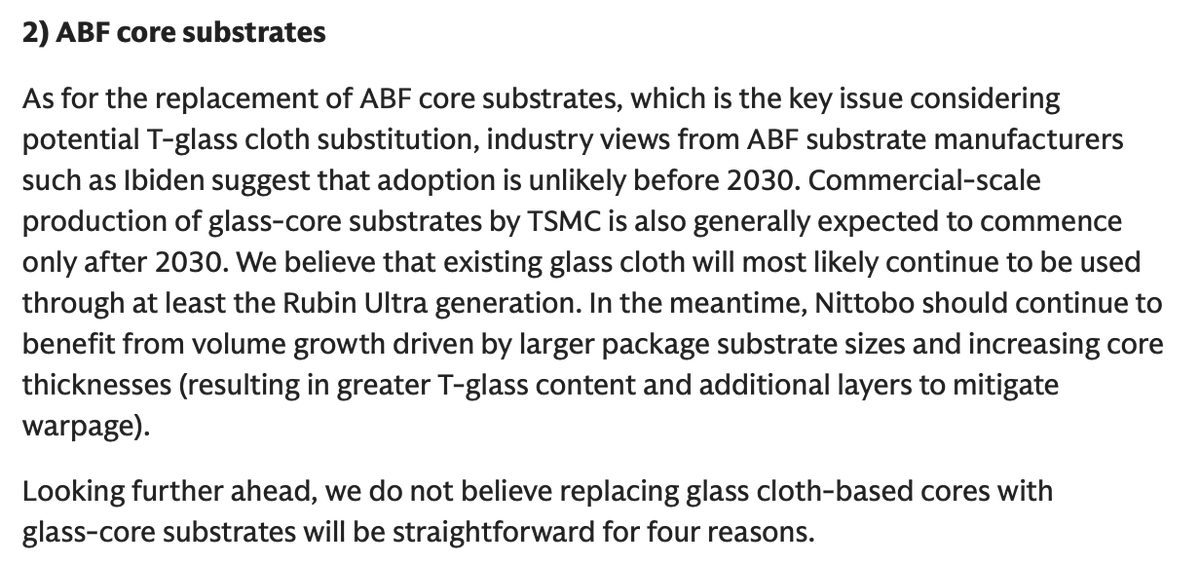
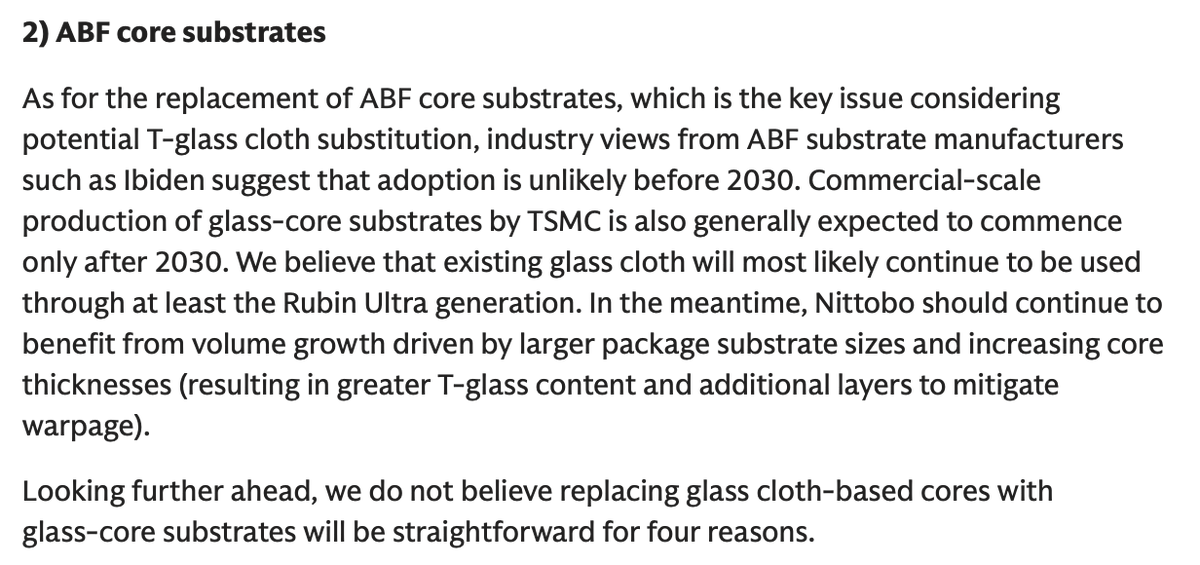
Goldman Sachs upgraded Nittobo to Buy in a July 6 report. One key reason was its cautious view on TSMC’s glass core substrate (GCS) progress. I won’t add much commentary here. Just sharing the note.
That said, my takeaway is that the other reasons GS cited for the upgrade do not really conflict with a constructive view on GCS over the next several years.
One thing to note: based on past patterns, the likelihood of TSMC providing major updates on GCS/CoPoS at its upcoming July earnings call may be low. This is especially true since TSMC just shared key R&D results at a Japan symposium in June, where it also made a rare mention of supplier partners. If that read is right, the likelihood of major GCS updates at Innolux’s and Ibiden’s August earnings calls may also be low.
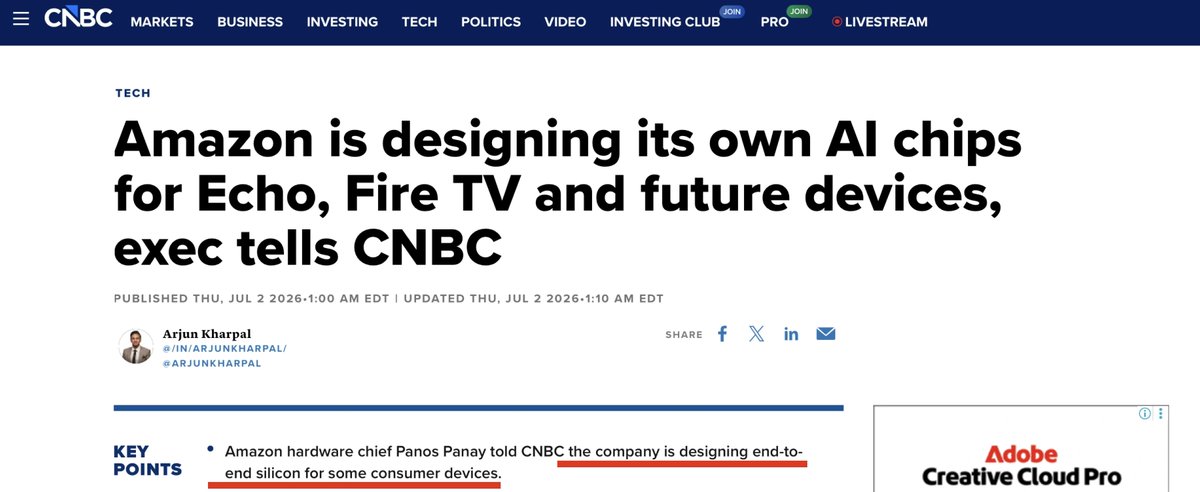
In this interview, Amazon hardware chief Panos Panay said the company is designing its own end-to-end silicon for some of its devices, while still sourcing chips from external suppliers such as Qualcomm.
This echoes the trend I previously predicted, that Amazon devices are moving toward in-house silicon. Another key takeaway is that Panay tied this effort to on-device AI, which suggests that beyond the cost considerations I noted earlier, in-house silicon is also a key part of Amazon's strategy for future AI devices.
https://t.co/OKtctYPmmp
This structural shift suggests that Amazon has been preparing for the long-term expansion of AI compute, and that it does not see AI compute oversupply as a real issue.
My latest industry checks indicate that Amazon’s processor procurement strategy for its own consumer electronics is set to undergo its first major shift in 20 years: moving away from externally sourced processors and adopting a COT (customer-owned tooling) model, with Alchip as the exclusive provider of back-end design and testing for its self-developed chips. Key points:
1. Amid the rapid expansion of AI compute, Amazon’s free cash flow for the 12 months ended 1Q26 fell 95% year over year to about US$1.2 billion. To maintain financial flexibility and keep funding its AI investment cycle, Amazon is also streamlining its organization and improving the cost structure of its non-AI businesses.
2. Amazon's own-brand consumer electronics, including Kindle, Fire TV, Echo, Alexa-enabled products, Blink, and Ring, currently use externally sourced processors. To optimize its cost structure, Amazon plans to gradually shift away from external sourcing and adopt a COT model similar to the one used for AI chip Trainium, taking more control of processor development in-house.
3. For this transition, Amazon has selected Alchip as its exclusive partner for back-end design and testing. Alchip is expected to receive non-recurring engineering, or NRE, fees for each design project, while also benefiting from processor shipments.
4. The strategy is expected to begin in 2027. Once the transition is complete, annual shipments of Amazon’s in-house processors are estimated at around 40 million units. This shift should help improve the cost structure of Amazon��s own devices and become a meaningful growth driver for Alchip.
My latest industry checks indicate that Amazon’s processor procurement strategy for its own consumer electronics is set to undergo its first major shift in 20 years: moving away from externally sourced processors and adopting a COT (customer-owned tooling) model, with Alchip as the exclusive provider of back-end design and testing for its self-developed chips. Key points:
1. Amid the rapid expansion of AI compute, Amazon’s free cash flow for the 12 months ended 1Q26 fell 95% year over year to about US$1.2 billion. To maintain financial flexibility and keep funding its AI investment cycle, Amazon is also streamlining its organization and improving the cost structure of its non-AI businesses.
2. Amazon's own-brand consumer electronics, including Kindle, Fire TV, Echo, Alexa-enabled products, Blink, and Ring, currently use externally sourced processors. To optimize its cost structure, Amazon plans to gradually shift away from external sourcing and adopt a COT model similar to the one used for AI chip Trainium, taking more control of processor development in-house.
3. For this transition, Amazon has selected Alchip as its exclusive partner for back-end design and testing. Alchip is expected to receive non-recurring engineering, or NRE, fees for each design project, while also benefiting from processor shipments.
4. The strategy is expected to begin in 2027. Once the transition is complete, annual shipments of Amazon’s in-house processors are estimated at around 40 million units. This shift should help improve the cost structure of Amazon’s own devices and become a meaningful growth driver for Alchip.
@UvixOnly@Semicon_player Thanks for flagging this. I really appreciate you looking out. I’m aware of it and will follow up appropriately. Grateful to have readers who care about original work.
The memory supply-demand gap will keep widening through 2027. That is the real reason Apple is lobbying the White House to keep CXMT off the Entity List.
▌Start with my latest industry checks: The pressure on Apple has shifted from soaring memory costs to a widening supply gap.
1. Of the memory capacity allocated to consumer electronics in 2026, an estimated 15–20% is expected to shift to data centers in 2027, and that share could grow.
2. Due to tight memory (LPDDR) supply, Apple's actual pull-in volume of A20 chips in 2H26–1Q27 could be 10–20% below its original target (though part of that may reflect Apple’s own overbooking).
▌CXMT states in its IPO prospectus that its capacity is far below domestic demand. Given the persistent global memory imbalance, even if Apple’s lobbying succeeds and it buys DRAM from CXMT, that would not materially lower costs or fill the supply gap. Still, with the imbalance widening, Apple has every reason to secure an additional source.
▌This also explains why Apple is being more proactive this time than it was when it evaluated YMTC in 2022. YMTC was mainly about lowering NAND costs; CXMT is about managing DRAM supply risk.
▌Tim Cook is one of the few tech leaders who can still navigate both Washington and Beijing, so this is better handled before he steps down as CEO. Even if the effort goes nowhere, the media coverage can still leave the market with the impression that Apple tried but was constrained by U.S. policy. That may help ease frustration over price hikes and longer delivery times.