My latest industry survey indicates Google has cut 2027 shipments of the Broadcom-designed TPU 8i series by ~1M units (mostly the higher-priced 8i Max / Whalefish). The cut amounts to roughly 20% of 2027 TPU 8i series shipments.
The survey also indicates Google plans to increase 2027 shipments of the MediaTek-designed TPU 8t series, though details aren't final yet. Google has repeatedly stressed in recent months that frontier model development gets first call on compute, and this shift in the 8t and 8i shipment mix is precisely the adjustment it's making amid a tight supply chain and data center power constraints.
Google TPU update: New OpenAI and Anthropic orders extend shipment visibility to 2029; v10 lineup overhauled (now Quillfish); MediaTek and Broadcom lead as the top suppliers to watch
Key takeaways from my latest industry survey and research conclusions:
1. Order visibility and shipment plans:
Strong new orders from OpenAI and Anthropic have extended Google TPU shipment visibility to 2029, ahead of Nvidia GPUs and other AI ASICs (mostly 4Q27–2Q28).
(1) From 2028, v9 will become the mainstay of Google’s own compute buildout, so v8-series orders (8t / 8i or their design variants) can be viewed as coming from OpenAI and Anthropic.
(2) Combined 2028–2029 demand: about 12M units for OpenAI (8t, designed by MediaTek) and about 14M for Anthropic (8i, designed by Broadcom), with both growing year over year. OpenAI buys outright, while Anthropic uses a mix of leasing and outright purchases.
(3) Given supply chain constraints, more reasonable TPU shipment estimates for 2027–2029 are 8–9M, 14–15M, and 16–18M units, respectively. The market broadly expects AI capex to peak in 2028, yet this plan shows TPU shipments still growing in 2029, driven by direct orders from AI service leaders OpenAI and Anthropic.
2. v10 lineup and supply chain changes:
v10 has changed from Icefish and Merope / Bladerunner to Quillfish, with mass production expected in 2029. MediaTek has won the design service order.
(1) Icefish is now v11, with mass production expected in 2030 and the design service order also going to MediaTek. Merope has lower visibility: no supplier has been chosen, and it may be canceled.
(2) MediaTek will be the sole supplier for v9 (Humufish & Triggerfish) and v10 (Quillfish), accounting for about 45–50%, 50–55%, and 55–60% of total TPU supply in 2027–2029, respectively. TPU’s contribution to its revenue and profit should rise each year.
(3) From v9 onward, all new TPUs use Intel’s EMIB-T advanced packaging. Given limited initial production capacity, the v8 series should remain the bulk of TPU shipments through 2029. v8 is expected to be the main source of TPU profit growth for MediaTek and Broadcom over the next few years, thanks to significant accumulated learning-curve benefits and the fact that both handle procurement of key components and materials.
3. Market attention and supplier outlook:
Recent events should raise and sustain market attention on Google TPU, with key design service providers MediaTek and Broadcom likely to be the supply chain’s top focus.
(1) Uncertainty over Nvidia’s CEO succession helps Google in discussing post-2028 long-term plans with customers. OpenAI and Anthropic are both key TPU customers, so their IPOs should also raise and sustain attention on TPU, and MediaTek and Broadcom are the suppliers the market most readily associates with it.
(2) MediaTek is clearly the biggest TPU winner of the next few years. Its position as sole design supplier from v9 onward, together with a supply share that rises each year alongside TPU shipments, will expand its TPU revenue. The high-margin 8t series, with shipment visibility through 2029, is a key profit source.
(3) Because Broadcom leads the 8i design, its gross margin is even higher than the 8t’s, supporting Broadcom’s profit growth. Note, however, that Broadcom’s focus over the next few years will be non-TPU XPU and AI networking chip orders, with non-TPU revenue expected to surpass TPU revenue as early as 2027.
Trump says Tim Cook is the best person to take Jensen Huang’s place as Nvidia CEO, but I think where Cook’s strengths would shine most is cost management. Having watched Apple’s supply chain management from the sidelines for more than 10 years, and comparing that with what I’ve learned tracking and researching Nvidia in recent years, I think Nvidia still has clear room for improvement in supply chain and cost management.
As for everything else, especially the most important part, planning and developing new technologies, this isn’t just about Cook. So far, the only CEO who has clearly proven he can do this well, bringing humanity’s most cutting-edge technologies from across fields into AI chips and rack solutions while keeping up a fast pace of commercial iteration, is Jensen Huang. (Of course, others will likely prove they can do this well in the future too.)
Key takeaways on Nvidia CEO Jensen Huang’s resignation:
1. Near term, the bad news is priced in:
For the stock market, this could be a one-time clearing event. Huang has now fully cut ties with Nvidia, so Congress summoning him and any follow-up investigations should have less impact on Nvidia’s stock from here. As for how Huang’s next moves might affect Nvidia, it’s too early to call before the investigation results are out.
2. Google’s TPU is likely the biggest beneficiary:
With Nvidia facing succession uncertainty, Google’s TPU has a chance to win more trust from customers and the supply chain. Its key partners, MediaTek and Broadcom, could be the market’s near-term focus.
3. Succession impact shows up in 2028 at the earliest:
CFO Colette Kress is now interim CEO. The formal CEO transition and the organizational changes that come with it will likely start affecting Nvidia’s product development and competitiveness in 2028 at the earliest.
4. Capacity pre-booking and spec upgrades are the key focus for supply chain checks:
Huang’s product strategy pushed the supply chain hard in two ways: capacity pre-booking and spec upgrades. It’s critical to watch for any changes in capacity expansion and new tech development across the supply chain. These are among the core reasons Nvidia’s supply chain trades at high P/E multiples.
5. China demand and export controls:
The share of Nvidia’s AI chip revenue that ultimately ends up with Chinese buyers may be higher than what the company has officially stated. That’s why some investors worry Nvidia’s revenue will drop sharply once the US government tightens export controls. But China’s end demand won’t disappear because of export controls. Even under tighter rules, as long as overseas resale channels exist, Chinese buyers may still pay the premium, even at several times the price, and get Nvidia chips/racks through indirect routes.
Jensen Huang matters to Nvidia because he can take technologies his engineers believe are possible and turn them into products the whole company commits resources to, takes risks on, and has to deliver. That's why the supply chain gets such strong order visibility and is willing to keep up with aggressive spec upgrades. It also forces competitors to follow, which drives technology upgrades and supply chain investment across the entire AI industry.
Between the two, deciding on aggressive spec upgrades and making them happen is the harder part, compared with giving the supply chain order visibility. Huang doesn't need to be the person at Nvidia who knows the most about new technologies like HVDC, CPO/NPO, or CCL/PTFE. His value is that he weighs strategy, organization, technology, and supply chain all at once, then makes the call quickly and puts resources behind it.
Based on what's public so far, it looks hard for Huang to come out of this unscathed. If so, the practical move may be to gradually reduce Nvidia's reliance on Huang's personal decision-making while preparing a succession plan. Along the way, two things are worth watching to gauge where AI technology and investment are heading: whether Nvidia can keep developing new products and technologies as efficiently as before, and how competitors respond. Supply chain research will be an important basis for that judgment.
My latest supply chain checks indicate that Nvidia has begun testing glass-free copper-clad laminate (CCL) based primarily on hydrocarbon (HC) resin as a replacement for glass-free PTFE-based CCL tested previously, paired with glass-free HC-based PP. The goal is to determine whether this material combination can meet the switch tray PCB requirements for Rubin Ultra NVL576, an eight-rack interconnected solution expected to enter mass production in 2H27.
Preliminary tests conducted as part of efforts to improve PCB manufacturability show that glass-free HC CCL meets the switch tray’s high-frequency electrical requirements. Its electrical performance trails that of the original PTFE solution but exceeds that of M9-class solutions and even surpasses M10’s stated specifications. These results do not represent a final material selection, but they indicate that NVIDIA continues to seek higher PCB manufacturing yields and greater production efficiency while meeting electrical requirements.
1. Key Takeaways and Analysis
(1) Previous NVL576 switch tray tests used glass-free PTFE CCL paired with glass-free HC PP. The latest round replaces the PTFE CCL with glass-free HC CCL while retaining the same HC PP part number.
(2) Shengyi Technology is currently the leading supplier in the NVL576 switch tray material evaluations. The materials involved are SG5300N (glass-free PTFE CCL), SG1030N (glass-free HC CCL), and SIF09 (glass-free HC PP).
(3) The primary objective of testing glass-free HC CCL as a replacement for glass-free PTFE CCL is to determine whether PCB manufacturing yields and production efficiency can be improved while still meeting high-frequency electrical requirements.
(4) To further improve PCB manufacturability, subsequent tests may also evaluate replacing glass-free HC PP with woven-glass-reinforced HC PP. The challenge is whether the glass-reinforced material can still meet signal integrity and 0.4 dB/in loss requirements.
(5) Notably, both SG1030N and SIF09 still contain small amount of PTFE, although HC is the primary material. These tests therefore do not represent a complete shift away from PTFE. Rather, they involve adjusting the primary resin system and material combination to balance high-frequency electrical performance with PCB manufacturability.
2. Conclusions
(1) The long-term trend toward broader use of PTFE in advanced PCB materials, including CCL and PP, remains clear. However, the pace of shipment growth over the next two years remains uncertain. Key variables include NVL576 switch tray PCB’s final material selection, NVL576 adoption rate, and development progress on Kyber-like rack designs that use orthogonal backplanes.
(2) HC use in advanced CCL and PP continues to expand. Beyond NVL576 switch trays, near-term growth drivers include the production ramp of M9-class materials beginning in 4Q26, followed by the adoption of M10-class materials.
(3) Once specifications are finalized and mass production begins, it's expected that Shengyi Technology to accelerate sourcing from Chinese HC suppliers. These include existing suppliers such as Dongcai and Shengquan, as well as potential ones such as GCH Technology. This should help alleviate supply shortages and optimize its cost structure.
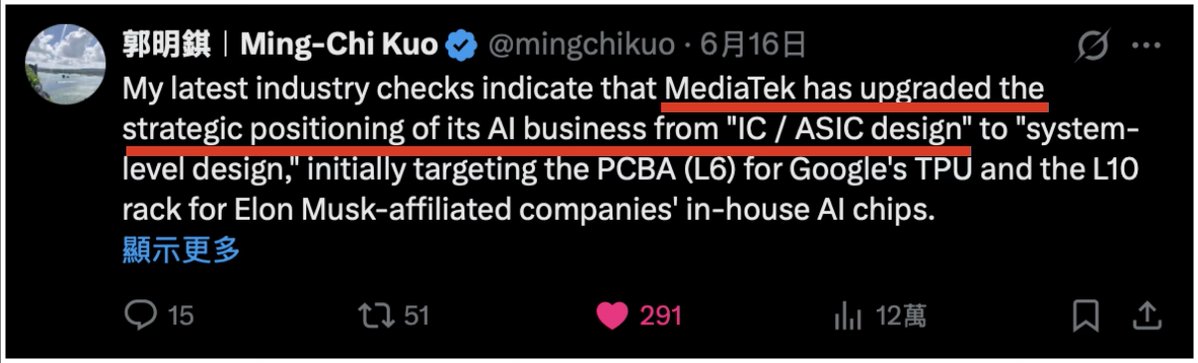
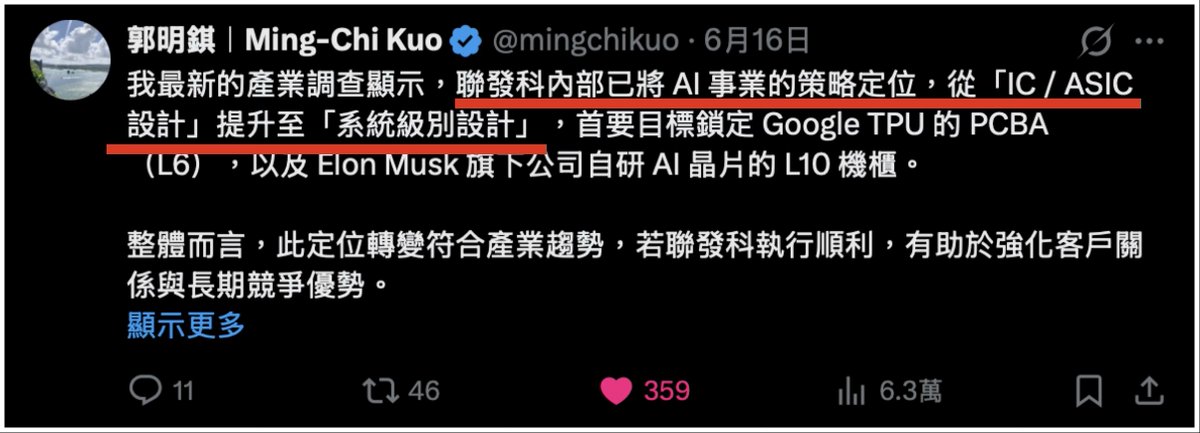
MediaTek’s latest announcement on the deepening of its long-term partnership with Nvidia repeatedly uses the term “rack-scale.” This is the key to understanding the announcement, and it directly validates the central conclusion of my research from more than two months ago:
MediaTek has upgraded the strategic positioning of its AI business from "IC / ASIC design" to "system-level design."
The announcement link:
https://t.co/Yf4XOFVvSH
The announcement also explains how MediaTek plans to put this new positioning into practice. By working with Nvidia, MediaTek can bring custom chips and XPUs into Nvidia’s mature rack-scale ecosystem, so that once chip development is complete, they can be integrated more quickly into rack-scale systems for deployment in data centers and AI factories.
For MediaTek, Nvidia’s mature rack-scale systems ecosystem means it does not need to start from scratch, giving this new strategy a much clearer path to execution.
For Nvidia, MediaTek’s custom silicon design capabilities and customer base can help extend Nvidia’s rack-scale ecosystem further into the custom silicon market.
This also explains why “rack-scale” is the key term in the announcement: it is where the two companies need each other most. MediaTek can move from chips to systems, while Nvidia can extend its rack-scale ecosystem into the custom silicon market, creating a win-win that opens up new growth opportunities for both.
Just as the market had come to believe that Rubin CPX had been dropped from Nvidia’s product roadmap, my latest industry checks indicate that Nvidia has revived the program, with production expected to begin in 1Q27. Compared with the previous design, the revived Rubin CPX delivers stronger prefill performance and features major changes to both its GPU specifications and rack architecture, underscoring the high priority Nvidia places on prefill solutions.
Key changes:
1. Rubin CPX GPU specs
CPX delivers near-Rubin compute performance and matches Rubin’s maximum power rating of 2,300 W per GPU. CPX moves to 168 GB of HBM4, vs. 288 GB on Rubin and 128 GB of GDDR7 on the previous CPX design.
2. Rack design
The new CPX uses a standalone MGX ETL rack rather than sharing a rack with Rubin, as in the previous design. Customers can opt for 64, 128, 192, or 256 CPX GPUs depending on their needs. Within a CPX rack, each group of 64 CPX GPUs forms a rack module comprising eight compute trays (eight CPX GPUs per tray) and one switch tray.
3. Scale-up and scale-out
NVLink is used only for scale-up among the eight CPX GPUs within each tray, with 1–1.5 TB/s of NVLink bandwidth per CPX (vs. 3.6 TB/s per Rubin). Inter-tray scale-out within each rack module runs over Spectrum-6 Ethernet using all-copper L1 links. Across rack modules, scale-out is handled by each module’s Spectrum-6 switch over OSFP optical links.
4. How it works
CPX must be paired with Vera Rubin NVL72, and Nvidia recommends a 1:1 ratio of CPX to Rubin GPUs. CPX handles prefill and builds the KV cache, which is then transferred to Rubin over Ethernet RDMA for decode.
5. Product positioning: Best performance per dollar for long-context prefill
Over 50% of today’s AI inference workload comes from processing input context and building the corresponding KV cache. CPX therefore offers a more flexible, lower-cost way to handle prefill. Each eight-CPX tray has approximately 1.34 TB of HBM4, sufficient for most long-context prefill workloads and associated KV cache requirements.