Test-time scaling, reasoning, and generally search-like processes clearly drive significant gains in LLMs. Largely owed to the structure of language. One would think the same could apply to non-linguistic domains, like image generation, but that obviously depends on whether the structure of the domain's representation lends itself to search.
1D ordered tokens (e.g., image FlexTok, video FlexTok) seem like a natural fit since they enable a step-by-step coarse-to-fine generation. We investigated that and found they indeed enable search and scale far better with test-time compute than 2D grids. See the visuals on the webpage. Appearing in @icmlconf 2026.
🔗 https://t.co/yOFqeIJrEz
📄 https://t.co/WFZCihp1m4,
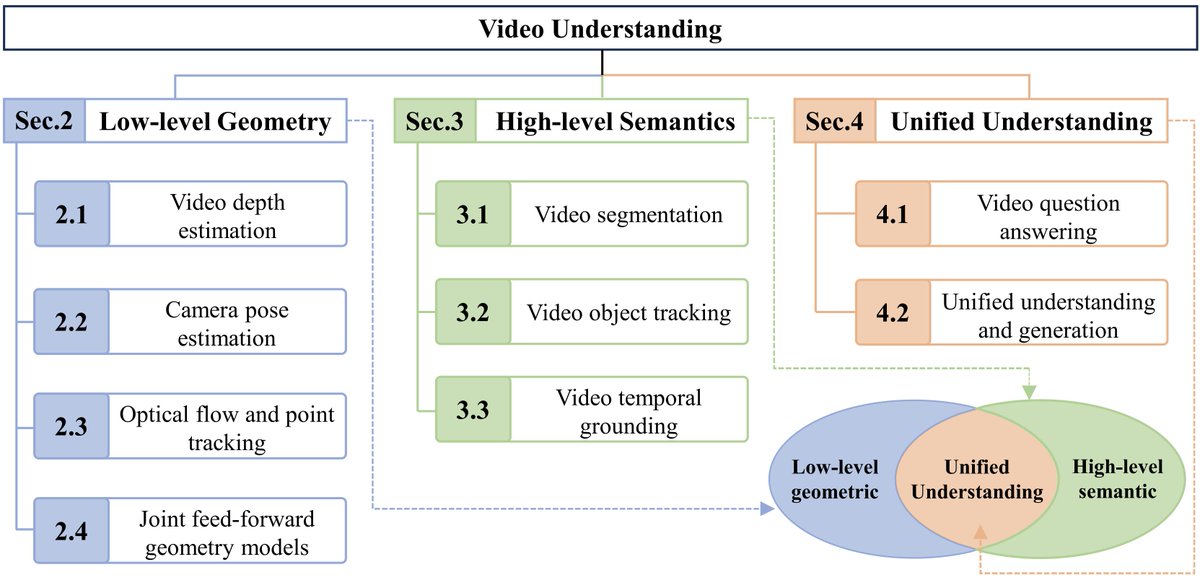
🚀New survey paper "Video Understanding: From Geometry and Semantics to Unified Models"
💡A structured review of video understanding across geometry, semantics, and unified models, with discussion on emerging joint paradigms and future directions.
📖https://t.co/9XlYzQTRmb
🧵👇
For too long, users have lived under the software lottery tyranny of fused attention implementations.
No longer.
Introducing FlexAttention, a new PyTorch API allowing for many attention variants to enjoy fused kernels in a few lines of PyTorch.
https://t.co/IXeUS6AkrY
1/10