A centralized data center goes down thousands of workloads stop.
A node in a decentralized network goes offline the network routes around it. No single point of failure.
No single company controlling capacity.
No single line to cut.
Distributed infrastructure isn't just cheaper. It's harder to break.
That is how we built YOM.
https://t.co/EvAydwgc0G
We’ve all been there: a massive new game drops, but your PC just can’t handle it.
For too long, gaming has been gatekept by expensive hardware.
Walter is here to change that.
By tapping into YOM’s decentralized GPU network, Walter lets you launch and play PC games instantly without the need of a heavy duty rig.
The network does the heavy lifting so you can just play.
This launch is a huge moment for us. It’s not just a new product; it’s proof that decentralized tech can step out of the shadows and power real, large-scale apps that people actually want to use.
Today is just day one. Welcome to Walter.
Try the early Alpha version : https://t.co/jeLvenzsAU
Day 1 is officially in the books. 🎮
Seeing players jump straight into games without waiting on massive downloads or annoying updates has been incredible. Just click, launch, and you’re in.
Huge thanks to everyone who jumped in on day one. This is just the very beginning of what we're building
Try Walter Alpha Version now: https://t.co/n55D1U6irt
Your gaming PC has more compute than it uses.
Between sessions, the GPU sits idle. The hardware runs, the electricity bill runs, the compute does nothing.
YOM routes that compute to real workloads gaming and AI inference.
No mining. No wasted energy. Useful work, real demand.
🛠️ https://t.co/EvAydwgc0G
A GPU that renders a game session at 7pm can process an AI inference job at 3am.
One machine. Two workload types. Zero idle time wasted.
YOM's network routes the right workload to the right node at the right time.
Operators earn from utilization, not speculation.
That's what useful infrastructure looks like.
Traditional mining spends energy to secure consensus.
YOM uses compute to render real games for real players.
One protects a ledger.
The other delivers a product people can use instantly.
DePIN is not a new version of mining. It is a different model entirely.
Every new gamer can make the YOM network stronger.
More local demand means more regional nodes come online.
More nearby nodes means compute gets closer to players.
That is how YOM is designed to scale: not by adding friction, but by improving coverage and latency over time.
https://t.co/EvAydwgc0G
This week on YOM 🛠️
→ Why the hardware model is breaking and what replaces it
→ How publishers skip app stores with instant play (+1,316% DAU case study)
→ Heading to @developconf Brighton, July 14–17
→ Town Hall Ep. 80 Xbox layoffs and what it means for decentralized gaming
→ MiCA fully enforced $YOM was compliant from day one
→ The network loop: more gamers → more compute → more $YOM settlement
Building continues. 🫡
The YOM network runs on a simple loop.
More gamers using platform → more compute consumed → more network activity → more $YOM settlement on-chain → more operators joining to serve demand.
Token utility grows when the network grows.
That's the design.
Every year the checklist gets longer: better GPU, more storage, faster internet, a newer console.
And every year the actual game stays exactly the same size it always was.
Publishers integrating YOM can bypass the traditional app-store funnel.
No downloads.
No store install friction.
No 30% platform fee on streamed access.
A player clicks a link. The game streams instantly from the nearest available node.
In the Martians vs Roughnecks case study, replacing a multi-GB download with instant play drove a +1,316% DAU increase.
That is what removing the barrier does.
https://t.co/AlRT6r6mwt
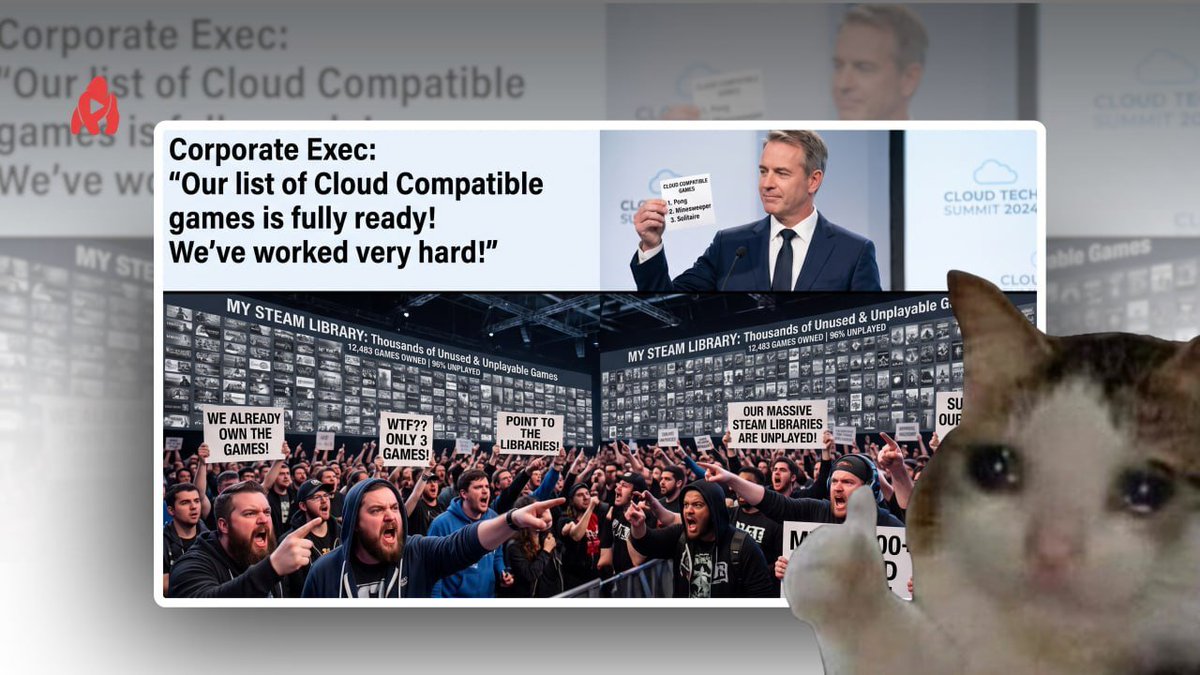
"We added three indie titles from 2019 to our service this month!"
Gamers with 300+ owned AAA games on Steam: 👁👄👁
The current cloud gaming model is fundamentally broken.