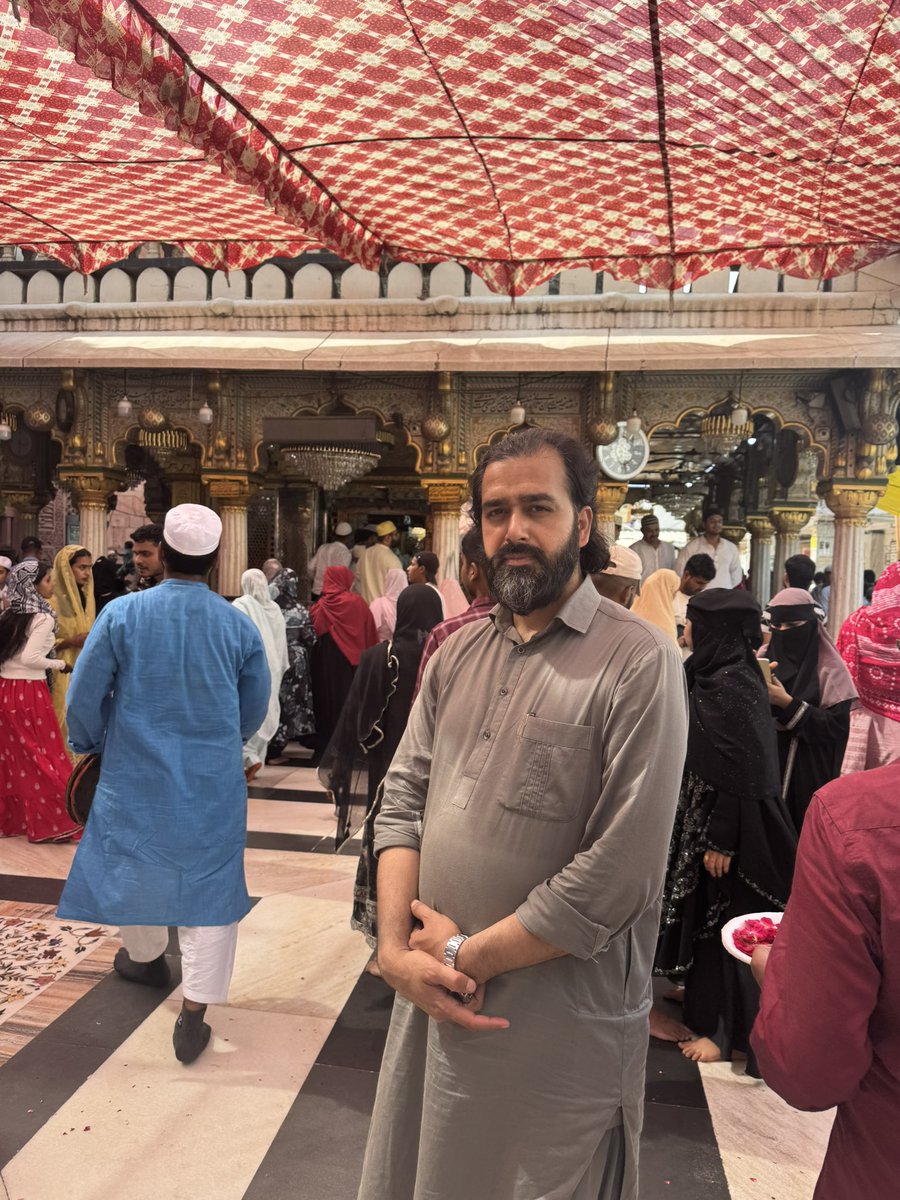
Today I was blessed to visit the Dargah of Mehboob i Ilahi Hazrat Khwaja Nizam ud din Awliya after a long time. The thin alleys leading to Dargah with rose petals, jaggery and aromas sold on both sides for the visitors makes alleys vibrant and some what fragrant with the occasional burning of incense and the smell of Mughlai dishes being prepared in the eateries, where visitors eat and beggars wait endlessly in queues so that any philanthrope may arrange a feast for them.
While entering into the Dargah complex, we first entered into the red stone mosque which is also known as the Jamat Khana Masjid and was built by Khizr Khan, the son of Sultan Ala ud din Khilji as a token of respect for Hazrat Nizam ud din. Even Hazrat Nizam ud din used to pray in this mosque and the grandiose of its architecture is really a treat for eyes to behold.
After Zuhr prayers, we sat alongside the Qawwals who were per chance singing a manqabat of Hazrat Ali and the Qawwals were singing it in between the mausoleums of Hazrat Nizam ud din and Ameer Khusrau. I could feel with my heart, how Khusrau as a master musician would have made a value addition to the Indian classical Sufi Sema by inventing ragas like Hussaini and by improving upon the instruments like Veena and Sitaar. And it is recorded in the historical sources that it was Ameer Khusrau himself who melodised the words of Hadith “ MAN KUNTO MAULA” into a rhythmic metre and which eventually the aforementioned Qawaals were singing in a high pitch. Further, my imagination reeled back to the saga of love and devotion which Tooti e Hindustan Hazrat Ameer Khusrau manifested for his spiritual beloved…. his beloved Nijaam, in a Brij Bhasha accent.
Khusrau Nijaam Kay Bal Bal Jayiyay
Mohey Suhaagan ki ni re mo se Naina Milai key
It reminded me of many spiritually evolved duos like Shamas and Rumi, Sudhama and Krishna, Nanak and Mardana, and many others who were meant for each other as soul mates winding their ways to the realm of the Eternal together. Using the symbolisms of the worldly love, Khusrau was pointing towards something deeper when he was beholding his Nijaam and was saying:
Khusrau Ren Sugaag ki Jaagi Piya kay sangh
Tan Mero Man Piyo ko, Dueoo Bhayay ek Rang
And I was imagining what would have been the state of Khusrau’s mind when the thunder bolt of his beloved Nijaam’s demise would have struck him and when he would have said:
Gori soyay Sejh par aur Mukh par daaray Kaes
Chal Khusrau Ghar aapnay, Raen bhayee chuho Daes
“My beloved is resting on a flower bed with tresses of hair on the face
Come back home Khusrau, time has come to return.
I could feel Ameer Khusrau compiling his Persian Mathnawis and Panegyrics to the beloved Prophet Alaih i Salam, wherein he eulogises him like:
Ay Chehrayyay Zebay i Tu Rashkay Butaan e Aazari
Har Chand wasfat mi Kunam ammaa az aan Baalaa tarie
O you my beloved, your countenance is an envy for the images carved out by the master sculptor, Aazar
Every time I praise you, your stature grows out of the bounds of my words.
Aafaq ha gar deedah am, Mehrey butaan warzidah am
Bisyaar khubaan deedah am, amma tu Cheezay deegarie
I have traversed the horizons, I have seen many dear darlings
I have seen limitless beauties, but O my beloved your are “something” different.
Khusrau ghareeb ast o ghadaa, uftaadah dar Shahr e Shuma
Baayad ki az Behray e Khuda, Suyay Ghareeban bingarie
Khusrau is a destitute traveller, stranded in your City
It behoves you that for God sake, do have a look or two upon the travellers as a mark of your courtesy.
While leaving, I bought some books written by Khwaja Hassan Nizami, the late Sajadah Nisheen of the Dargah, who was a great scholar and literary genius in his own right and had famously held written debate with Dr. Sir Muhammad Iqbal about his ideas regarding Hafiz Shirazi in his books and letters. But the likes of Hassan Nizami are nowhere to be found these days within the circle of Dargah’s keepers unfortunately.
No one who has felt Ghalib by heart can ever resist the temptation of visiting his Mazaar at Basti Nizam ud din after paying an obeisance at the Dargah of Hazrat Nizam ud din Awliya. So was I longing to pay my homage at Ghalib’s Mazaar after a pretty long time. In fact the temptation to visit Dabir ul Mulk Khan Bahadur Mirza Asadullah Khan Ghalib’s Mazar entered my mind once I stepped out of the threshold (Dahleez) of Hazrat Ameer Khusrau’s Mazaar which lies within the Dargah complex of Hazrat Nizam ud din Awliya. My thoughts hung in balance when I remembered the two icons of Subk i Hindvi poetry, Ameer Khusrau and Mirza Ghalib together and a couplet of Ghalib eulogising the legacy of Khusrau came to my mind:
غالب میرے کلام میں کیوں کر مزہ نہ ہو
پیتا ہوں دھو کے خُسروِ شیرین سُخن کے پاؤوں
At Basti Nizam ud din I could image how Ghalib would have been visiting the Dargah of Hazrat Nizam ud din all the way from Ballimaran in ShahJahan Abad with all devotion and respect, particularly during the festival of Phool Walun ki Sayr, wherein the gentry and peasantry alike would present the floral presents at the Dargah. My memory struggled but finally succeeded in recalling a couplet of Ghalib:
فروغِ جلوۂ حُسنِ ازل مبارک شُد
چراغِ خانقۂ خواجہ را فروزان باد
Hail! the beneficence of the eternal beauty
May the lamp of Khwaja Nizam ud din’s Khanqah be ever luminous.
I could remember Ghalib’s Zindadili amidst the throes of Gham e Rozgaar. His struggles during the turmoil of 1857. His struggles to reclaim his pension from Company Sarkar and all that which made Ghalib to lament:
کہوں کس سے میں کہ کیا ہے شبِ غم بُری بلا ہے
مجھے کیا بُرا تھا مرنا اگر ایک بار ہوتا
While seeing his name inscribed upon the plate of his Lauh e Mazaar, I recalled Ghalib’s love for Asadullah (the lion of Allah), being one of the epithets of Hazrat Ali bin Abi Talib. The pen name Ghalib (ever triumphant) too had been taken by him from Maula Ali’s epithet, Asadullah ul Ghalib (the ever victorous and triumphant lion of God). And right there I recalled Ghalib’s Persian couplet:
غالب نام آورم نام و نشانم مپرس
اسدُ اللّٰہم و ہم اسدُ اللّٰہِیَم
I have earned the name Ghalib, don’t ask about my name and mark
I am Assadullah for I belong to the cult of Asadullah.
And verily this one:
غالب ندیمِ دوست سے آتی ہے بوۓ دوست
مشغولِ حق ہوں بندگئّ بو تراب میں
Inspite of his struggles and shortcomings as a human , my heart began to pay salutations to him for his hope of being blessed because of his pertaining to the Ummah of Beloved Rasulullah (peace be upon him and his progeny):
اُس کی اُمت میں سے ہوں میرے رہیں کیوں کام بند
واسطے جس شہہ کے غالب گُنبدِ بے در کُھلا
May Allah’s mercy be upon these afflicted lovers of Eternal Beauty !
Khuda Rehmat Kunad ein Aashqaan e Paak Teenat Ra.