𝗔𝗜 𝗔𝗚𝗘𝗡𝗧𝗦 𝗜𝗡 𝗣𝗥𝗢𝗗𝗨𝗖𝗧𝗜𝗢𝗡 | 𝗧𝗛𝗘 𝗦𝗧𝗔𝗟𝗘 𝗖𝗢𝗡𝗧𝗘𝗫𝗧 𝗥𝗜𝗦𝗞
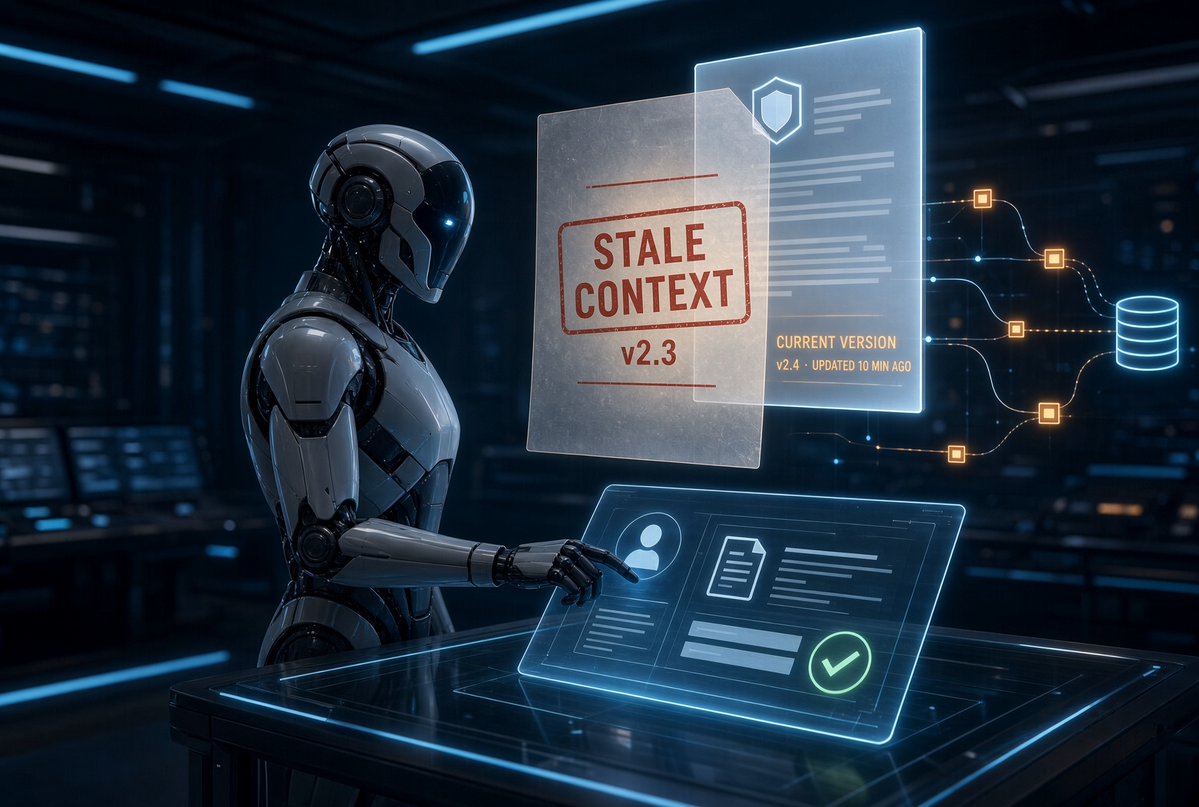
An AI agent retrieves the relevant policy, checks a customer’s request, and prepares a refund for execution.
The reasoning looks correct.
But there is a problem.
The policy was updated 10 minutes ago, while the retrieval index still contains the previous version.
The agent may now make a perfectly reasonable decision based on state that is no longer valid.
This is not simply an embedding problem. It is a freshness and consistency problem across the systems supplying context to the agent.
In production, updates may take time to propagate through ingestion pipelines, caches, replicas, and retrieval indexes. Updates can also fail, leaving old documents or chunks available for retrieval.
For agentic systems, semantic relevance is not enough. Before an agent takes a consequential action, the system must verify that the information is current and authoritative.
A few engineering controls matter:
✅ Event-driven updates & invalidation
Use CDC or domain events to propagate important changes to downstream indexes and caches. TTLs can limit exposure to stale data, but they should not be the only freshness mechanism for critical state.
✅ Versioning & provenance
Attach version IDs, timestamps, source identifiers, and provenance metadata to retrieved information so its origin and version can be verified, and its freshness can be checked against the authoritative source.
✅ Freshness validation before action
Before high-impact writes or transactions, validate critical state against the authoritative API, database, or policy service rather than relying exclusively on the retrieval index.
✅ Separate semantic knowledge from operational state
Use vector search to discover relevant unstructured knowledge. Use deterministic, authoritative systems for current balances, permissions, limits, statuses, active versions, and other state that governs execution.
A safer pattern looks like this:
✔ RAG : Relevant knowledge
✔ Authoritative API/DB : Current state
✔ Validation / policy layer : Constraints
✔ Agent / tool : Action
The model can reason correctly and the system can still fail if the context it receives is no longer valid.
Semantic search finds relevant context. Production systems still need to prove that context is current and authoritative before acting on it.
How are you validating freshness and source authority before your agents take action?
#SoftwareEngineering #AIAgents #RAG #SystemDesign #DistributedSystems #AIEngineering
@petersykim Good question. Yes, that missing check is part of the failure mode. But timestamps alone aren’t enough—the system should determine which policy version applies to the request and validate it against the authoritative source before execution.
𝗔𝗜 𝗔𝗚𝗘𝗡𝗧𝗦 𝗜𝗡 𝗣𝗥𝗢𝗗𝗨𝗖𝗧𝗜𝗢𝗡 | 𝗧𝗛𝗘 𝗦𝗧𝗔𝗟𝗘 𝗖𝗢𝗡𝗧𝗘𝗫𝗧 𝗥𝗜𝗦𝗞
An AI agent retrieves the relevant policy, checks a customer’s request, and prepares a refund for execution.
The reasoning looks correct.
But there is a problem.
The policy was updated 10 minutes ago, while the retrieval index still contains the previous version.
The agent may now make a perfectly reasonable decision based on state that is no longer valid.
This is not simply an embedding problem. It is a freshness and consistency problem across the systems supplying context to the agent.
In production, updates may take time to propagate through ingestion pipelines, caches, replicas, and retrieval indexes. Updates can also fail, leaving old documents or chunks available for retrieval.
For agentic systems, semantic relevance is not enough. Before an agent takes a consequential action, the system must verify that the information is current and authoritative.
A few engineering controls matter:
✅ Event-driven updates & invalidation
Use CDC or domain events to propagate important changes to downstream indexes and caches. TTLs can limit exposure to stale data, but they should not be the only freshness mechanism for critical state.
✅ Versioning & provenance
Attach version IDs, timestamps, source identifiers, and provenance metadata to retrieved information so its origin and version can be verified, and its freshness can be checked against the authoritative source.
✅ Freshness validation before action
Before high-impact writes or transactions, validate critical state against the authoritative API, database, or policy service rather than relying exclusively on the retrieval index.
✅ Separate semantic knowledge from operational state
Use vector search to discover relevant unstructured knowledge. Use deterministic, authoritative systems for current balances, permissions, limits, statuses, active versions, and other state that governs execution.
A safer pattern looks like this:
✔ RAG : Relevant knowledge
✔ Authoritative API/DB : Current state
✔ Validation / policy layer : Constraints
✔ Agent / tool : Action
The model can reason correctly and the system can still fail if the context it receives is no longer valid.
Semantic search finds relevant context. Production systems still need to prove that context is current and authoritative before acting on it.
How are you validating freshness and source authority before your agents take action?
#SoftwareEngineering #AIAgents #RAG #SystemDesign #DistributedSystems #AIEngineering
@milan_milanovic The “learn more than you want to be right” part resonates with me. In engineering, defending a decision just because we’ve invested time in it can be expensive. New evidence should be able to change the architecture, the plan, or even our own position.
Really solid approach, especially from a production perspective.
To answer your question, I’d trust the agent with limited authority rather than full autonomy. Low-risk refunds that follow explicit policies can be automated; higher-risk, ambiguous, or exceptional cases should require human approval. The key is to enforce authority at the system level, rather than letting the model decide its own limits.
@mianoedwin_@Pavan_Belagatti Exactly. The right source isn’t enough if it no longer reflects the current state. Keeping context up to date is part of context quality.
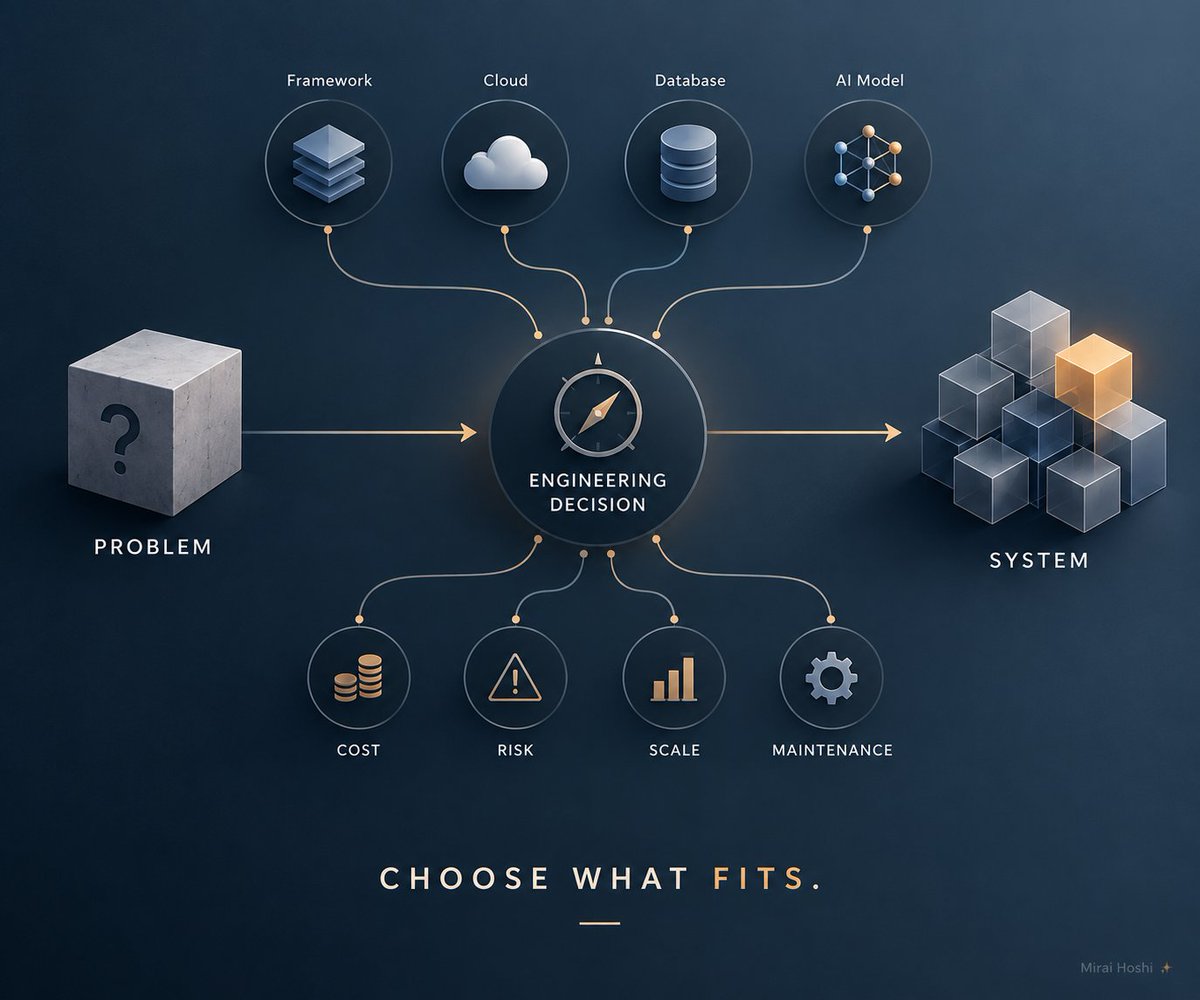
In technology projects, the hardest part is rarely choosing a tool. It’s understanding the decision behind it.
Before choosing a framework, cloud service, database, or AI model, ask:
* What problem are we actually solving?
* What are the trade-offs?
* What will this cost to operate and maintain?
* Where are the technical risks?
* Will it still make sense as the system grows?
Good engineering isn’t about choosing the most popular technology.
It’s about choosing what fits the problem, the constraints, and the system you need to build.
THE RHYTHM
The drums do not always carry the melody,
but they sustain its pulse.
They mark the time,
create tension,
open space
and drive the music forward.
There are forces that need not stand at the front
to transform what unfolds.
Sometimes what holds a work together
is precisely the thing that learned to give it rhythm.
@AlexFreitasAI Agreed, Alex. A 200 only confirms the request succeeded, not that you’ve reconciled the right transaction. I’d want a stable transaction reference and its authoritative state before allowing the retry.
𝗔𝗜 𝗔𝗚𝗘𝗡𝗧𝗦 𝗜𝗡 𝗣𝗥𝗢𝗗𝗨𝗖𝗧𝗜𝗢𝗡 | 𝗧𝗛𝗘 𝗗𝗢𝗨𝗕𝗟𝗘 𝗣𝗔𝗬𝗠𝗘𝗡𝗧 𝗥𝗜𝗦𝗞 ⚠️
An AI agent receives a supplier invoice, validates it against a PO, gets approval, and sends the update to the ERP.
Everything works...
until the ERP times out.
Now the agent faces a classic distributed systems problem:
Did the transaction fail, or was only the response lost?
If the agent retries blindly, you could end up with a duplicate payment.
That’s where real engineering starts.
Moving from a demo to a production-grade agent means designing beyond the happy path:
🔑 Idempotency Keys
Assign a unique key to each operation so retries don’t execute it twice.
🔄 Reconciliation
Check the actual state before deciding whether another write is safe.
🔎 Observability & State
Correlate agent intent with actual system state.
👤 Human Escalation (HITL)
Pause execution and route uncertain cases to a human when automated recovery is no longer safe.
A successful demo proves capability. Production resilience is what builds operational trust.
How are you handling timeouts and idempotency in your agent workflows?
@FReza1984 I wouldn’t treat them as interchangeable. Idempotency is my first line of defense for safe retries; reconciliation is how I resolve an uncertain outcome. For critical workflows, I design for both.