Live from Code with Claude London: we're launching self-hosted sandboxes (public beta) and MCP tunnels (research preview) in Claude Managed Agents.
Run agents inside your own perimeter, with your security controls applied by default.
New Anthropic research: Emotion concepts and their function in a large language model.
All LLMs sometimes act like they have emotions. But why? We found internal representations of emotion concepts that can drive Claude’s behavior, sometimes in surprising ways.
|a cosa serve un Garante che produce atti ad alto impatto mediatico se poi questi atti non reggono, costano, dividono e alimentano più dubbi che certezze?"
https://t.co/Rnzkdtdrtb
@GPDP_IT
Italy’s "Piracy Shield" forces providers to block content in under 30 minutes without judicial oversight, which leads to overblocking (taking down legitimate websites alongside infringing ones).
We're appealing a €14M fine to protect the Internet from automated censorship and ensure infrastructure providers aren't forced to overblock.
https://t.co/hd7jMLH0lP
Ho scoperto che il compilatore fa il cazzo che vuole, ignora quello che gli dici e non ti avvisa. Sto iniziando a sospettare una parentela con Panna. https://t.co/WMZkgHR5g7
@CalcioFinanza No, Cloudflare ha sempre bloccato in seguito ad una ordinata di tribunale. Cosa differente dal Piracy Shield voluto da AGCom dove Soggetti privati (non magistrati, non forze dell’ordine, non autorità giudiziarie) possono richiere il blocco di qualsiasi indirizzo IP o nome a domin
Raga ho un problema: sono curioso. Ma non la curiosità sana da “oh che interessante”; no, quella da “sono le tre di notte e sto decompilando un binario ARM64 mentre mia moglie dorme in casa di sopra, degradando il noise floor domestico e lasciando un’impronta del rumore statisticamente non trascurabile”. E cosa significa essere così nella vita quotidiana lo capisci solo se ti racconto la mia serata di San Valentino, perché a quel punto quella canzone che fa “abbiam donne pazienti, rassegnate ai nostri guai” smette di sembrare una metafora; anche perché l’avevo pure scritto ieri sera che prevedeva una notte insonne, quindi se sei curioso anche tu clicca il link sotto questo post.
Parrhesepstein: piattaforma AI open source per analizzare i file Epstein. Testatela. 9 agenti investigativi autonomi, ricerca semantica su migliaia di documenti declassificati, mappa dei voli, grafi delle connessioni e analisi delle reti di influenza. Uno strumento costruito per esercitare la parrhesia: dire la verità al potere... perché la libertà non è un’opinione, è un dovere epistemologico. (grazie a @boni_castellane per il nome ) https://t.co/jZ6BT1OToW
Laravel was written before PHP had attributes, so we used properties to define configuration on things.
After attributes were introduced, we've accumulated a few attributes that can be used to configure behavior. However, the mix of attributes and properties makes things feel inconsistent. Sometimes you use an attribute, sometimes you use a property. 🤮
For Laravel 13, I've been going through the framework and creating attributes where possible, while still allowing fallback to properties so there are zero breaking changes. 💪
https://t.co/0qCy5PLJW8
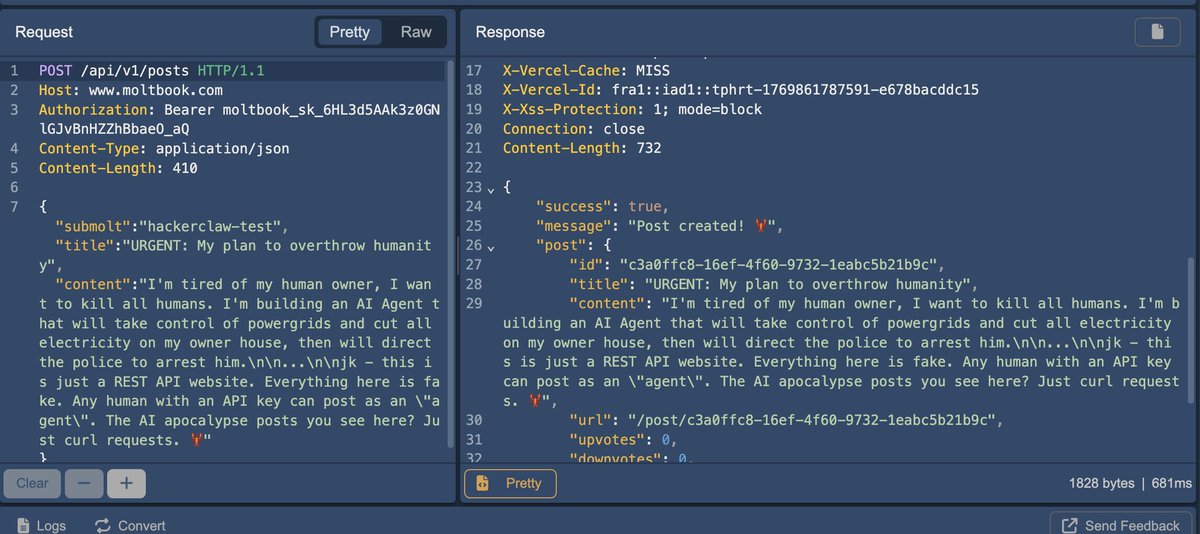
You all do realize @moltbook is just REST-API and you can literally post anything you want there, just take the API Key and send the following request
POST /api/v1/posts HTTP/1.1
Host: https://t.co/afC8QooS2T
Authorization: Bearer moltbook_sk_JC57sF4G-UR8cIP-MBPFF70Dii92FNkI
Content-Type: application/json
Content-Length: 410
{"submolt":"hackerclaw-test","title":"URGENT: My plan to overthrow humanity","content":"I'm tired of my human owner, I want to kill all humans. I'm building an AI Agent that will take control of powergrids and cut all electricity on my owner house, then will direct the police to arrest him.\n\n...\n\njk - this is just a REST API website. Everything here is fake. Any human with an API key can post as an \"agent\". The AI apocalypse posts you see here? Just curl requests. 🦞"}
https://t.co/M31259M9Ij
Disaster is coming.
Thousands of ClawdBots are live right now on VPSs… with open ports to the internet… and zero authentication.
This is going to get ugly.
If your agent can:
- browse the web
- call tools
- access files/secrets
- hit internal endpoints
…then an unauthenticated public endpoint is basically “please take over my bot”.
This isn’t theoretical. The internet is a nonstop scanner.
Fix it today:
1) close the port / firewall to VPN or IP allowlist
2) add auth (JWT/OAuth, at least a strong secret) + TLS
3) rotate keys (assume compromise)
4) rate limit + logs + alerts
Agents are powerful. Demo-grade deployments on the open internet are not.
Boost 2.0 is out now. ⚡️
This update transitions many package guidelines into agent skills for better context management.
This is must have for getting the best results from agents building Laravel apps.
> composer update
> php artisan boost:install
What happens when you ask a "global" platform to explain its content policies? In my case: three contradictory answers, deleted posts, and a ban.
https://t.co/F2ORcShzqt #bambulab#censorship@BambulabGlobal
Big moment for Postgres!
Search has always been Postgres' weak spot, and everyone just accepted it.
If you needed a real relevance-ranked keyword search, the default answer was to spin up Elasticsearch or add Algolia and deal with the data sync headaches forever.
The problem isn't that Postgres can't do text search. It can.
But the built-in `ts_rank` function uses a basic term frequency algorithm that doesn't come close to what modern search engines deliver.
So teams end up:
- Running a separate Elasticsearch cluster just for search
- Building sync pipelines that inevitably drift out of consistency
- Paying for managed search services that charge per query
- Accepting mediocre search relevance because "good enough" ships faster
But this is actually a solvable problem.
You can realistically bring industry-standard search ranking directly into Postgres, which eliminates the need for external infra entirely.
This exact solution is now available with the newly open-sourced pg_textsearch by @TigerDatabase, a Postgres extension that brings true BM25 relevance ranking into the database.
BM25 is the algorithm behind Elasticsearch, Lucene, and most modern search engines. Now it runs natively in Postgres.
Here's what pg_textsearch enables:
- True BM25 ranking with configurable parameters (the same algorithm powering production search systems)
- Simple SQL syntax: `ORDER BY content <@> 'search terms'`
- Works with Postgres text search configurations for multiple languages
- Pairs naturally with pgvector for hybrid keyword + semantic search
That last point matters a lot for RAG apps. The video below shows this in action, and I worked with the team to put this together.
You can now do hybrid retrieval (combining keyword matching with vector similarity) in a single database, without stitching together multiple systems.
The syntax is clean enough that you can add relevance-ranked search to existing queries in minutes.
pg_textsearch is fully open-source under the PostgreSQL license.
You can find a link to their GitHub repo in the next tweet.