1/ Real-time HDR reflections on automotive paint. Streaming to headsets, Android tablets, mobile phones, and desktop browsers. One 1.2GB source asset. No cloud GPU per viewer.
We built a WebXR configurator to stress-test the Miris platform on the hardest visual category in commerce. Here's what we learned.
1/ Real-time HDR reflections on automotive paint. Streaming to headsets, Android tablets, mobile phones, and desktop browsers. One 1.2GB source asset. No cloud GPU per viewer.
We built a WebXR configurator to stress-test the Miris platform on the hardest visual category in commerce. Here's what we learned.
One source asset. 72 configurable variations. No per-platform rebuild.
The same 1.2GB Blender file streams to headset, mobile phones and browsers. Adaptive streaming delivers as much fidelity as each device and network can support.
@earthtojake you should use @Miris_spatial to stream it to any device globally!
https://t.co/SyX7DBUVJO for examples — it’ll work on your phone over commodity 5G/wifi :)
Most "3D streaming" isn't streaming 3D. It's pixel streaming or a download in disguise.
Miris CPO Will McDonald explains why that breaks at scale and what Miris does instead on the latest episode of Dream Machines with @evanhelda#3Dstreaming#webdevelopment
5/ We built https://t.co/YsW6OqHjDo to show the difference on your device, your connection. Three approaches, three very different outcomes.
Worth a look → https://t.co/9WHqtQa6kv
4/ Streaming is a different model entirely. Miris sends the minimum data needed to render and delivers a first frame in under a second. The rest resolves while you're already navigating.
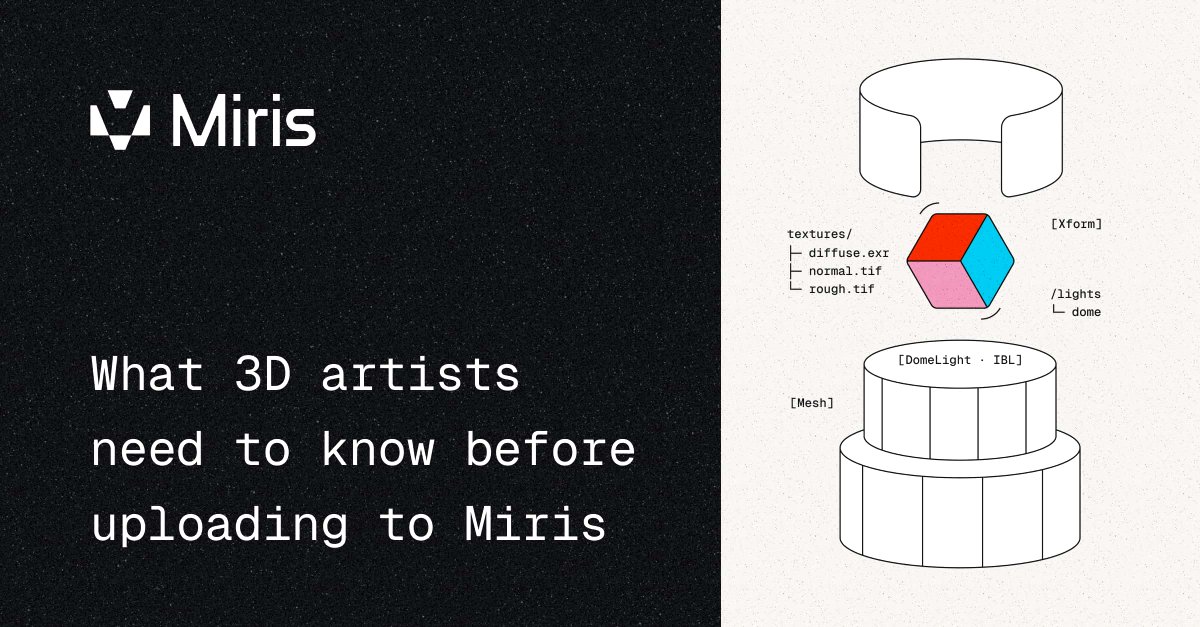
What do creators need to know before uploading to Miris?
1. Miris inputs OpenUSD natively.
2. Skip pre-optimization before uploading.
3. After uploading, review the lower-resolution preview to confirm materials and scale, then generate the streamable asset.
Read the full getting started guide here: https://t.co/3GdhEvLPDl
#3Dstreaming #openUSD #webdev #threejs
Miris streams 3D assets that deliver upwards of ~50-100x faster than Draco compressed (at Raw CAD fidelity) with sub-second load time to first view.
A 1GB source asset loads and becomes interactive as quickly as a simple 5MB glTF.
Want to experience Miris streaming for yourself? https://t.co/CYjY7HLEIx
Generation is step one. Step two is getting that content in front of users without melting your infrastructure.
Miris CPO Will McDonald covered exactly how we're solving that at #GTC26. Worth a watch.
Everyone's talking about generating 3D content with AI, but fewer people are talking about what happens next — delivering it in real time, at scale.
Miris CPO Will McDonald joined @CoreWeave at #GTC26 to dig into exactly that 👇
https://t.co/UytO6kXNqX
Did you miss the live session? Our Miris overview webinar is now available on demand.
In 30 minutes, you'll see how Miris streams production-quality 3D to the web with no compromise to speed, fidelity, or scale.
Watch it now → https://t.co/DsvkEJBi33
Traditional content delivery falls apart for real-time 3D
So we partnered with @cavrnus to demonstrate how adaptive spatial streaming helps teams build better collaborative 3D experiences at scale.
Read more: https://t.co/mjPeEfpcUX