The Mises Institute advances Austrian economics, freedom, & peace. Our bookstore supports this mission. Proceeds directly support our work on behalf of liberty!
To celebrate The Year of Rothbard, we're giving away some of his most radicalizing and influential books. Get your copy of our June offering, Keynes the Man, before June 30.
https://t.co/yJJfmnqnHo
New Release! The Influence and Significance of Human Action After 75 Years, edited by Joseph T. Salerno. If you have not read Human Action, let the scholars who contributed to this volume be your guide to its timeless importance. The contributions to this volume are a testament to the scope and importance of Human Action. They touch on money, uncertainty, business cycles, environmental policy, entrepreneurship, monopoly and competition, antitrust, economic calculation, and comparative economic systems. Combined, they show that Human Action is more than a book about economics broadly construed. It is a guide to civilized social life which elucidates the laws of reality that apply if human persons are to engage in peaceful and prosperous social cooperation. Order a copy here at the Mises Bookstore! https://t.co/1P4BkW8RDl
You can now get a free copy of Anatomy of the State for the next 100 days, as we continue to celebrate the Year of Rothbard!
Sign up here:
https://t.co/tptAHVG0Ye
This book helps explains why prices of everything has gone up, why there’s so many flock cameras, TikTok censorship, endless wars, and more.
I heavily recommend everyone to read this book!
“The greatest danger to the State is
independent intellectual criticism.”
—Murray N. Rothbard
To further celebrate the Year of Rothbard, we’re offering some of Murray's most influential books for 100 days—for free. Request additional copies—limit 5—to share with friends and family.
The first offering is Murray Rothbard’s Anatomy of the State. This is arguably the most radicalizing influence of all his books. It’s an easy read but cuts like a knife, dissecting myths about the state and exposing its inherent chaos and violence. Once you read it, you never think about the government the same way again.
We’re preparing for the release of Murray N. Rothbard: The Making of an Austrian Economist, an intellectual biography of Rothbard by Professors Joe Salerno and Patrick Newman, by giving away his most devastating critique of the state.
Rothbard starts by dispelling the idea that “we” are the government. This rhetorical diversion is used to convince the public that the state’s actions are merely an extension of the population’s wants and needs. But this is not the case, because if there were unanimity regarding an action, then state violence would not be necessary to carry it out. Even if a majority of the citizenry approves of expropriating a minority, it remains wrongful and involuntary expropriation.
The state, then, according to Rothbard, is “that organization in society which attempts to maintain a monopoly of the use of force and violence in a given territorial area; in particular, it is the only organization in society that obtains its revenue not by voluntary contribution or payment for services rendered but by coercion.”
The state flourishes via predation and expropriation. But no population would tolerate blatant and widespread theft. Thus, the state relies on intellectuals to persuade the public that the state’s crimes are not crimes and that the state not only is necessary but is a kind and benevolent institution. Rothbard notes that in modern times, these state intellectuals employ a scientific and technocratic mystique. Questioning the state means questioning the “experts”!
This is what led Rothbard to the conclusion quoted above: “The greatest danger to the State is independent intellectual criticism.” Liberty requires breaking free from the state’s propaganda. Reading Anatomy of the State has helped many people do just that.
Get your free copies today before May 25. And look for our next book offering on May 26
https://t.co/13FzTtopxS
In 1849, a French economist asked a question nobody had dared ask: if free markets produce better food, better clothing, and better housing—why not better security? Gustave de Molinari's answer changed everything. Free audiobook: https://t.co/lZgInXjbrb
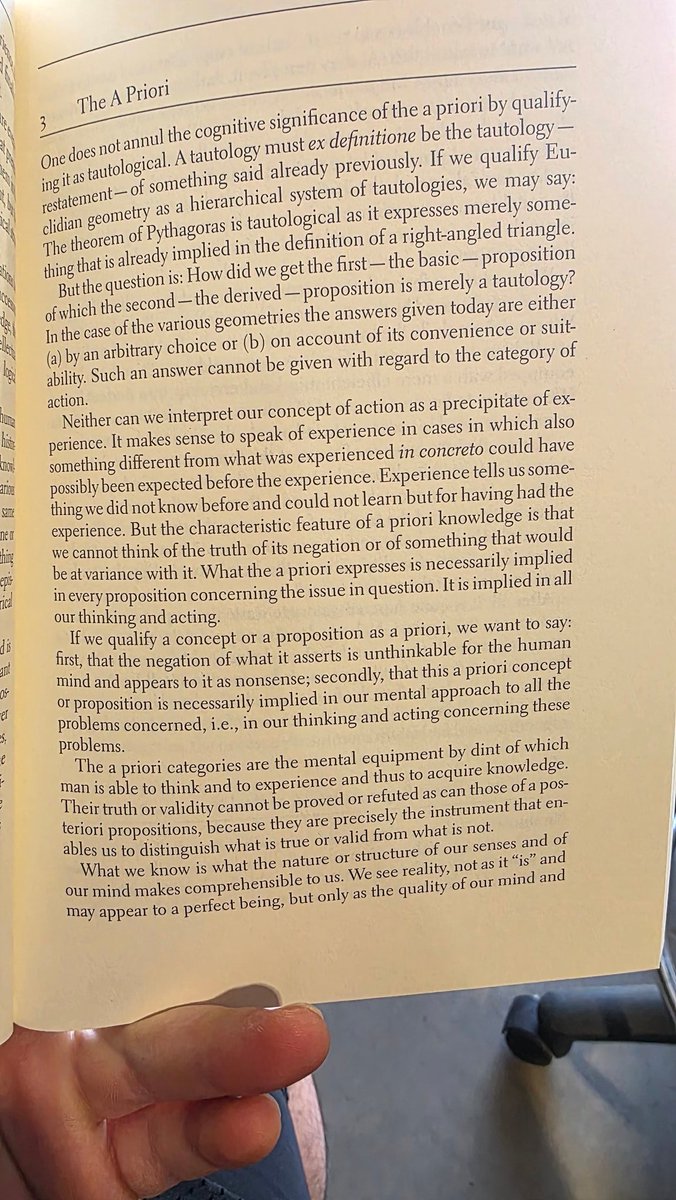
As his career was coming to a close, Mises saw that that fiercest battles over economic questions come down to issues of epistemology: how do we determine what is and what is not true in economics? How do we even know that economics is a valid science? What are the methods we should use in studying economics? What constitutes a true proposition and how do we know? In The Ultimate Foundation of Economic Science, he argues true economic propositions are grounded in the apriori. To learn more, grab a copy here at the Mises Bookstore: https://t.co/Ivvc0Toqsh
“The state of California today has more people than all of France during the revolution. New York, Texas, and Florida are not far behind. All of these states are controlled by unitary governments lacking provisions that temper democracy and protect minorities. Such a state of affairs would be unrecognizable to the Americans of the nineteenth century. By their standards, the US has become a country of mega-states, mass democracy, and enormous republics that Rousseau might have looked on with approval.”
@ryanmcmaken
If Mises has an unheralded masterpiece, The Ultimate Foundation of Economic Scienceis it. There are two senses in which this book is indeed ultimate: it deals with the very core of economics as a science, and it is the last book that he wrote. For that reason, it is a real milestone in the history of the Misesian oeuvre that this book is newly available in this beautiful new hardbound edition. Get it here at the Mises Bookstore!
https://t.co/Ivvc0Toqsh
One of the most popular books in the @MisesBookstore. Not just for the titular title, the entire collection is loaded with bangers.
https://t.co/RLIRPIYeoA
In these discouraging times, I URGE you to read Étienne de la Boétie’s “The Politics of Obedience: The Discourse of Voluntary Servitude”
“Resolve to serve no more, and you are at once freed. I do not ask that you place hands upon the tyrant to topple him over, but simply that you support him no longer; then you will behold him, like a great Colossus whose pedestal has been pulled away, fall of his own weight and break into pieces.”
free @mises link in first reply