The High Court today summarises the law of negligence in the sporting arena.
Significant weight is accorded to what a ref did at the time of the alleged incident (eg was it a foul?) but this is not determinative; non-fouls can still amount to negligence.
https://t.co/HyEzSLunzg
High Ct finds that a witness substantially exaggerated and was in contempt of court. The judge placed little weight on surveillance evidence because there might be a 'good days & bad days' explanation. But other evidence conclusive proved the dishonesty.
https://t.co/HA5gjNYtSs
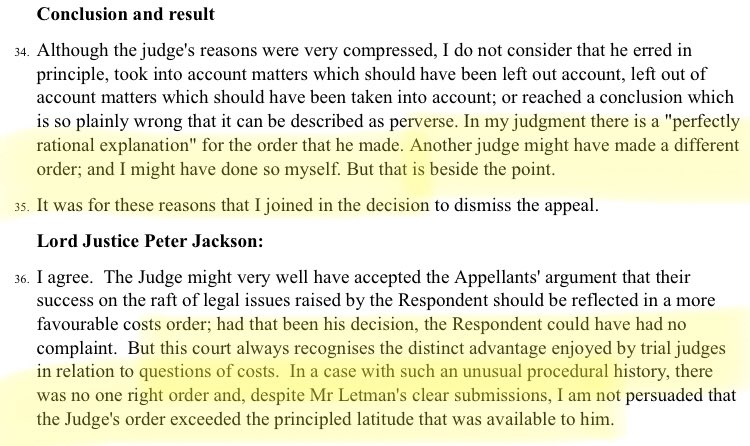
“This court always recognises the distinct advantage enjoyed by trial judges in relation to questions of costs.” So says the Court of Appeal in dismissing a costs appeal today. The lower court had not exceeded its “principled latitude”.
https://t.co/8M03KSouw3
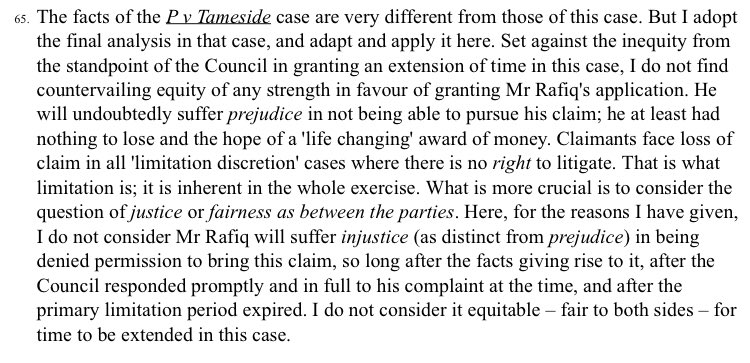
Very good to see a clear distinction here between ‘prejudice’ and ‘injustice’ when considering applications. The CPR doesn’t conflate them, and nor should parties: https://t.co/HVwyB0lhlJ
This is a convenient (though unusually multifaceted) summary of the principles which govern any application for an adjournment. As with much of the CPR, it boils down to ‘is it fair?’
https://t.co/XdXN25QiXD
Interesting ruling on fundamental dishonesty: even if proven, dishonesty must relate to the trial issues to result in an FD finding. High Ct states the issue starkly: https://t.co/2wep0S1fLP
Credibility on non-trial issues is not directly relevant to credibility on trial issues.
https://t.co/zoKDwcm8KT
An interesting case where the evidence of a more junior expert was preferred to that of a "highly experienced" professor. The latter's evidence was "too complex", "contorted", "contradictory".
Experts need clarity of expression, not just qualifications.
Court of Appeal finds that (1) an unsealed claim form cannot be validly served; and (2) that CPR 3.10 does not allow a court to rescue the claimant and dispense with the requirement for good service - it cannot be used to override other CPR rules.
https://t.co/gLuOZp4F2F
Another vicarious liability ruling: D's employee, who wrongly accessed personal information about C & disclosed it to another, was acting on a 'frolic of her own'; C's claim against D was dismissed.
https://t.co/2Lr4Q4PBMU
Morrison [2020] AC 989 continues to dominate VL rulings.
1. The expert’s duty did not extend to protecting C from the risk of an adverse credibility finding or a finding of dishonesty.
2. In any case, C could not use such litigation to mount a collateral attack upon the earlier court’s findings.
https://t.co/KuMBCyYcpC
/END
New case on extent of medicolegal expert’s duty: C lost a trial and received adverse findings on his credibility. An appeal against those findings failed. So he sued his expert for failing to take accurate notes/read the medical records properly. The High Court yesterday ruled:/1
New: confirmation from the High Court that the common law doctrine of mistake does apply to Part 36 offers "where a clear and obvious mistake has been made.. and this is appreciated by the offeree at the point of acceptance".
https://t.co/FmCkSg19Pj
New case on fundamental dishonesty:
https://t.co/F5GBJtKQxG.
Judge noted: (1) social media posts can be 'glossy' (=unreliable) images of a poster's life; (2) a failure to volunteer information not asked for during a medical assessment does not amount to dishonesty by omission.
This new Court of Appeal decision provides a full survey of the law relating to the duty of care owed by police to members of the public. It distils caselaw from 1978-2019 into 9 digestible principles.
https://t.co/B0B1RQpvmI
Court of Appeal considers interpretation of the OLA 1984 where the trespass is inadvertent: the court held that the principles in Tomlinson v Congleton [2004] 1 AC 46 are still directly applicable and the duty to trespassers remains circumscribed.
https://t.co/clcZOHmiFU
High Court stresses the "agony of the moment" accommodation to negligence principles:
the standard of care to be expected of someone acting in the agony of the moment is more forgiving than that of someone acting without pressure.
https://t.co/C3Y2HhUkEq
Confirmation that where D wants C to undergo medical tests (eg genetic) to challenge causation, the court's approach is: 1) whether interests of justice require the test; then 2) whether C has advanced a substantial reason why test should not be taken.
👇
https://t.co/P3qBrmkuo7
The Court of Appeal grapples with the Animals Act 1971 s.2(2)(b), described by another LJ as "oracular", "tortuous" and "opaque". It illustrates the careful limits that must be placed on strict liability so as to ensure fairness to those who keep animals.
https://t.co/FlwsVfM4Bb