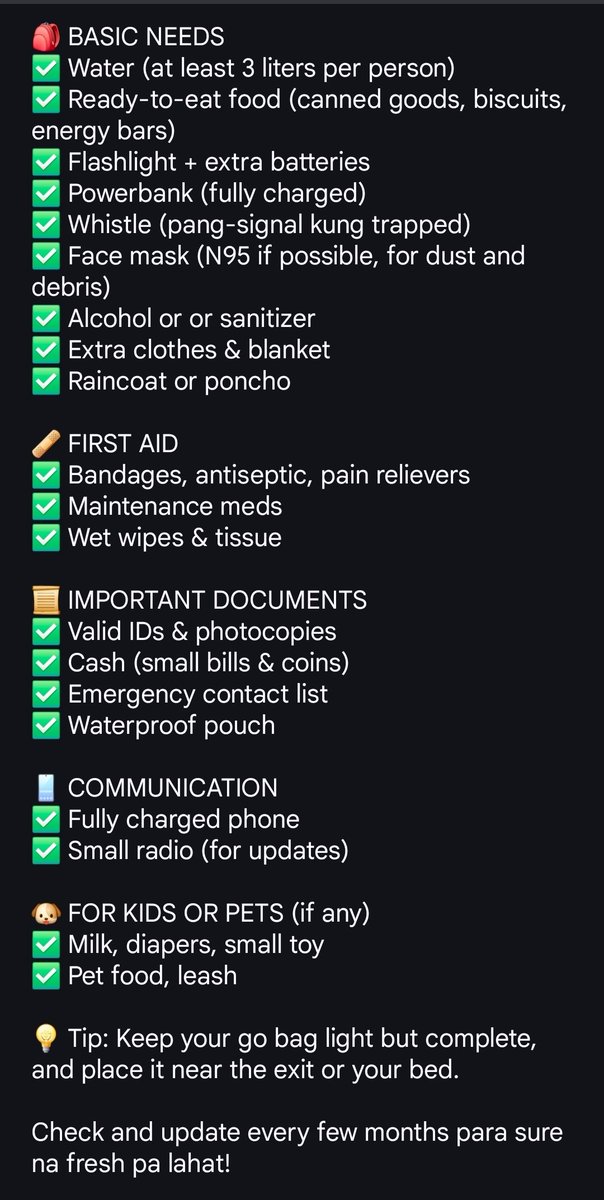
The Philippines has been shaking lately kaya mas mabuting handa
Here’s a quick list of what to pack in your Emergency Go Bag (ilagay sa backpack na madaling dalhin)
Let’s all stay safe and prepared. 🙏
#EarthquakeReady#GoBag
Caption and Photo from:
MIGUEL LUNA CUSI (FB)
Yung kitang kita mong nagulat si Atty. Quimbo Hahahhahhaha! Kase naman MARYOSEP! Panalong panalo si Sen tulfo sa kanyang statement hahahha! PALONG PALO ANG EMOTION! Sabay pikit nalang si Atty. Quimbo! 😂🤣😂 @highlight
Finally found the full footage from the Estrada impeachment proceeding when Senator Raul Roco reminding Senator Miriam Santiago of the quote by Dean George Malcolm himself about the business of law, which resulted in a fit from Sen. Santiago.
(c) GMA News
The Supreme Court reiterated that while lenders can acquire properties used as loan collateral, ownership cannot automatically transfer to them.
The SC explained that pactum commissorium occurs when (1) a property is used as collateral for a loan; and (2) the loan agreement includes a provision automatically transferring ownership of the collateral to the lender if the borrower fails to pay.
The SC emphasized that pactum commissorium is prohibited to protect borrowers from losing properties that may be worth more than their debt. Ownership can only be transferred through foreclosure and a public auction.
However, the SC clarified that this prohibition only applies to automatic transfers of ownership. Borrowers are free to voluntarily sell their collateral to lenders as repayment.
In this case, the realty corporation willingly entered into a separate agreement to sell its properties to the lenders as payment for the loan. The SC ruled that this was not an automatic transfer and, therefore, did not violate the prohibition against pactum commissorium.
The Decision is from the SC First Division, penned by Chief Justice Alexander G. Gesmundo.
Read the full text of the press release at:
https://t.co/EGHaSqh0PL
Read the full text of the Decision at:
https://t.co/oqNaJh7BRn
#SupremeCourtPH
Copying of this content is subject to the SC PIO’s Credit Attribution Policy: https://t.co/F48RF1vtzZ
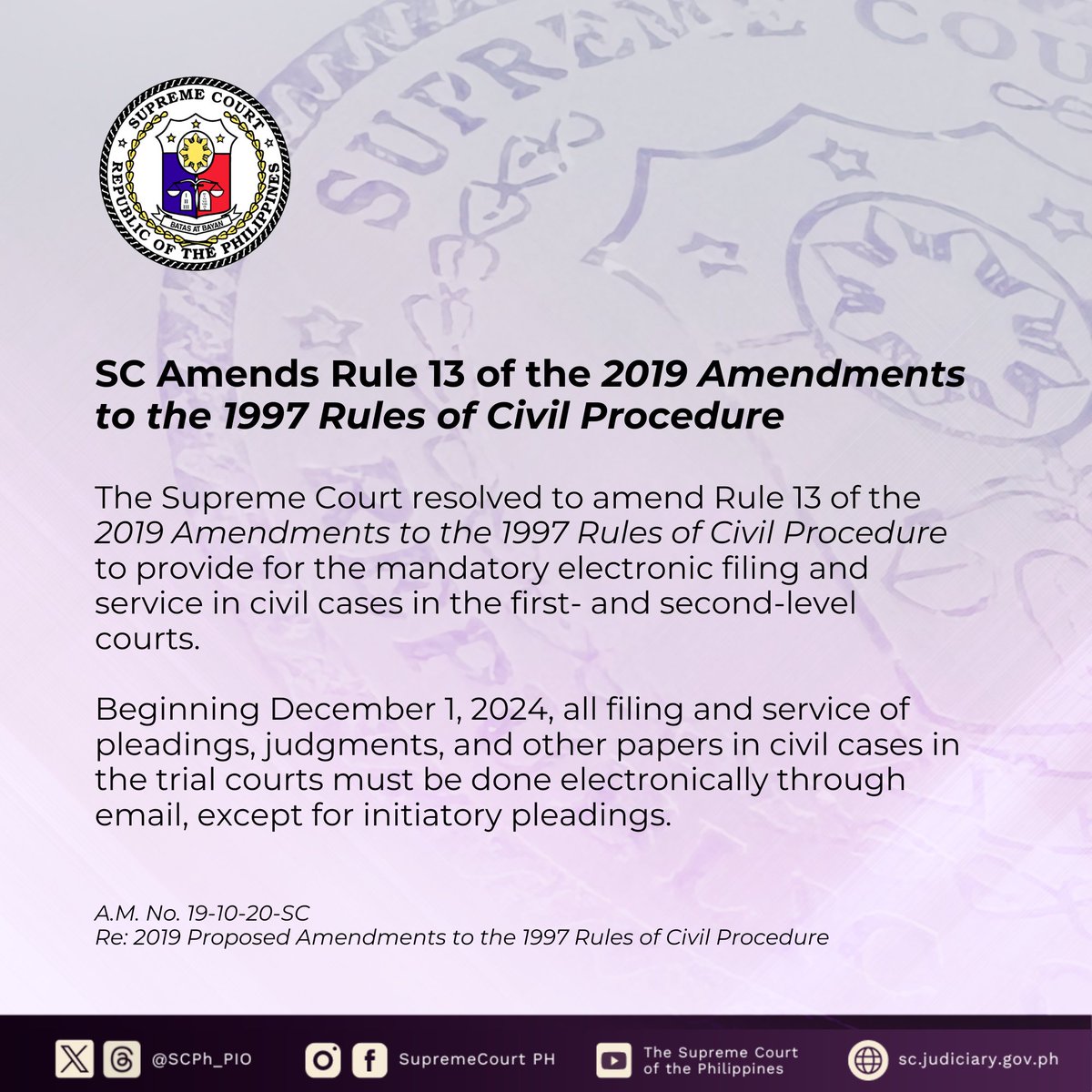
The Supreme Court resolved to amend Rule 13 of the 2019 Amendments to the 1997 Rules of Civil Procedure to provide for the mandatory electronic filing and service for civil cases in the first- and second-level courts.
The Court issued Rule 13-A or the Interim Rule on the Electronic Filing and Service of Pleadings, Judgments, and Other Papers in Civil Cases (Interim Rule).
This Interim Rule shall take effect on December 1, 2024, following its publication in the Official Gazette or in two newspapers of national circulation.
Beginning December 1, 2024, all filing and service of pleadings, judgments, and other papers in civil cases in the trial courts must be done electronically through email, except for initiatory pleadings.
Read the full press briefer at: https://t.co/12vwMDXeE5
#SupremeCourtPH
Copying of this content is subject to the SC PIO’s Credit Attribution Policy: https://t.co/F48RF1vtzZ
The Supreme Court has ruled that demotion, verbal abuse, and indifferent behavior by an employer that forces an employee to resign constitute constructive illegal dismissal.
Constructive dismissal happens when an employer creates such unbearable working conditions that the employee feels forced to resign.
The Supreme Court’s Second Division, in a Decision penned by Associate Justice Amy C. Lazaro-Javier, stressed that actions demonstrating extreme dislike and hostile behavior, such as demotion, uttering insulting words, and apathetic behavior toward an employee, constitute constructive illegal dismissal when such actions cause the employment conditions to be so unbearable that there is no other choice but to resign.
The Court held that the standard for constructive dismissal is whether a reasonable person in the employee’s position would have felt forced to give up their employment under the circumstances.
While the Court said that strong words may be exchanged in the workplace where there are bound to be disagreements, these should not degrade the dignity of employees to avoid a hostile work environment.
Read the full press release: https://t.co/st0Mmvx1GQ
Read the full text of the Decision: https://t.co/Y371zq6XvZ
#SupremeCourtPH