As engineering, product, design, DS, etc. melt into a new kind of role, I was reflecting on what roles might look like in the future. For example, when I look at the Claude Code team I see what I think is five archetypes:
1. Prototyper: comes up with brand new ideas; churns out many ideas, most of which don't ship
2. Builder: quickly turns a prototype/idea into production-grade product/infra
3. Sweeper: cleans up the UI, simplifies the code and system, unships, optimizes performance
4. Grower: takes a product that has been built and iterates on it to improve Product-Market Fit
5. Maintainer: owns a mature system to make it secure, reliable, fast, and efficient as it scales
Many people span across 2 roles, and sometimes 3 roles. I also notice that these roles are not really tied to job function -- eg. across Anthropic, some designers match category 1, some 2, some 3; same for engineers, PM, DS.
A healthy team needs a mix of these, depending on the product:
- A product that is new and pre-PMF needs people that are strong at 1+2+3
- A product that is growing and has found PMF needs 2+3+4 and some 5
- A product that has strong PMF needs 3+4+5 and some 2
Maybe product roles of the future will look more like this, and less like the domain-specific roles of today?
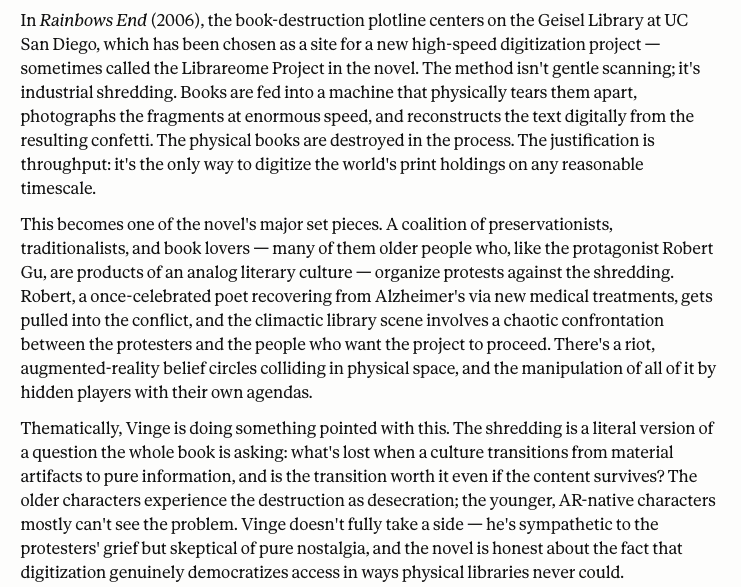
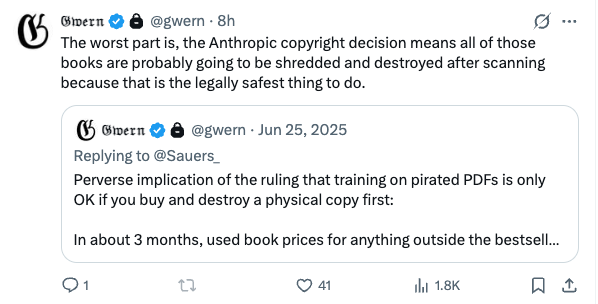
Anthropic is buying millions of rare books, scanning and destroying them because legally destruction is the safest option. This was a plot element in the Vernor Vinge novel, "The Rainbow's End", which I read 20 years ago.
This is a tool I created that gives you 4-10 expert Claude Codes for different sections of your codebase (auth, DB, API) with their own memory, tasks, and skills. They can:
> spawn a swarm of other Claude Codes,
> talk to each other
> manage parallel work
Open-source for anyone interested.
it's called OctoGent, a prototype I made out of curiosity about what an Agent Engineering dashboard might look like.
OctoGent is simply a thin agent orchestration dashboard running locally, and it's built AROUND Claude Code, not to hide it under abstraction.
with OctoGent you can have:
> specialized context and skills for multiple sections of your codebase. (I call them tentacles)
> a list of tasks for each tentacle, defined by you or Claude.
> a CLI for Claude Code to create other Claude Codes, prompt them, and check their work.
> you can control these children and see their work.
> all visible in a graph canvas, so you have a God-view of what's going on.
> Claude usage limits always visible so you don't get surprised.
> a token heatmap of your Claude usage, like GitHub's.
> a list of your past conversations with Claude Code that you can search through, or export to use elsewhere.
It is pretty straightforward:
spawn a new Claude Code under the database tentacle,
it reads all the memories and context it wrote down,
reads the to-do list,
and starts working on tasks,
Basically, the way you use Claude Code, just with more utilities.
This is still in early stages and experimental, so if you hit any issues, submit it on the repo. You can also fork it and change it however you want.
There are docs on how you can use Claude Code as a coordinator agent, how to make it use other agents, message them, how to work with its hooks, inject prompts into Claude, and use all the things it exposes.
Check it out: https://t.co/95pqACH57l
This is an INCREDIBLE post. Everyone working with AI needs to read IMMEDIATELY.
Becoming incredibly obvious that the most secure, best paying job in the next 1-3 years will be AI orchestrator - basically someone that coordinates AI agents to solve any problem a business has with EXTREMELY EFFICIENT token usage.
Whoever figures out how to squeeze 90%-95%+ Opus 4.6 performance, 90%+ of the time, at 1/10th the cost is going to make AN ABSOLUTE KILLING.
@boringmarketer@coreyganim I've got a 3 tiered memory system i've made for openclaw and I get great results. If it's just memory that's the sell i'm not sure i want to switch over. I have a huge database of knowledge about me currently i find invaluable.