This is one of the most important directions in AI and biology.
we spent billions of years waiting for evolution to discover useful molecular machines.
Now we're starting to engineer them ourselves.
Google DeepMind just introduced AlphaProtein Novo, a generative AI system designed to create completely new enzymes from scratch.🤯
And the results are wild.
The system designed a new-to-nature enzyme for synthesizing PIPERIDINE, an important building block in many pharmaceutical molecules.
The initial AI-designed enzyme had only ~0.1% yield.
But after computational redesign and two rounds of directed evolution, the researchers pushed the yield to >60%, including activity in 40% DMSO.👀
The enzyme also showed extraordinary selectivity, producing piperidine over pyrrolidine at up to a 99:1 ratio.
Then they used AlphaProtein Novo for something completely different:
DEHP, a persistent plastic-associated pollutant.
The AI designed enzymes capable of hydrolyzing DEHP into MEHP under conditions that are extremely harsh for natural enzymes.
One designed enzyme remained highly active at 90°C and in 75% acetonitrile.
THIS IS THE PART I FIND MOST EXCITING:
AlphaProtein Novo combines generative diffusion, catalytic-motif scaffolding, LigandMPNN sequence redesign and AlphaFold 3-based structural evaluation to search for entirely new protein architectures.
It doesn't mean AI can design any enzyme on demand yet.
But this could become a powerful new layer of chemistry, drug manufacturing, bioremediation and sustainable industrial processes.
paper:
https://t.co/YVnIb0Tdlf
Dr. @michiokaku, your work has long inspired me to keep asking bigger questions about the nature of reality. Some of the ideas I explore here are influenced by concepts you’ve discussed in your own work, which pushed me to think further about dark matter and the possibility of overlapping physical reality.
I’d genuinely love to hear your thoughts if it catches your interest. 🌌
https://t.co/gmgXjYX7TF
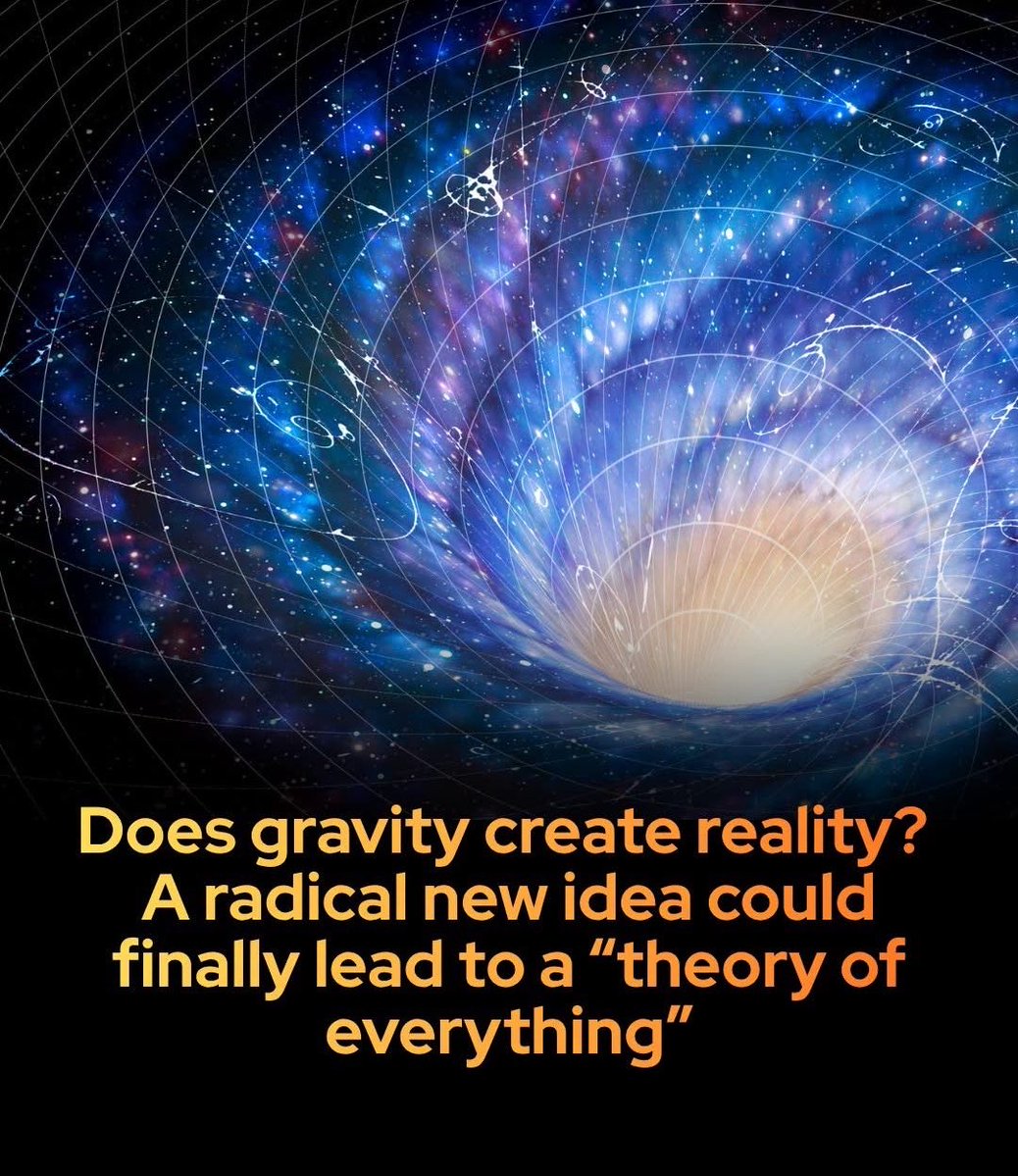
🚨 THE UNIVERSE MAY HAVE A HIDDEN LIMIT ON TIME ITSELF
For almost 100 years, physics has been trying to solve one of its biggest mysteries: how can Einstein’s gravity and quantum mechanics both describe the same universe when their rules seem so fundamentally different?
General relativity explains gravity, planets, stars and the structure of space and time on a massive scale. Quantum mechanics describes the strange behavior of particles at the smallest scales. Both theories work extraordinarily well in their own worlds—but when physicists try to make them fit together, something breaks.
Now, some researchers are exploring a very different idea. Instead of turning gravity into a quantum theory, what if quantum mechanics itself needs to be rewritten?
This approach, sometimes called a post-quantum theory, keeps spacetime fundamentally classical rather than treating it as something that must be divided into tiny quantum pieces. But the price of this idea could be astonishing.
According to the proposal, when gravity interacts with the quantum world, it may create an unavoidable form of randomness. And that randomness could mean something we normally take for granted is not perfectly stable: time itself.
At an extremely deep level, time could have tiny unpredictable fluctuations—almost like microscopic wobbles in the flow of reality. No clock, no matter how advanced, would ever be able to measure time with absolute perfection. There could be a fundamental limit built into nature itself.
If this is correct, the problem would no longer be simply about finding a better equation for gravity. It would force us to rethink what a clock actually measures, what spacetime really is, and whether the smooth passage of time we experience is only an approximation of something far stranger underneath.
And physicists are not leaving the idea on paper. Experiments involving incredibly precise clocks and even levitating microscopic diamonds are being developed to search for the tiny effects predicted by these theories.
If those experiments detect the predicted fluctuations, we could be looking at evidence that the universe does not behave exactly as smoothly and precisely as we once believed.
The most unsettling possibility is that the fuzziness may not be in our clocks at all.
It may be built into time itself.
Source: Savitsky, Z. (2026). “Does gravity create reality? A shocking path to a theory of everything.” New Scientist.
A tiny hanging light can turn an ordinary bookshelf into a cozy little scene straight out of an old story. Add a touch of vintage charm to your reading corner.
Shop now ➤ https://t.co/ivOD3dwgdp
How does time change which outcomes remain physically accessible?
I’ve started Between Theory and Creation to explore my Paradox Decay hypothesis, dark matter, AI, and the systems I build.
Bring your curiosity and your counterarguments.
https://t.co/k686LZCa3Q
Convince you to buy me a coffee? Easy. ☕️
I’ve been fighting pneumonia for the past month and I’m finally crawling back toward civilization. At this point, all I want is that first glorious sip of smooth, roasted coffee hitting my lips like a tiny caffeinated resurrection. 😭😂
Bonus mission: I also really want to try Javvy protein coffee while I’m getting back on track with my diet, because apparently I now need my coffee to multitask as hard as I do.
And just to be clear, I’m not an official promoter or affiliate for Javvy. I just saw it, thought it looked ridiculously interesting and tasty, and now I want to know what their protein coffee actually tastes like.
So… coffee for the recovering pneumonia zombie? 😇☕️💪 @drinkjavvy
@ConnorTalksAI@IndependentEco Same. I already put mine to work with my freelance jobs and confused my husband with a call from from him. 🤣. It's paying for itself.