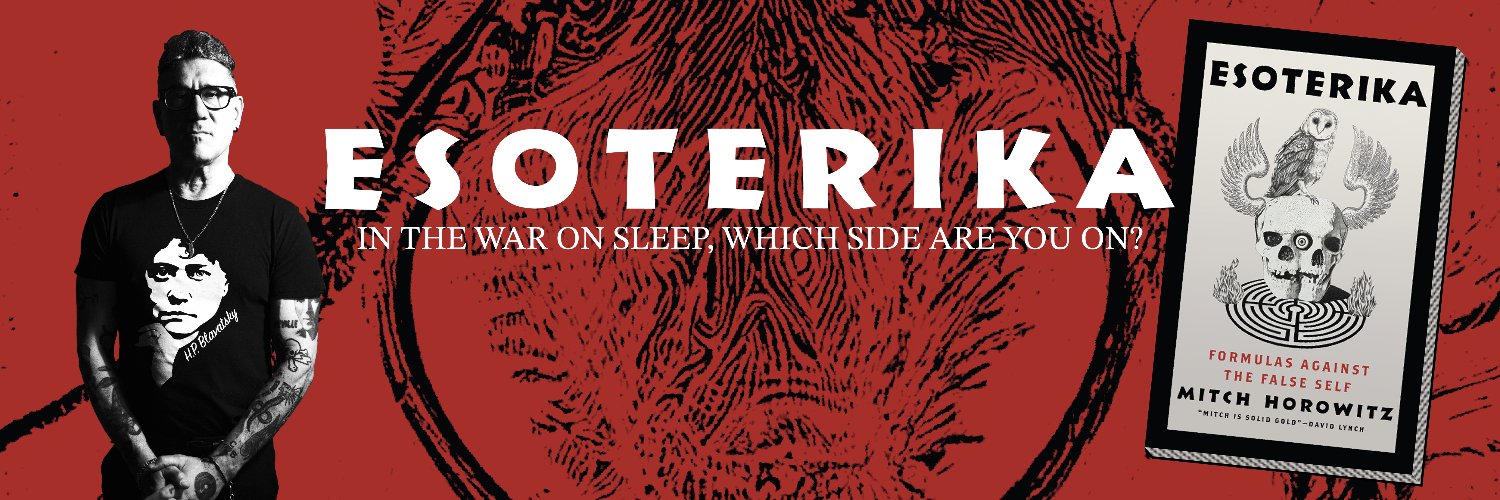
This story may be apocryphal, but it has vintage within the spiritual work brought by G.I. Gurdjieff (1866-1949).
When the teacher first visited the U.S. in 1924, a reporter asked: “Mr. Gurdjieff, what is your message for the people of America in one sentence?”
He replied: “Think."
There is a danger in this story. Everyone who reads it believes it is intended for someone else. Everyone who reads it believes it is political or social in implication.
Thinking means observing self. Everything starts with that function.
This effort—if applied—suggests the depth of the familiar Delphic maxim, “know thyself.” It further indicates the interior of the Hermetic dictum, “as above, so below.” And the esotericism of the Scriptural, “God created man in his own image.”
Familiarity obfuscates the interior and scale of these statements.
To stand against sleep is to think. It is among the only tools we possess. It is insufficient. But—it can remake a life. To think is to know remorse of self. It places you, if I may employ such vernacular, on the right side in the war on sleep.
It is war we will lose. But will be greater for waging.
Esoterika is out June 16 in print, digital, and audio. Your preorders matter: https://t.co/hutdtF4arE
Please join us for the launch event on Summer Solstice, Sunday, June 21, 7 p.m., at TV EYE in NYC. SPECIAL GUEST: fine artist John Newsom will be displaying his original cover art "Esoterika" (pencil, 60 x 44 inches) and will talk about its creation.
RSVP (free): https://t.co/6ce3Dg5H5E
With great warmth:
Portrait by Sante D'Orazio
Poster by @joshhyde666
Have you ever sat in a therapist’s office and been effectively diagnosed, or even pathologized, for speaking, say, of prayer, metaphysical meaning, extra-physicality, or a near-death experience?
I have.
Have you or your kids ever experienced a sociology or psychology college course where such experiences are demeaned as “magical thinking” or “confirmation bias?”
You do not need fixing.
What requires fixing—or at least questioning—is a social-science academic and clinical apparatus that often gets it wrong on matters touching upon the paranormal. Sometimes egregiously wrong—and muddied. Due to cultural prejudice—not clinical data.
This article uses the same scholarly tools and methods used by that apparatus to explain why the social sciences frequently miss the mark on the paramormal and anomalous.
https://t.co/7hWzeQRvTW
Friends, I am delighted to announce the launch of ESOTERIKA on SUMMER SOLSTICE @tveyenyc in Ridgewood, Queens, at 7 pm on Sunday, June 21—please join us for a live talk and signing.
SPECIAL GUEST: fine artist John Newsom will be displaying his original cover art "Esoterika" (pencil, 60 x 44 inches) and will talk about its creation.
Food, drinks, books, and more will be available. DJ following.
PLEASE RSVP (free): https://t.co/oKgfsTUebp
Portrait by Sante D'Orazio
Poster by @joshhyde666
@MitchHorowitz As a token of appreciation, the Swamp hereby grants Mr. Horowitz's wish. Welcome to our 4-part essay on FOLK MAGIC: What it is, how it differs from ceremonial magick, and the role both play in shaping our lives — for better and for worse. https://t.co/O4Ij6yyUBH
"I wrestle with writing pieces like this one, which reflect polarities of character. In pursuing this portrait, I attempt to follow the classical Buddhist path of the Middle Way, an easily misconstrued ethic. My admiration for Alice Bailey is continually curbed by the extravagance of her prejudices. This analysis, I believe, integrates not the fullest explication of Bailey’s philosophy but rather the wholeness of her person, which is philosophy’s proving ground."
https://t.co/3dlJ9LQo9Y
This piece is now free. https://t.co/QLDOjs11wp
___________
I have no macro solutions to our present crises. You will not find them in me or my work.
But I have intimate solutions for any who want them. They are more dangerous.
What I prescribe represents true rebellion to our coarse and mean era. The word mean in Middle English denotes inferior and small.
Do not tell me about your positions or your trophies of self. Pull the plug on the hate machine. If you cannot—if I cannot—I have nothing to offer another. I possess no self.
Here I propose three principles. If they appeal to you, act on them—and do not look back. Each will make you stand taller.
Try what I suggest for one hour. See what occurs. Is your life worth an hour?
The three are:
1. Get away from cruel people.
2. Greet trash with silence.
3. Do not humiliate people.
Is there such a thing as a wrong wish? A wish that causes suffering and sorrow rather than deliverance? A wish that will, in the long run, deplete and degrade rather than fulfill?
These are difficult subjects because they prompt conditioned prejudices—a rush to say yes—and a tendency toward recited and sometimes untested conviction.
And there is an added dimension of relational complexity. Is my wish another’s ruin? Is my joy another’s despair?
I do not necessarily see those prospects as polarized or symmetrical imperatives; but there exists possibility that for every “win” coexists a reciprocal “loss.” Or possibly a sacrifice. Maybe, in some cases, a willing one.
Even a wish for understanding or truth—if sincere—can remove you from the company of people who desire your closeness, but may harbor indifference or perplexity toward your search.
Hence, can there exist a non-violative wish?
These questions should deeply concern you. Because your wish may very well come true.
I warrant the existence of a “wish machine.”
That term appears in the 1972 Soviet-era science-fiction novel Roadside Picnic by brothers Arkady and Boris Strugatsky. Their work formed the basis for the endlessly haunting 1979 movie Stalker directed by Andrei Tarkovsky.
The pressures of living in a censorious, officially atheistic society drove these Russian artists—both the novel and movie are extraordinary—to reach some of our era’s finest insights on metaphysical causes and effects, cloaked in sci-fi allegory.
In one of the grand ironies of the modern age, art pursued under Soviet conditions evinced perhaps the deepest revelations about American-style metaphysics.
As a side lesson: do not fear pressure—under which these creators sometimes staggered. Its burdens, if not overwhelming or fled from, engender refinements of thought, insight, and output. Fear ease . . .
https://t.co/4CkdfDMEa7
I am delighed to report that the audiobook of ESOTERIKA (June 16)—which I narrate—is now up for preorder @audible_com et al.
The cover art by fine artist John Newsom is one of the honors of my career:
John Newsom
"Esoterika," 2026
Pencil on paper
60 x 44 inches
https://t.co/BnieLDrkHn
I approach the book less as a student of Evola than as one whose life and writing has long been influenced by Gurdjieff. Evola’s encounter with Philippe Lavastine prompted the following thoughts. @MitchHorowitz
https://t.co/wHveYAuCFs
“The problem with New Age books,” my teacher once told me, “is that they actually make the work seem possible.”
Our mechanicality frustrates every effort at personal philosophy and awareness.
I do not run from that hard truth.
And yet—necessity beckons.
This book is a philosophy of necessity. It will get you from point A to point B—with greater happiness, agency, and honor. In short, it works.
But—it works within the current of a descending spiral.
We all oppose war. That is universal. But war is omnipresent. That is universal.
We, as individuals and a human community, are in decline. Call it sleep, call it Kali Yuga, call it planetary conditions. Humanity is mechanized and destructive, possessed of lesser and lesser personal agency. This is true on both intimate and macro scales.
But we must row even within that current. Esoterika is an oar.
It meets you and me where we live—in our weakness but also our legitimate needs. If esoteric and occult philosophy have practical assistance to share, let it be now. The hour is late.
Esoterika is out June 16 in print, digital, and audio. Your preorders matter.
**AUDIOBOOK LINK IS LIVE**
With great warmth:
Cover art by John Newsom
Portrait by Sante D'Orazio
Poster by @joshhyde666
https://t.co/rGh86qhXZo
“The line of books by science communication experts nominally aims to demystify contested topics, from vaccines to ghosts, beginning with a title on astrology by science journalist Carlos Orsi, released last week.” Science is methodical replication—not ideology. Rationalism is a process, not a conclusion. There is nothing scholarly about this wide net, broadly polemical tone advertised by @ColumbiaUP in Publishers Weekly. The effect—contempt for query—will prove the opposite of intent. See my article Question Authorities for how the social sciences mishandle the paranormal: https://t.co/7lAIXxJz0Z
Money is our most constant, empirical, and deeply felt human exchange.
Money and its uses amount to faith, trust, credit—and truth or lie. They are your word.
As such, money is not distinct from the spiritual and ethical search. It is the search. It is, emotionally and authentically, who you are.
Not because money is all-important—but because it is universal and constant. It permits no hiding—from self or other.
I call for a yoga of money, which honors currency’s centrality to human relationships.
I call for this unity (yoga) in a manner that re-sacralizes—not totalizes—money’s influence.
A yoga of money recognizes currency as relationship. This requires ethics, terms, and principles—as does any human polity.
Will practicing a yoga of money attract greater money to you? Maybe. The need for procurement is entirely real and deeply felt—I neither ignore it nor render it exclusive.
These thirteen principles frame the yoga of which I speak.
https://t.co/5wKLD15nPg