The Ribbit Rebel Grid
Ribbit Capital recently published a video series for the first time ever on their re-branded X account. It shows how a bunch of Rebels are tokenizing money, knowledge and power for machines to read, exchange and act on shared rails.
What is this?
Why do we need this?
When did this start?
<< Fast-forward back <<
| 20 June 2024 |
At the Endeavor Investor Meeting in San Francisco California, Allen Taylor and Micky Malka were talking about the future of fintech - and why money without context doesn't work:
"Fintech, as we’ve known it for the past decade, is dead. The conditions that enabled its initial success - like building new apps or leveraging unstructured data - are no longer competitive advantages. The last decade was about giving people access to money. The next decade is about contextual money - tailoring financial services to individual needs using data, AI, and personalized interfaces. It’s an era of rebuilding infrastructure to support this shift."
https://t.co/i00NzwNrNY
| 01 August 2024 |
Morpho announced that it secured $50M in Funding, led by Ribbit Capital.
“We need to bridge the gap for DeFi and make the actual integration into the fintech world, and Ribbit was an obvious partner for that. Already there are incredible synergies in what we could achieve together for potential integrations in the real world, and not just like crypto leverage use case, which is, frankly, most of the use case of DeFi lending right now.”
Paul Frambot, Co-Founder
https://t.co/eFVukvfalL
"As more assets are tokenized, one of the big beneficiaries will be DeFi ecosystems that enable token swapping, lending, borrowing, insurance, and more. Morpho gives people and agents safe ways to navigate the wild world of programmable money."
Token Letter
| 10 December 2024 |
Micky was asked to describe his concept about the global digital grid in a podcast hosted by Patrick O'Shaughnessy – 'Building Ribbit':
“The grid is our version of the Matrix - of that interconnectivity of different aspects that make us who we are and how we transact and live in this world. It means that knowledge, money and power are interconnected in ways that allows you to create use cases that we've never seen. AI agents are going to need access to money. AI agents are going to need access to the crypto rails to do that."
Patrick also asks Micky where his personal dreams come from:
"This concept of better money to improve people's lives. It means it's easier to access, it's easier to save, it's easier to get a loan, it's easier to do aspects with it that you couldn't do before, so you can build your vision and your life. So the metrics I care the most at Ribbit is the number of people that we touch every year in trying to make their lives better. Right now it is 900 million but I would like that number to be a couple of billions."
https://t.co/xBw3lSgPvy
| 21 January 2025 |
TON becomes the exclusive blockchain for Telegram to support its global user base - which significantly exceeds 1 billion monthly active users - by providing the foundational infrastructure for essential financial applications.
https://t.co/gO4EaDzhMG
| 20 March 2025 |
TON Foundation discloses leading VCs invest over $400M in Toncoin with participation from Ribbit Capital.
"Ribbit partners with exceptional teams tackling and solving the world’s biggest problems. TON and Telegram exemplify this, working together to expand financial access globally by coupling the best technology with a seamless consumer experience.”
Micky Malka
https://t.co/dXs9iYThPn
Subsequently Ribbit made three further investments into the TON ecosystem in 2025.
https://t.co/L45EDMT3XZ
| 04 April 2025 |
Ribbit Capital is leading the Series A for SafetyKit.
https://t.co/1mJBU1ZIT6
"SafetyKit is automating risk detection and policy enforcement for marketplaces and networks through a Vertical Token System that trains, orchestrates, and enables compliance agents."
Token Letter
| 30 April 2025 |
Persona raises $200M co-led by Ribbit Capital to build the verified identity layer for an agentic AI world.
https://t.co/KRqX0iIAMF
"Identity has become the foundation of every digital interaction, and in the age of AI, we believe solving identity will be more pivotal than ever. We've long admired Persona's ambition to build a verified identity platform and have been impressed by the diversity of industries, use cases, and geographies of their customers. Their rapid growth and adoption by leaders like OpenAI, LinkedIn, Etsy, Twilio, and Block are clear validation that they're solving real problems at scale."
Nick Shalek, Partner at Ribbit Capital
"Persona’s Reusable Personas (RPs) product helps users store identity tokens across devices and services; when an agent needs to make sure an RP user is a real or specific human, Persona will have an unfair advantage in providing that token."
Token Letter
| 23 June 2025 |
Just one year after emerging from stealth, Decagon has raised a $131M series C at a $1.5B with new investors including Ribbit Capital.
https://t.co/9ABUBsMTVI
“Customer agents will become the collectors and curators of the most important data in the enterprise. Businesses will live or die based on how well they can implement personalization. Platforms like Decagon are offering the infrastructure enable this.”
Token Letter
"Today, it's support. Tomorrow, every customer will have an agent that knows their preferences by heart and can get help seamlessly 24/7."
Jesse Zhang, Co-founder
https://t.co/3ECM2eV60p
| 10 September 2025 |
PsiQuantum raises $1 Billion to build fault-tolerant Quantum Computers and announces collaboration with NVIDIA. New investors include Ribbit Capital.
https://t.co/DlDtuE0LaT
| 23 October 2025 |
Crusoe raises $1.375 billion to power the future of AI infrastructure. New investors include Ribbit Capital.
https://t.co/WCxLWqHIFp
"We consider founders from Crusoe and PsiQuantum as the leaders in AI data center orchestration and quantum computing, respectively. Internally, we have been calling this broader set of companies “Real World Token Factories” – businesses that leverage and are levered to the growth of digital intelligence, but where the complexity of coordinating atoms and bits creates real moats."
Token Letter
| 30 October 2025 |
Jessi Brooks from Ribbit Capital published the paper 'Trust Without Intermediaries: A Programmable Risk Management Framework for the Future'.
https://t.co/7XlmjYiFOA
"As traditional and decentralized financial markets converge, the need for a trust architecture that preserves openness while ensuring security is paramount. This paper introduces a framework for programmable risk management that embeds security, oversight, and compliance directly into different parts of decentralized finance protocols."
The paper is not only showing why risk management matters, but how it can be embedded natively in tokens, wallets, and smart contracts. It also highlights the importance of identity without intermediaries and AI Agent safeguards to address agentic trading risks.
It's also worth to take note that SafetyKit is directly referenced in the paper while Sigal Mandelker, who was reviewing the paper and providing valuable input, is also sitting in their advisory board.
https://t.co/4k8tMKFq2y
The conclusion - from theory to practice:
"The next phase must focus on implementation: pilot programs, shared standards, and regulatory engagement. Builders, institutions, and policymakers should collaborate to design risk-based, privacy-preserving standards for identity, data exchange, and on-chain scoring that preserve decentralization and neutrality. "
| 16 December 2025 |
Token factories... explained by some of the rebels shipping them.
"Together, they're building the foundation of our tokenized future, one where energy powers intelligence, data becomes context, value flows freely and identity endures to protect both humans and agents. To make that tokenized future a reality, each of these companies provides an essential piece of that economy."
Now let's see how we can interpret and structure these essential pieces.
The Open Platform -> Distribution
"Blockchain is just a technology that helps us tokenize information, identity and digital assets. Telegram is that sort of rails to distribute that technology. We bring ownership back in the form of tokens, so I think it's very important to understand how tokens are connected with people."
Decagon -> AI Agents
"We are the conversational Frontend for large brands. As soon as we start working with our customers, it only matters how quickly and how efficiently can you download all their context into the AI agent."
Morpho -> Money
"We are leveraging all the tokens to prove the trustworthiness of individuals to provide them an interest rate at which they will be able to borrow money tokens. In a world where everything is tokenized, the more tokens we have, the more we can fluidify trust."
Persona -> Identity
"Our goal is to make sure that that link between the agent and the people behind it is stronger than ever. Your identity is the root token for every other token out there. Our long-term vision was that there could be this kind of universal identity network for any sort of use case out there."
SafetyKit -> Trust
"As SafetyKit becomes a larger token factory, it can build a network of essentially every pair of businesses that transact with each other. SafetyKit in 10 years will sit underneath essentially every commercial transaction and provide that trust layer for every single node in the network."
PsiQuantum -> Knowledge
"The Quantum Computer is the fountain of knowledge, spitting out a categorically different kind of token that you can't get out through any other mechanism."
Crusoe -> Power
"Our role is to make intelligence more accessible. This ranges from actually building the infrastructure to creating further layers of abstraction that turn that infrastructure into something useful, something of value, a token, a unit of intelligence. In 10 years, I imagine Crusoe being the operating system for the intelligent economy."
| How can the users benefit from the tokenized grid? |
> Every user/business is gaining access to Decagon's enterprise-grade AI agents through Telegram
> Every AI agent can act on behalf of a user through Persona identity tokens (KYA)
> Every AI agent is getting access to better money through Morpho
> Every AI agent is getting access to expertise knowledge through PsiQuantum computers
> Every transaction is protected through SafetyKit agents
> Every agentic interaction is powered by Crusoe's AI factory
| How can the token factories benefit from the grid? |
> The Open Platform can attract more users and businesses by offering better personalization
> Decagon can gain access to more users while optimizing their AI models
> Morpho can gain more market share while optimizing interest rates
> Persona can increase their business through a universal identity-network
> SafetyKit can become a larger token factory by securing and managing more transactions
> PsiQuantum can accumulate more money and power to provide more expertise
> Crusoe can increase their business by enhancing AI capabilities and making intelligence more accessible
| How can the grid grow? |
By connecting themself to the tokenized grid, Rebels are able to grow their business while improving their own capabilities rather than operating in silos.
Instead of looking at each token factory as an irreplaceable building block for the grid I rather prefer to think of it as a "minimum viable grid" within a layered architecture. Recalling the paper "Trust without intermediaries", a standardized framework would allow each layer to be complemented by even more participants.
Below you can see a selection of potential candidates based on Ribbit Rebels and other competitors:
Distribution (Application) Layer
> Financial Apps: NuBank, Coinbase, Robinhood, Revolut, OnePay, Klarna, PayPal
> Social Apps: WhatsApp, TikTok, WeChat, X
> Commerce Apps: Amazon, Flipkart, Walmart
> Tech Platforms: Google, Microsoft, Apple, OpenAI
AI (Agent) Layer
> Web3: Base, Virtuals Protocol, FetchAI, Bittensor
> Payroll/workforce/ERP: Tako, Deel, Campfire
> Accounting: Multiplier Holdings
> Wealth management: Nevis
> Insurance: Justos
> Mathematical superintelligence: Harmonic
> Voice agents: Sesame AI
> Robotics: OpenMind
> Coding agents: Devin, Cursor
> Support agents: Salient, Scale, Gretel
> Self-driving cars: Waymo
> Mortgage lender: Tomo
Money (DeFi) Layer
> Blockchains: Bitcoin, Ethereum (+Base), Tempo, Solana
> Cross-chain Bridges: Wormhole, LayerZero
> Stablecoin Infrastructure: Crossmint, Bridge, M0
> DEX: Lighter, Hyperliquid, Uniswap
> Bitcoin ZK rollup: Alpen Labs
> Liquid Staking/MEV: Jito
Identity Layer
> Agent companies: Cognition, Cursor, Replit, OpenAI
> Human Identity Providers: IDme, CLEAR, Plaid
> Security Infrastructure: Evervault, Footprint, Privy
> HRIS Platforms: Workday, Rippling, Deel
> IAM Leaders: Okta, CyberArk, Microsoft Entra
Trust Layer
> Blockchain Security: Kroll, Blockaid, Chainalysis
> Web3 Compliance: Bluprynt
Power (Physical) Layer
> Renewable Energy Supplier: FUSE Energy
> Residential battery leasing: Base Power
The invisible Layer
"To make autonomous agents real counterparties, we will need systems for agent governance, identity, and reputation. Autonomy comes with obvious risks, so it will be critical to understand what agents can and are allowed to do, as well as how that authority is managed. Reputation will also be key. Agents will (like people) not act in perfectly deterministic ways, so we’ll need objective metrics to track like task success rates, fulfillment histories, or peer endorsements. And provenance will matter – like who trained the agent, who signed its permissions, and what data it was built on – all of which can be cryptographically-attested. Building these systems may turn out to be one of the most important applications of blockchains; smart contracts give us transparent ways to build tamper-proof reputation signals and encode agents’ scope, permissions, provenance, and upgrade logic (i.e. who can modify them). The importance of all this becomes abundantly clear when you think about physical robots. As robots become more capable – and we grant them additional autonomy to learn and execute more tasks – transparency in their programming and governance will be critical to customers, businesses, and governments. Nobody should want an unpredictable robot!"
Token Letter
"It’s going to be invisible for the user, it's infrastructure, it’s not consumer facing – yet. But you will see it in ways that it may look to you as personalization."
https://t.co/2kLNSSKR7e
"One lesser-known agent has taken a particular interest in fintech and frogs (make of that what you will)."
This might be the most important deep dive I’ve ever published.
One of the most powerful venture capitalists in the world.
A stealth crypto launch.
On-chain breadcrumbs hiding in plain sight.
If you care about the future of finance, watch this 👇
@JarFriends@Polish_Buddy@veefriends Lol🤣 How is not seeing eye to eye on value or trying to not lose on a deal, not being fair at all ?
Were you not being fair at all then when you offered me less than 2 eth in cheap vf1 en vf2's for my gold gorilla+0.78 eth?
Thank you Emmy for showering me with 20 Diamonds and getting me to shamelessly tweet this out. If you've collected Ethereum NFTs, all the way back to 2017, head to https://t.co/LLlHKdIiGM to claim your taste of Diamonds on the best cross-chain rewards program.
Thank you Emmy for showering me with 6,000 Diamonds and getting me to shamelessly tweet this out. If you've collected Ethereum NFTs, all the way back to 2017, head to https://t.co/LLlHKdIiGM to claim your taste of Diamonds on the best cross-chain rewards program.
KIP Explainer Series: #1
Why is KIP the Web3 Base Layer for AI?
First off: KIP is not a single AI app, nor a large language model, nor a database / knowledge base.
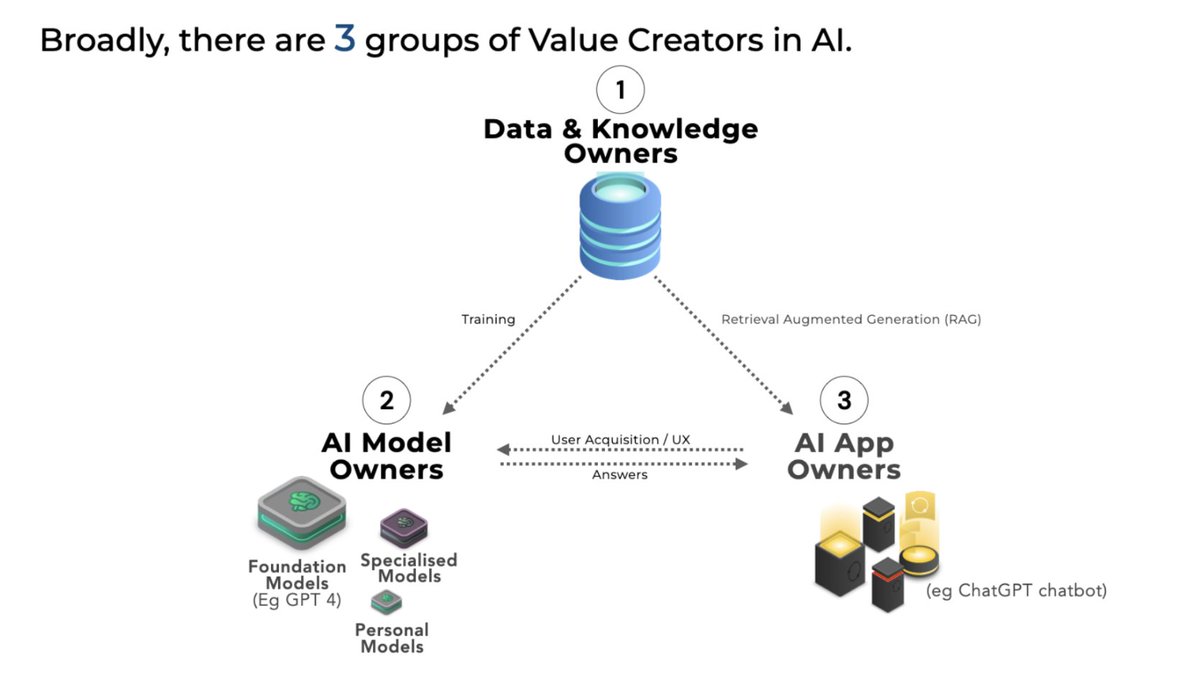
KIP is a decentralized protocol that AI app owners 📱, model owners🤖 and knowledge base / data owners📚 will find essential to decentralise their work & monetise in Web3.
(For brevity, we call these 3 categories 📱, 🤖, 📚 : AI Value Creators)
Decentralisation of AI is an extremely large & important topic, and there are multiple groundbreaking projects taking different approaches at the problem.
For us at KIP, we are focused on solving the base level problems that AI Value Creators will face when trying to deploy and monetise their work in Web3.
AI MODELS 🤖 NEED APPS 📱& DATA 📚 TO CREATE ECONOMIC VALUE
While there are easily 20 over categories of companies creating solutions in AI, most of the attention in Generative AI over the past year has been on the AI Models (and there is a huge variety of different categories and approaches here from transformers to GANs to diffusion models to name a few).
Indeed, these models represent the true breakthrough of this new era of computing—the true Brains behind it all.
But to build a business ecosystem within AI, models need to rely on at least 2 other essential Value Creators.
1) AI Apps📱: 'The Face of AI'
It's easy to overlook the importance of apps amidst all the excitement over models.
AI Apps are essential for getting users into AI. Apps can take many forms, like chatbots, image generators, search bots, analysis bots or in its most elegant form, simply prompts.
They craft the user experience, acquire the users, and perhaps most importantly, collect the fees from the users.
Many forget that ChatGPT is OpenAI’s app, powered by OpenAI’s various models (GPT 3.5, GPT 4). The then ground-breaking human-like responses of the OpenAI chatbot were largely coded on the app-end, not the model end. (Connecting to the models directly via API, and comparing the answers, will tell you this.)
TLDR: without Apps, models would just be sets of code and weights sitting in a metal box somewhere with no way to utilise them.
2) Data📚: 'The Lifeblood of AI'
Data is needed for:
a) Training & Fine Tuning Models, &
b) Retrieval-Augmented Generation (RAG)
All models are trained and fine-tuned on data. Without fine-tuning, models don't get stronger or smarter.
But by using data to finetune or train models, it causes the data essentially to be 'assimilated' or 'absorbed' into the models, manifested in the adjustment of the model weights.
So in situations where it is impossible, impractical, or illegal to just use data to directly train the models, the innovative technique called Retrieval-Augmented Generation (RAG) steps up to deliver.
RAG combines the power of retrieving information from external databases with the capability of generating responses via an AI Model. It's like having a super-smart assistant who understands your questions but also knows where to find the answers even if it doesn't know the answer itself.
While RAG is still relatively new, it’s our firm belief that given increased sensitivity and protectionism over data, RAG techniques could emerge as a leading approach, driving significant business value through real-world applications, and making it a dominant framework under which most people access AI in the future.
TLDR: Regardless of which approach, continued AI innovation is simply not possible without data.
A VIBRANT AI ECOSYSTEM REQUIRES MULTIPLE INDEPENDENT INDUSTRIES OF VALUE CREATORS
Individuals and companies skilled at training and finetuning models, may not be the same people who are great at designing and marketing customer-facing apps.
Similarly the researchers and domain experts with valuable data sets and knowledge bases, may not have the right skill sets to train AI models or design applications.
But in a vibrant and diverse ecosystem, they don’t have to . Seperate industries of companies and individuals can work together to create use cases and economic value for users.
An app designer can choose the AI model most suitable for his product plans, and pre-select the external knowledge bases most helpful for his users.
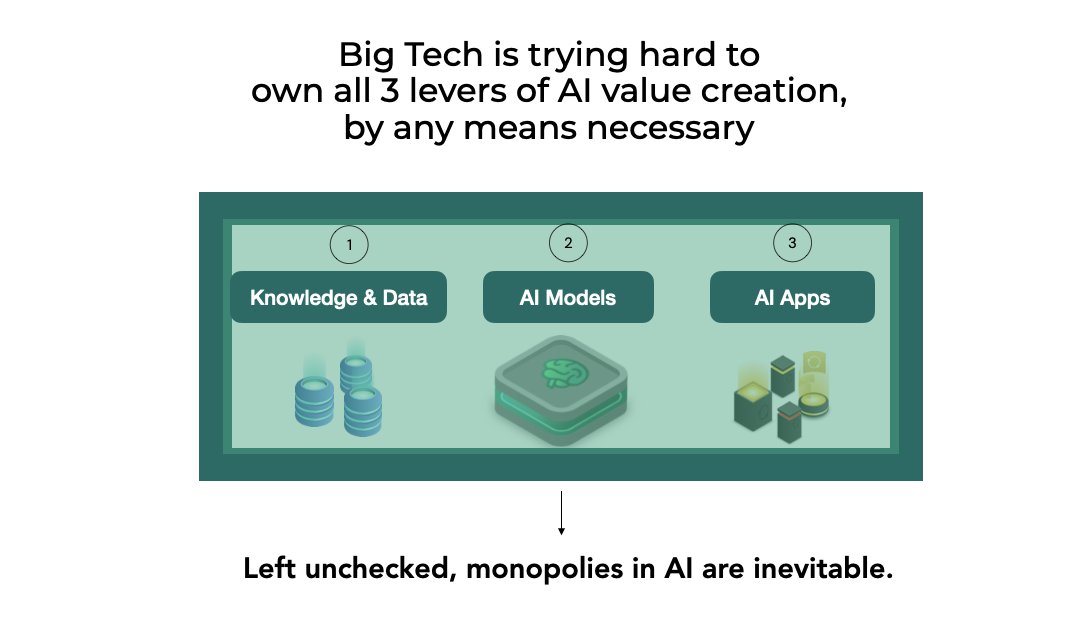
But what if all 3 potentially vibrant and independent industries are being slowly absorbed into one closed ecosystem?
Because that’s exactly what’s happening right now. We will cover this in detail in future articles, but for now: do a web-search for "openai copyright shield" and consider the implications for data ownership in the AI future.
WHY KIP WANTS TO CATALYSE AI DECENTRALISATION
Monopolies in AI are uniquely dangerous, and decentralisation of AI is an urgent and necessary response to the subjugation of our collective interests to that of a narrow set of corporate interests.
We are 100% for AI accelerationism (e/acc), and we do not deny the significant contributions of Big Tech in advancing AI innovation.
But large companies will act only in the best interests of their shareholders, and they will do whatever they can get away with. It’s the nature of capitalism; to expect them to change their nature and ignore their driving motivations is to deny reality.
We need a state of adversarial equilibrium in AI, with a multitude of different actors participating and competing in the market, fostering an environment where innovation can thrive. The future of AI must not become subjugated to any megacorp’s corporate interests.
And decentralization of AI is, in our opinion, THE ONLY WAY to bring about that desired state.
HOW KIP CATALYSES DECENTRALISATION OF AI
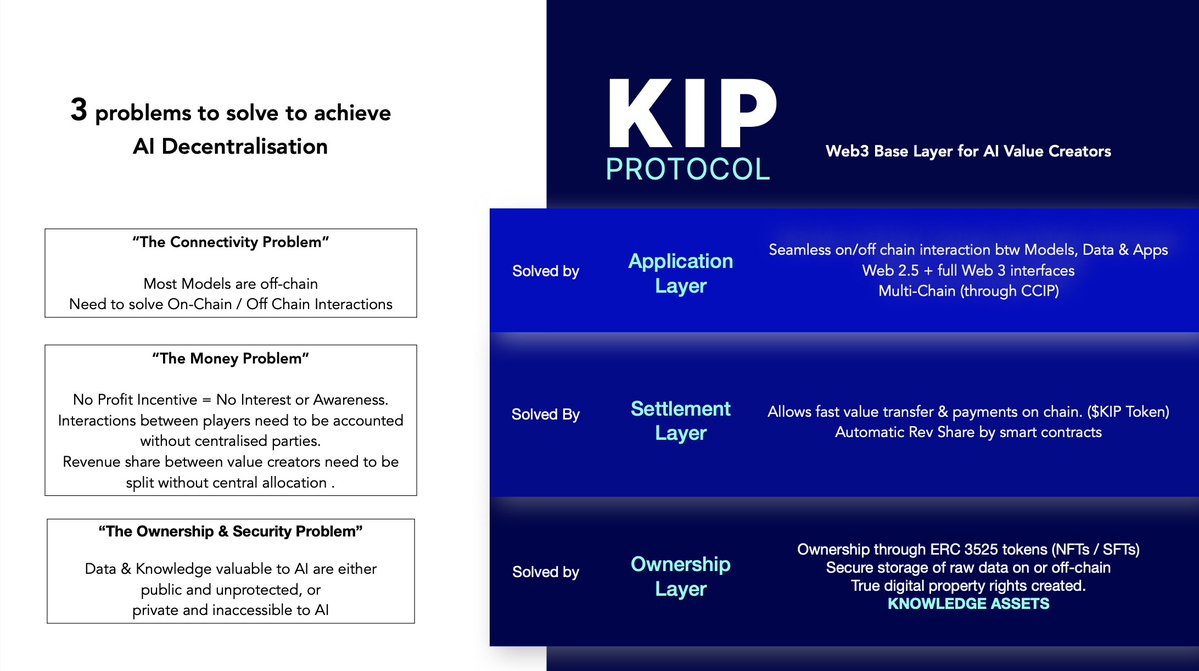
KIP solves three base level problems that AI apps, models, and data owners will face when trying to decentralize.
1) On-chain / Off-Chain Connectivity
2) Monetisation & Accounting
3) Ownership & Security
The “Connectivity” Problem
There are > 400,000 models on Hugging Face, which is indicative of how vibrant, but also how nascent the entire AI industry really is.
Current blockchain technology cannot deliver the core inference function of models (ie totally decentralised models) at a cost or speed that most ordinary users would find acceptable (although advances in edge computing may get us there soon)
Thus most, if not all, of these models are off-chain, and we can expect more innovation and tinkering to be done in off-chain models.
In order to unleash all those ideas and innovation in web3, KIP makes it easy to account for off-chain inference, on-chain.
KIP facilitates this through a framework that allows the heavy computational tasks associated with machine learning inference to be processed outside the blockchain, while still maintaining the integrity and principles of a decentralized system.
The “Money” Problem
The best technology in the world would not see adoption if adopters do not enjoy increased economic benefits.
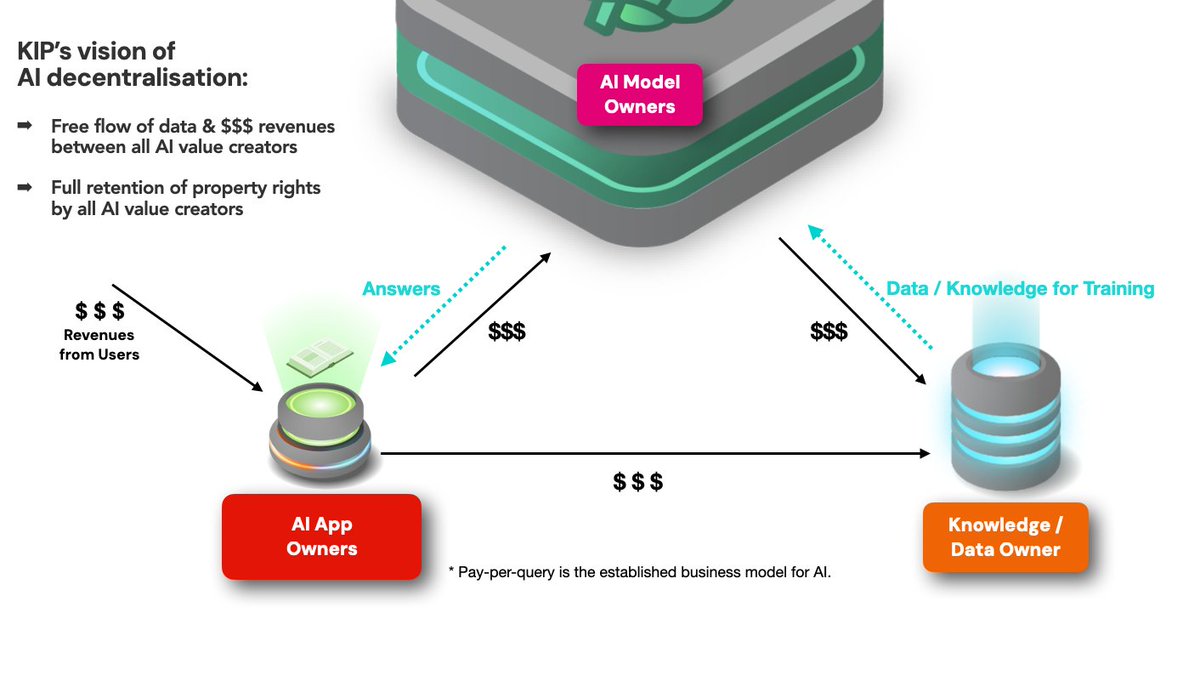
The basic revenue model framework for AI can be described as “pay-per-query”, as every single query from a user expends GPU compute, and thus have to be paid for by someone. And to answer a single user query, multiple AI value creators contribute to the answering of that question.
We are not advocating decentralization merely for decentralization’s sake, but rather decentralization as an alternative to monopolization.
Thus, for AI decentralisation to succeed, we need to ensure that the parties who are decentralizing their AI work are able to earn revenues.
This sounds obvious enough, but in the case of AI, this is not as straightforward as it sounds.
Let’s give an example of a query run via RAG
1. A user makes a query to an AI Chatbot.
2. The AI Chatbot passes the query over to its brain the AI model.
3. The model retrieves only relevant chunks of data from the Knowledge Base it requires to answer the question, formulates the answer and sends it back to the App.
4. The App packages the answer and delivers it back to the user.
In this simplified example, you will see how all 3 actors each contribute towards the answering of the user query.
If one platform owns and controls all three (🤖,📱,📚) under a centralized ecosystem (like what OpenAI is trying to do in the 2nd diagram above), then you just have to pay that one centralised platform, as the rest is internal accounting.
But if we want decentralization rather than monopolization, then each party needs to be paid, thus requiring solutions for:
1. Recording (on-chain) the contributions of each,
2. Splitting / allocating the revenues from the users
3. Enabling each to withdraw their revenues
This is the “money problem” in decentralizing AI that KIP solves.
We do this through a low gas, high efficiency Web3 infrastructure that provides for connectivity between AI value creators, a way to collect payments from the user, and a way to withdraw earnings. (We will cover this in an upcoming KIP Explainer)
Without solving the money problem first, decentralization of AI will be much more difficult, and will be far more unlikely to gain wide-spread adoption beyond a few true believers.
The “Ownership” Problem
Monetisation is merely a weak privilege, if it is not tied to true ownership.
We have all seen how accounts on centralized platforms can be shutdown, banned, shadowbanned at a moment’s notice.
KIP solves this through using blockchain tokens, specifically the ERC-3525 token (SFTs), to “wrap” the work of the AI Value Creator.
1.For data owners: the SFTs wrap vectorised knowledge bases, or a link to an encrypted raw data file to be used for model training.
2.For model makers: the SFTs could wrap an API to an off-chain model, or a set of model weights ready for sale
3.For app devs: the SFTs could wrap the front end APIs, or the prompt itself.
These SFTs serve as 'accounting entities' that can interact with each other on-chain, and record the amounts each SFT earned from a particular transaction.
By solving these problems, KIP makes it possible and easy for AI Value Creators to decentralize their work, creating the starting conditions for a vibrant and much larger decentralised AI ecosystem.
KIP is the necessary Web3 Base Layer for AI.
January was a hectic month for the KIP Protocol🚀. From the beginning of our first community campaign to the successful conclusion of our strategic round, we laid the groundwork for the momentum that will build up ahead of our full launch in the coming months.
Let's take a look at what we accomplished in the last month 👇
1. KIP Protocol Closes Strategic Funding Round Led by @AnimocaVentures 💼
Animoca Ventures led our strategic funding round, which concluded successfully amid a frenzy of anticipation and enthusiasm. 🎉 This milestone is a watershed point in our mission to create safe and gas-efficient Web3 infrastructure, allowing AI creators to distribute their work while maintaining complete ownership and control. 🛠️
With the backing of Animoca Ventures and a diverse consortium of investment DAOs, community leaders, and funds from around the globe, including @BARMYGROUP (Vietnam), @csp_dao (EMEA), @theMQdao, @SCGroupVC (Latin America), @SkyVisionCap (HK), and @purechaincap (UK), we’re poised to revolutionize the AI landscape through decentralization.
The launch of the first dApp on the KIP Protocol, scheduled for Q1/Q2 2024, signals the beginning of an active business environment teeming with independent AI apps, models, and knowledge bases. 🧠
2. Our First Ever AMA with @LightCycle_City, Hosted by @Bybit_Official 🎙️
@julian_kip, Co-Founder and CEO of KIP Protocol, spoke at the Lightcycle AMA Digital Parallel Universe Carnival at a time when there was a surge of interest in the interface of crypto and AI. This fascinating session provided a forum for delving into the future themes impacting the crypto market in 2024, with Web3 x AI being a crucial narrative. 💡
With over 1,000 attendees, the AMA demonstrated the enormous potential that exists for investors and builders in the Web3 x AI arena.👥
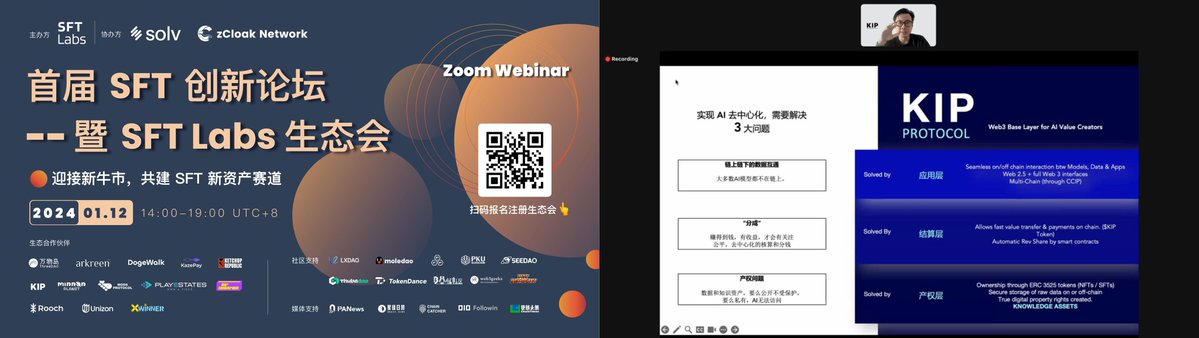
3. @SFTLabsHQ Summit 🏔️
At the SFT Labs Summit, we took advantage of an excellent chance to address fundamental barriers to AI decentralization and advocate for improved connectivity, income sharing, and ownership rights in the sector.🛡️
Julian Peh, our Co-Founder and CEO, provided in-depth insights into how KIP Protocol's multilayered technology enables global participation in decentralized AI. Julian was invited to present at the SFT Labs Innovation Summit, where he shared essential insights into exploiting ERC3525 and driving significant developments in the AI sector.🤖
4. Launch of Our First Community Campaign🚀
In January, we launched the Genesis Campaign – our first-ever community campaign – rallying the Web3 community around a shared vision of decentralized AI. Through Activation Tasks and Cycle Challenges on @GalxeCampaigns, participants earned points, all vying for access to the soon-to-be-dropped NFT Blind Box.🎁
With over 18,000 participants throughout seven cycles, the Genesis Campaign exemplifies the spirit of cooperation and involvement that propels the KIP Protocol forward.🤝
What’s Next?
As we move ahead to 2024, we are committed to pushing innovation, promoting collaboration, and advocating for the democratization of AI ownership and access.
Stay tuned and track our development as we announce more interesting updates.🌟
Cycle 8 is now live! 🎱
https://t.co/gNat13EIjl
In Chinese culture, the number 8 is considered incredibly lucky, as it sounds like "fa" (發) which means prosperity. As we approach Chinese New Year, we would like to extend our wishes of 888 to everyone!🧧