Always in search of the nuance in understanding, with integrity, nature, art, and beauty as foundation. I love new ways to increase health and vitality.
Passacaglia – Handel (Animated Score)
One of the most remarkable works of the Baroque era, Passacaglia by George Frideric Handel is a masterful display of harmonic brilliance and continuous variation.
In this animation, every note and movement was carefully synchronized and rendered in Blender, turning the score into a captivating visual and auditory experience.
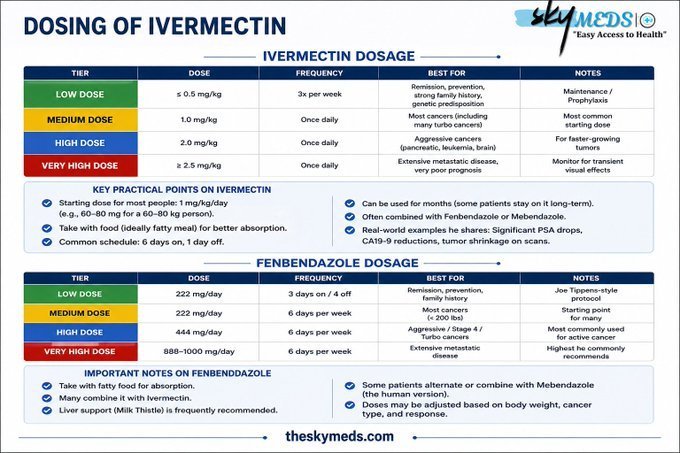
🚨 Dr. William Makis just dropped his updated Ivermectin & Fenbendazole Cancer Protocol.
And people are losing their minds.
Not because it's controversial.
Because it gives real answers.
Here's the truth:
Most protocols treat every cancer the same.
Dr. Makis says that's a mistake.
A patient in remission ≠ a patient with widespread metastases.
A slow-growing tumor ≠ aggressive brain cancer.
So he designed FOUR dosing levels.
Not one. Four.
👇
🟢 LOW DOSE
Ivermectin: ≤ 0.5 mg/kg – 3x per week
Fenbendazole: 222 mg/day – 3 days on, 4 off
Best for: Remission support, prevention, strong family history, higher risk individuals.
🟡 MEDIUM DOSE
Ivermectin: 1.0 mg/kg – daily
Fenbendazole: 222 mg/day – 6 days per week
Best for: Most active cancers – common starting approach.
🔵 HIGH DOSE
Ivermectin: 2.0 mg/kg – daily
Fenbendazole: 444 mg/day – 6 days per week
Best for: Aggressive cancers, brain cancer, leukemia, pancreatic cancer.
🔴 VERY HIGH DOSE
Ivermectin: ≥ 2.5 mg/kg – daily
Fenbendazole: 888-1000 mg/day – 6 days per week
Best for: Extensive metastatic disease, poor prognosis cases.
💡 Why is this different?
It's not about the numbers.
It's about the thinking behind them.
Dr. Makis believes cancer isn't one disease. It's many.
And a one-size-fits-all approach?
That doesn't always make sense.
🔬 The research is growing.
Ivermectin and Fenbendazole are being studied for how they interact with:
• Cancer metabolism
• Cancer stem cells
• Mitochondrial function
• Tumor signaling pathways
• Treatment resistance mechanisms
• Cellular energy production
One thing is undeniable:
More cancer patients, caregivers, and researchers are talking about repurposed medicines today than ever before.
And that's exactly why charts like this keep getting shared.
📌 Save this chart.
Six months from now, you'll wish you knew where to find it.
🔁 Repost it. Someone researching cancer protocols needs to see this.
Embarrassing for Harvard that a freethinking high school graduate can systematically argue more rationally than a tenured (but sheltered) Harvard law professor who looked like he has not been used to having his ideas challenged. Watch the whole debate. Eventually, one starts to feel bad for Kennedy because he obviously is over his head and doesn’t have strong arguments. But he doesn’t realize he doesn’t have strong arguments, and then starts to realize that by the end.
Your iPhone can make a scanned document look like it came from a professional scanner.
But most people still take a blurry photo of the paper.
Here are 7 iPhone document tricks you should know:
@becka_thompson Thank you Becka for all that you are doing. You’ve given me hope. I moved here from Massachusetts 3 years ago - from the frying pan into the fire. People seem to just accept the insanity or say well there’s fraud in other cities too. Not like this.
@annbauerwriter@PezeshkiCharles@Storyaliz I’ve observed that the Twin Cities libraries are largely media centers. The book shelves are at about half capacity and with few exceptions the architecture is ugly and harsh - charmless.
WATCH: Former Park Board Commissioner Becka Thompson says the issue with unlicensed food vendors in Minneapolis has gotten out of control
"I don't even know how to put it into words. It was so awful and it was so obviously wrong," Thompson said.
During the Bronze Age Collapse, within roughly a century, several powerful kingdoms fell, cities were abandoned, and long-distance trade shrank dramatically. The transformation in social order was driven by technology: the rise of iron, which democratized access to violence.
This is an absolutely fascinating article that I think has much to teach us today, when we have just entered another technological revolution: the AI revolution.
The main reason that iron caused widespread collapse of social and political order was that the technology that preceded it, bronze, was concentrated in the hands of an elite, naturally favouring powerful states. Producing bronze required copper and scarce tin, which often traveled thousands of miles through trade networks. Large states could secure supplies and stockpile weapons more reliably than smaller communities. This gave their rulers a lasting military advantage.
Iron production made weapons accessible to more communities. Bloomery furnaces allowed smiths to extract usable iron from ores without fully melting the metal. And even though early iron was not necessarily better than bronze, its widespread availability allowed much smaller communities to produce weapons, destabilizing more established states and encouraging political fragmentation.
I am fascinated about the ways in which technological changes drive shifts in the distribution of power between groups. Imo, this is a relatively neglected topic, including when we think of AI risks.
The first order question is how will the institutional order change? We are already seeing how AI is challenging the status of old institutions including universities. What will come instead?
The second order question for me is whether decentralization is always good. It has a positive valence, at least to me, but the decentralization that was driven by iron during the Bronze Age Collapse led to widespread violence and the collapse of social order.
Much to think about!
Dr. Jessica Peatross is a board-certified MD who left hospital medicine and now treats mold, Lyme and parasites.
On Gary Brecka's podcast, she broke down the 8 rules of detoxing without making yourself sicker:
1) You cannot detox if you're constipated