Jensen Huang: Because of the way I was raised, I have no trouble taking criticism
"Asian parents' way of showing love is to criticize you.
That's their way of saying I love you, I want you to be better, it looks like you did the best you could, but that's not good enough."
Brutal 😂
@MarioNawfal Constructive criticism accelerates personal and professional growth by identifying blind spots, providing actionable solutions, and fostering resilience. When delivered with empathy, it serves as a catalyst for continuous improvement, builds trust, and strengthens relationships.
🚨 SECRETARY MARCO RUBIO JUST TRUTH NUKED THE WHOLE WORLD
"They could make our gas $8 a gallon and we wouldn't be able to do ANYTHING about it!"
"A nuclear-armed Iran could do whatever the HELL they want with the Straits — and there's NOTHING anyone would be able to do about it!"
"And that's one of the many reasons, apart from the massive loss of life and a nuclear strike, why Iran can never have a nuclear weapon."
"I mean, so this is an example of if they had a nuclear weapon, they closed the Straits and they would tell the world, what are you going to do about it?!"
"We have a nuclear weapon, we can attack you with it. That's the world NONE of us want to leave behind."
"It won't happen under this President's watch, but some future President and future Americans will have to deal with this. So just one more example by these guys can never be allowed to have a nuclear weapon."
He said it perfectly.
What people will do to look rich is honestly insane.
They will finance the truck.
Finance the boat.
Finance the Rolex.
Finance the jet ski.
Finance the vacation.
Finance the furniture.
Finance the lifestyle.
And then call it success.
But most of the time, it starts in the same place.
Emotion.
Not numbers.
Not goals.
Not planning.
Not strategy.
Emotion.
I deserve this.
I work hard.
Everyone else has one.
Life is short.
I can afford the monthly payment.
And that last sentence is where people destroy themselves.
Because being able to make the payment does not mean you can afford the thing.
Then the bills show up.
Car payment.
Insurance.
Credit cards.
Student loans.
Childcare.
Property taxes.
Groceries.
Gas.
Subscriptions.
Random nonsense from Amazon you do not remember ordering.
And somehow people are shocked that there is no money left at the end of the month.
But hey, the driveway looks amazing.
Then life does what life always does.
Job loss.
Medical bill.
Business slows down.
Bonus disappears.
Rates go up.
Emergency hits.
Suddenly the whole fake rich lifestyle starts shaking like a cheap folding table.
And that is when people learn a painful lesson.
Expensive toys that do not fit your financial reality are not rewards.
They are anchors.
A $90,000 truck does not make you successful.
A boat you barely use does not make you wealthy.
A luxury watch bought on credit does not make you rich.
It just makes you a volunteer employee for the bank.
Build wealth first.
Then buy toys.
Assets first.
Cash flow first.
Emergency fund first.
Investing first.
Freedom first.
Then, when the money is actually there, enjoy the toys without turning your life into a monthly payment prison.
The American dream is not the problem.
Buying status without a plan, without margin of safety, and without understanding the numbers, that is the problem.
Be smart with your money folks.
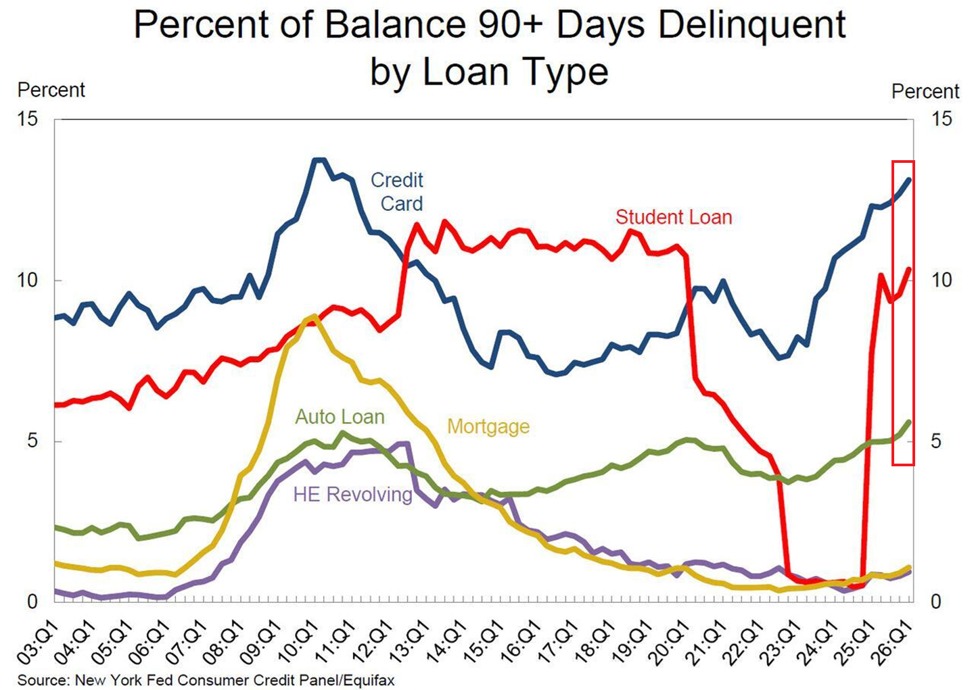
BREAKING: Credit card serious delinquencies rose +0.4 percentage points in Q1 2026, to 13.1%, the highest since Q4 2010.
This is only below the 2010 peak of 13.7%, in the aftermath of the 2008 Financial Crisis.
Since Q3 2022, serious credit card delinquencies have surged +5.5 percentage points, even larger than the +3.9 point increase in 2007-2010.
Furthermore, student loan 90+ days delinquencies jumped +0.7 percentage points in Q1 2026, to 10.3%, the highest since Q1 2020.
Auto loan serious delinquencies increased +0.4 percentage points, to 5.6%, the highest on record.
US consumers are falling behind debt at a crisis pace.
Iran Strikes, Sinks Indian Vessel Sinks Near Oman, Seizes Tanker
Why are we putting up with this? Why haven’t we utterly destroyed these savages?
https://t.co/TJp9ts9625
❌❌ This is what the Islamic Regime occupying Iran does not only to its people but also tobthe world!!
Their Oil storage is maxed out because of the US blockade and not having been able to export for a month!
Now they are just spilling the oil in Persian gulf and killing all the fish & birds.
This is an environmental disaster for the whole region for the years to come!
I called my dad today.
He’s 72 and has spent his whole life taking engines apart.
Cars aren’t just a hobby for him - they’re his passion.
My car was in the shop with a couple issues that needed fixing.
Normally I’d call him immediately.
Instead, I caught myself opening ChatGPT first - asking if I was getting ripped off, what questions to ask, all of it.
I stopped.
Closed the app.
Called Dad.
We talked for over an hour.
AI is an incredible tool.
But never let it replace the people who actually love you.
Call your family. ❤️
Food for thought.
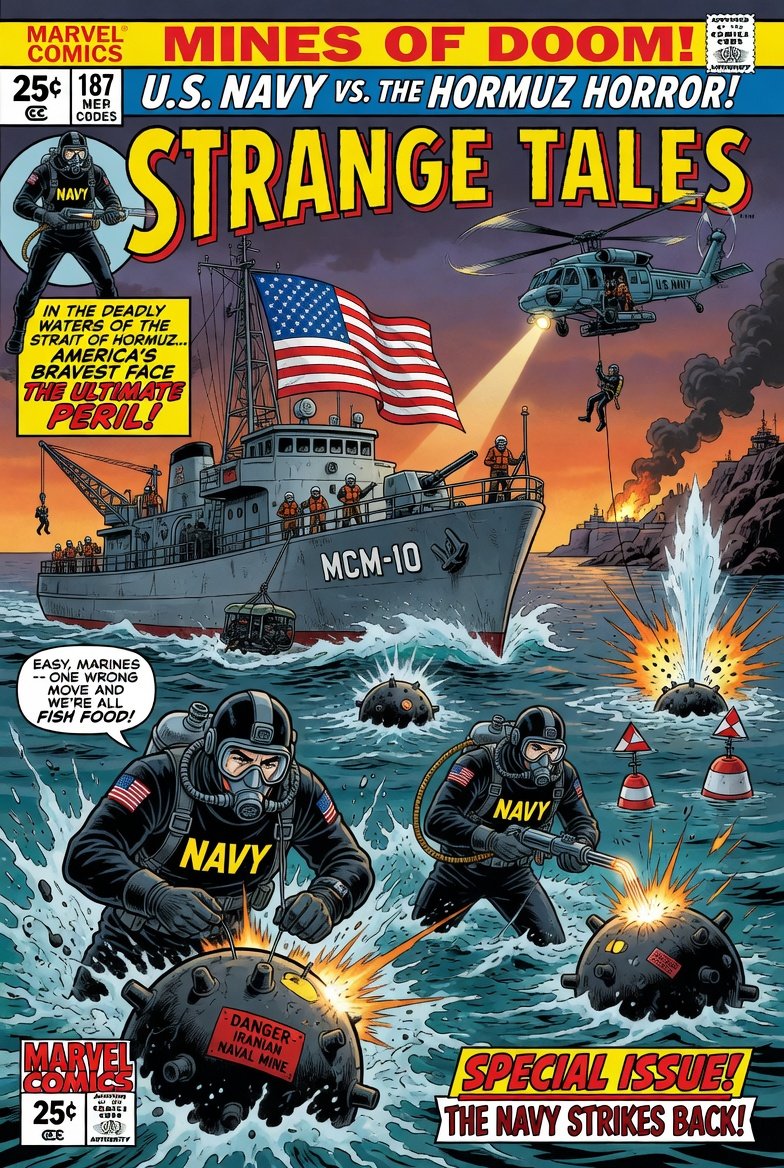
Trump, Hormuz and the End of the Free Ride
For half a century, Western strategists have known that the Strait of Hormuz is the acute point where energy, sea power and political will intersect. That knowledge is not in dispute. What is new in this war with Iran is that the United States, under Donald Trump, has chosen not to rush to “solve” the problem. In Hegelian terms, he is refusing an easy synthesis in order to force the underlying contradiction to the surface.
The old thesis was simple: the US guarantees open sea lanes in the Gulf, and everyone else structures their economies and politics around that free insurance. Europe and the UK embraced ambitious green policies, ran down hard‑power capabilities and lectured Washington on multilateral virtue, secure in the assumption that American carriers would always appear off Hormuz. The political class behaved as if the American security guarantee were a law of nature, not a contingent choice. Their conduct today is closer to Chamberlain than Churchill: temporising, issuing statements, hoping the storm will pass without a fundamental reordering of their responsibilities.
Trump’s antithesis is to withhold the automatic guarantee at the moment of maximum stress. Militarily, the US can break Iran’s residual ability to contest the Strait; that is not the binding constraint. The point is to delay that act. By allowing a closure or semi‑closure to bite, Trump ensures that the immediate pain is concentrated in exactly the jurisdictions that have most conspicuously free‑ridden on US power: the EU and the UK. Their industries, consumers and energy‑transition assumptions are exposed.
In that context, his reported blunt message to European and British leaders, you need the oil out of the Strait more than we do; why don’t you go and take it? Is not a throwaway line. It is the verbalisation of the antithesis. It openly reverses the traditional presumption that America will carry the burden while its allies emote from the sidelines.
In this dialectic, the prize is not simply the reopening of a chokepoint. The prize is a reordered system in which the United States effectively arbitrages and controls the global flow of oil. A world in which US‑aligned production in the Americas plus a discretionary capability to secure,or not secure, Hormuz places Washington at the centre of the hydrocarbon chessboard. For that strategic end, a rapid restoration of the old status quo would be counterproductive.
A quick, surgical “fix” of Hormuz would short‑circuit the dialectic. If Trump rapidly crushed Iran’s remaining coastal capabilities, swept the mines and escorted tankers back through the Strait, Europe and the UK would heave a sigh of relief and return to business as usual: underfunded militaries, maximalist green posturing and performative disdain for US power, all underwritten by that same power. The contradiction between their dependence and their posture would remain latent.
By declining to supply the synthesis on demand, and by explicitly telling London and Brussels to “go and take it” themselves, Trump forces a reckoning. European and British leaders must confront the fact that their energy systems, their industrial bases and their geopolitical sermons all rest on an American hard‑power foundation they neither finance nor politically respect. The longer the contradiction is allowed to unfold, the stronger the eventual synthesis can be: a new order in which access to secure flows, Hormuz, Venezuela and beyond, is explicitly conditional on real contributions, not assumed as a right.
In that sense, the delay in “taking” the Strait, and the challenge issued to US allies to do it themselves, is not indecision. It is the negative moment Hegel insisted was necessary for history to move. Only by withholding the old guarantee, and by saying so out loud to those who depended on it, can Trump hope to end the free ride.