I have specifically told my second year university class that they can call me "Prof" if they're not comfortable just using my name. Sure beats the heck out of being called "Miss"
I was at the ASH conference when Chi Dang told us what process Myc regulated ... he put up a picture of the TCA cycle and the entire plenary session groaned in unison. This reaction to successfully drugging Ras will be almost as memorable 25 years from now, for sure.
I've been to 100s of scientific conferences. I've never seen a technical talk get cheers, much less a standing ovation, but this result on pancreatic cancer really deserves it
I've been to 100s of scientific conferences. I've never seen a technical talk get cheers, much less a standing ovation, but this result on pancreatic cancer really deserves it
Trouble with biomedical science is there are very few absolutes. Yes, the Warburg effect exists. But it is not 100% & cancer cells are not obligate glycolytic. Some use more glucose than others, always a range of metabolic flexibility. These shades of gray are hard for people.
Imagine designing a cancer ward from first principles.
You know the Warburg Effect. You know cancer cells are obligate glucose metabolisers with compromised mitochondria. You know ketones bypass the broken machinery entirely and feed healthy cells without feeding tumours. You know elevated insulin signals cellular growth, including tumour growth. You know chronic hyperglycaemia creates the permissive environment for metastasis.
You know all of this because it is in the published literature.
From those first principles, the dietary protocol writes itself:
Eliminate refined carbohydrates. Restrict glucose. Keep insulin low. Provide adequate protein without excess glutamine. Use ketogenic ratios where tolerated. Fast overnight at minimum.
Now walk into an NHS oncology ward at seven thirty in the morning.
White toast. Orange juice. Jam sachets. A bowl of porridge with a small pot of honey on the side.
Approximately 120 grams of glucose delivered to a patient whose immune system is already compromised and whose tumour is waiting for exactly this delivery.
Then chemotherapy at ten.
Then more toast at lunch.
The chemotherapy is evidence-based.
The toast has not been evaluated.
Nobody has asked why the chemotherapy and the toast are in the same protocol.
They arrived separately and were never introduced.
@CovidAnalysis@toobaffled Positive signal in meta-analyses largely driven by countries with high worm burden. Ivermectin is really good at treating worms. Worms are really good at suppressing the immune system. If you have worms, your immune system will have a harder time fighting off SARSCoV2.
@gringo504@toobaffled Ivermectin is really good at treating worms. Worms are really good at suppressing the immune system. If you have worms, your immune system will have a harder time fighting off SARSCoV2. Ivermectin will definitely help fight covid IF you have worms
@spfooz @TomSton93521872 @toobaffled Yeah ... the big pharma company that makes ivermectin for a few cents/kg decided not to ramp the price up during a world wide crisis. That sounds like big pharma - thoughtful, considerate, generous
@kymille @TomSton93521872 @toobaffled India has a very high intestinal worm burden in their communities. Worms suppress the immune system. Ergo, ivermectin killed the worms, and released the immune system to fight the virus
@TomSton93521872 @toobaffled Ivermectin is really good at treating worms. Worms are really good at suppressing the immune system. If you have worms, your immune system will have a harder time fighting off SARSCoV2. Ivermectin will definitely help fight covid IF you have worms.
@SmokeStarlight@TheSummerUKnow@mmitchell_ai Applicant has to name their price as part of the application " 3) a financial proposal: The amount to be charged for the assignment, which should be quoted in US dollars, GBP or Euros as a monthly fee."
I was on a short international flight when the cabin crew asked me if I was a medical doctor or the PhD type. Told them I was the PhD type. They were a bit disappointed.
When you read the studies on ivermectin, where ivermectin did improve outcome a little - at least for Covid - was in countries with high worm burden. Worms are known to suppress the immune system. Get rid of worms - which ivermectin is v good at - and you improve immunity.
The problem with this kind of rhetoric is that it throws around big numbers and assumes no one will look deeper. “400 studies” on ivermectin and cancer becomes zero randomized trials in humans showing better outcomes the moment you actually check PubMed.
@OdedRechavi I think paper rejection is worse ... a grant was an idea you had. A paper is the work you actually did. Our grant success rate in New Zealand is well below 10% - government does not prioritize research - so I'm well used to rejection there!
In the early 1940s, there was intense debate about the “true nature” of bacteriophages, the little viruses that infect bacteria.
Some biologists argued that they were bacterial enzymes, whereas others believed they were their own viral entities.
In 1940, Ernst Ruska (the same person who invented the electron microscope in 1931), published an article in German showing the first images of a bacteriophage.
Ruska’s original electron microscope magnified objects only about 400x, much less than light microscopes available at that time. But by 1940, advances by University of Toronto scientists pushed that magnification up to 7,000x, or about 3x higher than light microscopes were then capable of.
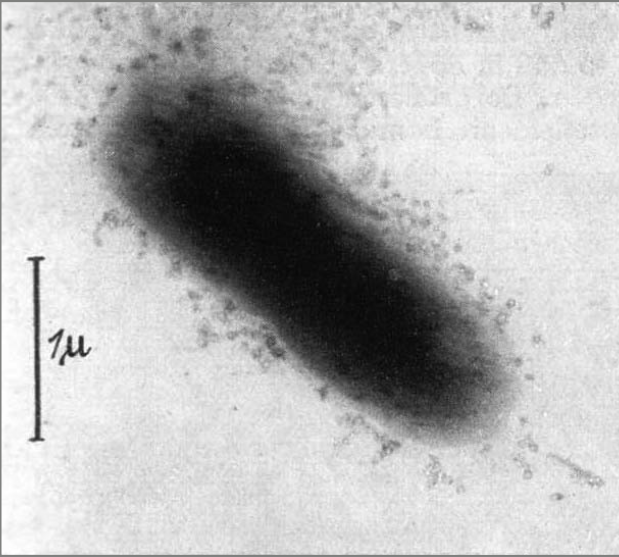
Using one of these newer electron microscopes, Ruska captured his photos of bacteriophages. Unfortunately, the images were not so great. It was difficult to tell, for example, whether these were well-defined particles or just random debris from the bacterial cell. (Ruska’s image is the first one below.)
In 1942, two Americans — the brilliant Salvador Luria and Thomas Anderson, both at Columbia University — finally settled the debate.
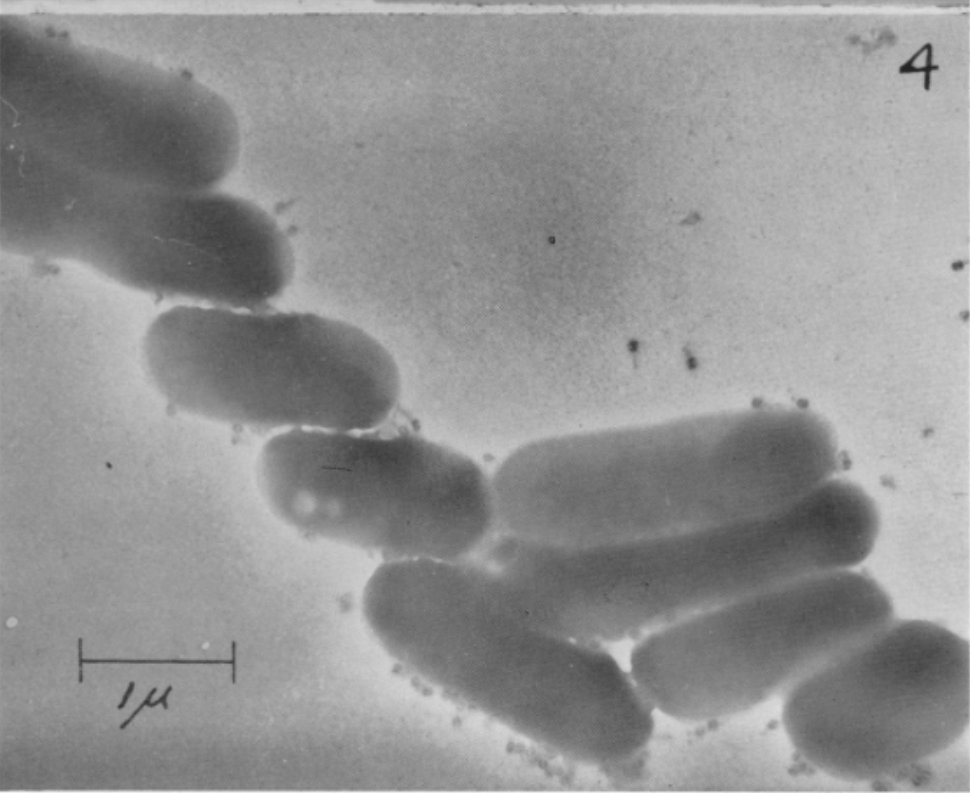
Using a RCA Electron Microscope (of which only 2,000 units were ever made, each costing about $200,000) the two men acquired much better images of bacteriophages nestled upon a single E. Coli cell. (Their image is the second one below).
With this image, they could clearly see individual phages and their little tails. They saw, too, that these phages were of an “extremely constant and characteristic aspect,” meaning they could not just be random cell debris or enzymes (since the phages had two parts; heads and tails).
Their experiment worked like this: The duo dropped some phages on a tiny collodion film (made of cellulose, and thin enough not to distort the electron beams too much), put them into the machine, and then used a vacuum pump to suck air out of the column. (Without the vacuum, electrons would bounce off air particles and scatter.)
Next, they aligned the focus using a fluorescent screen on the front console. This fluorescent plate would convert the invisible electron image into visible light so the operator could see and tune the image live.
Finally, taking a micrograph involved opening a shutter for a second or two, then closing it and resetting the system for another shot. There was a long glass plate, at the bottom of the column, that caught the electrons which scattered off the phages. Each glass plate carried multiple small frames, so a session could produce several images before the plate had to be removed and developed in a darkroom.
It’s wild to me that these images were taken in the early 1940s; or that engineers were able to build these half-ton, ten-foot-tall machines that could blast biological samples and resolve their structures at such high resolutions. Brilliant.