Coach for Math Contests | Mathematical Interests: Number Theory, Topology and Differential Geometry| Former student IIT Bombay | INMO 2011 participant.
Researchers proved AI has deleted every reason universities exist.
Harvard University ran a controlled experiment pitting a custom AI against their own top-tier classrooms.
And the results are going to collapse the higher education bubble.
They took 194 undergraduates and split them up.
One group learned physics in one of Harvard’s best hands-on, active-learning physical classrooms. Group work. Instructor support. The premium university experience.
The other group went home and learned the exact same material with an AI tutor.
The AI didn't just win. It embarrassed the institution.
Students using the AI learned more than twice as much as the students in the elite Harvard classroom.
They scored 30% higher on the final assessment.
And they did it in less time.
Let that sink in.
A piece of software sitting on a laptop outperformed a world-class faculty in one of the most elite learning environments on Earth.
Universities have always justified their exorbitant tuition with two things: access to elite knowledge and the physical classroom experience.
This study just proved both of those moats are gone.
When software can teach you complex physics twice as well as a $60,000-a-year institution, the math of higher education breaks permanently.
The AI didn't just give the students answers. It used strict pedagogical guardrails. It guided. It questioned. It forced the students to do the cognitive work.
It offered perfect, one-to-one tutoring, personalized to the exact moment a student misunderstood a concept.
That level of attention is mathematically impossible to scale in a physical lecture hall.
For a thousand years, the university was the only place to get a premium education.
Now, it’s the bottleneck.
If AI can double your learning speed for a fraction of the cost, what exactly are students taking on decades of debt to pay for?
Vandermonde's Identity: A combinatorial proof
The identity is named after Alexandre-Théophile Vandermonde (1772), although it was already known in 1303 by the Chinese mathematician Zhu Shijie (朱世傑; Chu Shih-Chieh in Wade–Giles — hence the name Chu–Vandermonde identity).
In next few days, I will discuss the combinatorial proof of many identities during the class so that students will have the idea about proving it combinatorially. The proof of many other similar identities will be assigned to the students so that they can discover it themselves.
For people getting upset about this, it's not that complicated. At bottom, all of these people have worked insanely hard, that's the main thing. Decades of 16 hour days focused on math. Grothendieck famously was so purely focused on math at times he wouldn't engage in discussions about anything else or see a movie, for fear of "losing time." That's the first thing to realize.
The second is that if you can truly sustain "work" this long and this intense, for decades, it's because you have an immense desire for it, it doesn't feel like "work", but like what just has to be done, there's no other way. And the level of focus this grants makes a 16 hr day of math from a Grothendieck or Tao become equal to many many days of work from someone without that. That compounds. Eventually, these people have built up so much momentum that they can do in 2 hrs what might take other competent mathematicians days.
That looks like magic, but it isn't. It's fundamentally hard work and insane levels of focus/devotion that gradually transform this work into something that doesn't look or feel like "work" in any sense normal people mean by that. It's just play or doing what they do and can't help but do.
"What about exceptions like June Huh who said 3 hours a day is all you need?" If you understand the context, you understand that this isn't an exception either, but shows the same thing. At some point, Huh stapled together fabric to make a blanket to essentially avoid having to go out and buy a blanket. Which, whatever reason he gave, surely was just because he was too deeply and constantly absorbed in math to be able to deal with that.
There's no magic. Just work and the transformation of work that happens when you do it with all of your soul, for the long march of your life, with no other motive than that it has to be done and it is your desire.
This applies to many niche skills. I didn’t learn astrophotography from school, I learned it by getting my hands dirty & spent every night learning how NOT to do it.
If you want to do something, just start doing it. Waiting for someone to teach you might leave you with nothing.
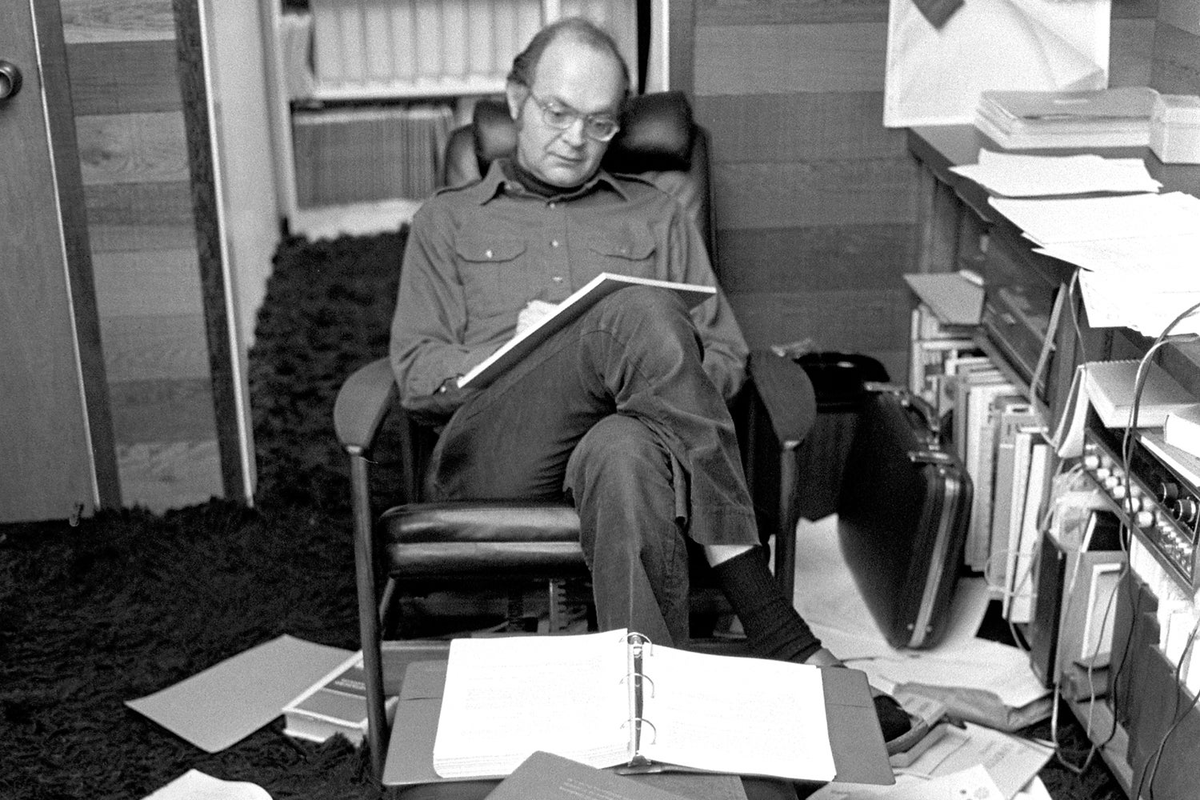
A computer scientist won the Turing Award at 36 and then walked away from almost every other project for the next 50 years to write one book that he has still not finished at age 88, and it may be the most important book in his field.
His name is Donald Knuth. He won the Turing Award in 1974, which is the closest thing computer science has to a Nobel Prize.
He was 36 years old. He had already written volumes one, two, and three of a book series called The Art of Computer Programming. He was the youngest person ever to receive the award at that point in its history.
Almost anyone else would have ridden that moment for the rest of their career. Founded a company. Sat on boards. Gone on speaking tours. Knuth did the opposite. He went back to his desk and kept writing.
He started the book in 1962. He was 24 years old. His publisher had asked him to write a short paperback on compilers. He sat down to outline it and discovered that to explain compilers properly he would have to explain the deeper algorithms underneath them first.
The short paperback became a draft outline of 12 chapters. The 12 chapters became a planned 7-volume series. The 7-volume series became the project he is still working on 63 years later.
Volume 1 came out in 1968. Volume 2 in 1969. Volume 3 in 1973. He was producing books faster than most academics produce papers. Then everything stopped.
In 1977 he received the printed proofs of the second edition of Volume 2. He looked at the pages and was so disgusted by how the publisher had typeset his mathematical notation that he could not bring himself to release the book.
The equations looked ugly. The fonts looked wrong. The spacing was off. He decided he could not in good conscience publish another volume of TAOCP until the typesetting problem was solved.
So he paused the book.
He stopped writing TAOCP and spent the next 8 years inventing TeX from scratch.
TeX is the typesetting system that every academic paper, every math textbook, every physics journal on earth now uses. Every PhD thesis in the sciences is set in TeX. Every paper on arxiv. Every equation in every paper Anthropic, OpenAI, and DeepMind have ever published. The system that the entire scientific publishing world runs on exists because one man refused to compromise on how the second edition of Volume 2 looked.
He gave the entire TeX system away for free. He never tried to commercialize it. He went back to writing TAOCP.
In 1992 he retired from Stanford at the age of 54. Most professors retire to slow down. Knuth retired to speed up. He explicitly said he was leaving teaching because he needed every remaining hour of his life to keep writing the book. He stopped using email on January 1, 1990.
He answers no calls. He takes paper mail only. He is on a personal mission to finish a multi-volume series that nobody is forcing him to write, on a deadline that only exists in his own head.
Volume 4A came out in 2011. Volume 4B in 2022. He is currently working on Volume 4C. Volumes 4D, 4E, 4F, 5, 6, and 7 are still ahead of him. He is 88 years old. He will almost certainly die before he finishes.
The thing that should haunt anyone reading this is the math of his choice.
Every modern incentive structure tells you to optimize for speed. Ship the imperfect version. Get it out the door. Iterate later. Move on to the next thing.
Knuth has spent 63 years doing the exact opposite. He pays a $2.56 reward in hexadecimal dollars to anyone who finds an error in his published books. Real checks, until check fraud made him switch to certificates of deposit. He treats every single error in every single volume as a personal failure. He revises. He rewrites. He goes back to fix issues that nobody else could have spotted.
He could have written 30 books in 63 years. He chose to write one.
The reason is the one almost nobody understands the first time they hear it. There is a category of work that loses all its value when it is done quickly.
A reference book that engineers will rely on for the next 200 years is not the same kind of object as a blog post that has to ship today. The slow project and the fast project look like the same activity from the outside. They are completely different games.
Bill Gates once said in an interview that if you can read the whole of TAOCP, you should send him your resume. He meant it. He was not joking. The man who founded Microsoft was telling the world that the rarest skill on earth is being able to finish a book that one man has spent his entire adult life writing for an audience that mostly does not have the patience to read it.
The book may never be finished.
The man writing it knows this and keeps writing anyway.
The work outlives the worker. That is the entire point.
It is often said that creativity simply involves rearrangements of such things as there are, and therefore that it is well within the reach of AI. But this is not so.
Novel arrangements of things—paint strokes, musical notes or business resources—may be a necessary component of creativity, but the ability to appraise the distinction between the vast majority of potential novel arrangements, which are junk, and the minute minority that constitute significant improvements over arrangements that have gone before, is called taste. The ability to create improved arrangements that refined humans will find tasteful is called creativity, and it can be found in all realms of human activity, and nowhere else.
Humans can cause AIs to rearrange things very quickly according to banal prompts or creative ones, but it is the prompter who is banal or creative, not the AI.
The wise conjecture is that AIs are unlikely ever to exhibit taste, and even less likely to exhibit creativity.
I'm happy to announce that the results of Singapore and Asian Schools Math Olympiad (SASMO) 2026 are announced. Students of the Cauchy Maths Circle won the following awards:
(1) Tarushi Panda - GOLD award
(2) Aditya Sachdeva - GOLD award
(3) Dishant Dutta - GOLD award
(4) Pragya Yadav - GOLD award
(5) Avyay Singh Chauhan - BRONZE award
(6) Sharwin Manish Chandra Yadav - BRONZE award
Congratulations to all the students.
Results are available at: https://t.co/9MMplzCeUo
https://t.co/hl1TbUMwSq
Real books change your very psyche. Not the self-help books. The long, difficult, soul-altering books. The Brothers Karamazov. One Hundred Years of Solitude. The Stranger. The Old Man and the Sea. Crime and Punishment. In Search of Lost Time. Writers who understood loneliness. Meaning. Human suffering. The quiet chaos inside the mind. Writers who sat alone for years and pulled something true out of their inner darkness and put it on a page so that one day you could read it and feel less alone in your own. They change the way you see people. They expand your perception. They upgrade your consciousness. That's what real books do.
They alter you.
I feel proud and happy in announcing the my mentee Tanvi Jaiguru has qualified the semifinals of the 51st Belgian Mathematical Olympiad 2026 in the MINI category. Finals are scheduled to be held on 22nd April 2026. Under my guidance, she has qualified for it for the 3rd time.
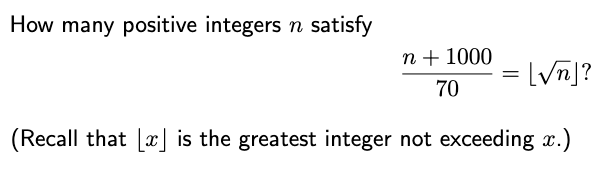
Take a few minutes to think it through carefully. Often, the key lies in identifying a small but crucial insight.
Feel free to share your answer along with your reasoning in the comments. Engaging with different perspectives is what makes this exercise valuable.
We read books & poetry because they enlarge us. They expand our thinking, our empathy, our connectedness. Art reminds us of why we live: for beauty, for wonder, for understanding. Though our culture may say otherwise, these are vital & necessary. They sustain us.
Most people never perform better because better performance would require them to contradict their own autobiography. And we're more loyal to our stories than we are to our potential.