Empowering young men to break free from the norm and achieve their full potential. 🌟
E-commerce entrepreneur | Mentor | Innovator
Let's rise above the ordinary
You will get NOWHERE prioritizing other peoples wishes over YOUR OWN
Your parents WILL NOT make you rich
Your friends WILL NOT make you rich
You are on YOUR OWN
Take care of yourself FIRST
And then you can take care of OTHERS
You can NOT pour from an EMPTY cup
Do NOT conform
Do NOT think like others do
It ALL starts in the mind
If you THINK like others do
ACT as others do
And AIM for what others want
You will be just like THEM
Adjust your AIM towards YOUR end goal
Do NOT let the winds of opinions sway your AIM
Before you PROVE anyone else
You have to prove it to YOURSELF
Set yourself up FIRST
Prove to YOURSELF that you KNOW what you are doing
Because you CAN lie to others
But you can NOT lie to YOURSELF
Deep down
You WILL know the TRUTH
You can SPIN any situation into a POSITIVE
Whatever it is There is a BRIGHT side to it
A SILVER lining
No matter how SMALL the positive aspect might be
It is THERE
And will benefit you MASSIVELY if you FOCUS on it
You are probably SMARTER than 90% of the dudes FLEXING on you online
Half of them are NERDS
Got NOTHING going on for them except MONEY
They are AMATEURS
And if they can MAKE money
So can YOU
You have to stay in MOTION
There is ALWAYS something to do
There is always a higer ROI task that you can do instead of CHILL
There is always more WORK to do
To IMPROVE your life even further
NO matter how far you have come
1 is GREATER than 0 FOREVER + ALWAYS
12 Reasons Why Cities Need More Trees:
1. Temperature Control
One large tree is equivalent to 10 air conditioning units, and the shade they provide can reduce street temperature by more than 30%.
2. Noise Reduction
Trees can reduce loudness by up to 50%. In urban areas filled with the sound of cars, construction, sirens, aeroplanes, and music, trees are essentially the best way to block noise and keep cities — along with the homes and workplaces in them — quieter.
3. Air Purity
Trees remove an astonishing amount of harmful pollutants and toxins from the air. In urban areas air quality is often disastrously bad — with severe consequences for our health. Trees make the air we breathe much cleaner.
4. Oxygen
And, while absorbing all those pollutants, trees also put more oxygen back into the urban environment. Oxygen levels are significantly lower in cities compared to the countryside; trees help to solve that problem.
5. Water Management
Trees do more than just shelter us and our buildings from rain — which is, in fact, extremely important. They also absorb huge quantities of water, reduce run-off, neutralise the severity of flooding, and make flooding more unlikely altogether. Not to forget that their roots absorb pollutants and prevent them from feeding back into a city's water supply.
6. Psychological Health
Studies have proven what we instinctively know to be true: that human beings are significantly happier when surrounded by nature rather than sterile urban environments. Our emotions, behaviour, and thoughts are shaped by the places we spend time — and trees have a profoundly positive effect on our psychology. The consequential benefits of being happier and more peaceful — as individuals and as a society — are immense.
7. Physical Health
Beyond all the other ways in which trees improve air quality and the urban environment, much to the benefit of our health, they also encourage people to go outside. Cycling, running, and walking are all more common in urban areas with plenty of trees. A knock-on effect of people spending more time outdoors is also social integration and stronger communities.
8. Privacy
A simple point, but not inconsequential, is that trees provide privacy.
9. Economics
The total economic benefit of urban trees is hard to calculate. There are costs, of course, including the repair of infrastructure damaged by roots and maintaining the trees themselves. But the total economic benefit — a consequence of everything else in this list and more — far outweighs the expenditure. Trees make cities wealthier.
10. Wildlife
Trees are miniature cities all of their own, serving as a habitat for hundreds of different species, including birds and mammals and insects.
11. Light Pollution
Trees don't only block the light shining down, therefore keeping us and our cities cooler — they also disrupt light shining up, from street lighting, cars, houses, and billboards. Skies are clearer in cities with more trees.
12. Aesthetics
And, finally, trees are beautiful. They break up the potential monotony of urban environments — the sharp geometry, the greyscale roads and buildings, the endless rows of cars — with their trunks, boughs, canopies, and flowers.
Just think: the gold and red of falling leaves in autumn, the white and pink blossom of spring, the vast green canopies of summer, and the branches lined with hoar-frost in winter. Every single tree is a myriad of intricacy and texture, of colour and scent, of dappled light on the pavement, mottled bark, knotted roots, of clustered leaves and delicate petals and stern boughs.
Few streets would not be improved by the kaleidoscopic aesthetic delights of a tree, not to mention the many different species of tree, all over the world, whether willow, oak, lime, cherry, aspen, maple, birch, horse chestnut, dogwood, hornbeam, ash, sycamore... the list goes on.
There are some drawbacks to urban trees, most of them context-specific, and they are not — of course — universally appropriate. But it seems fair to say that many cities would benefit from at least a few more trees here and there.
In the early 1990s, Brazilian photojournalist Sebastião Ribeiro Salgado was stationed in Rwanda to cover the genocide, an experience that left him traumatized.
In 1994, upon returning to his home in Minas Gerais, Brazil, Sebastião hoped to find solace in the lush green forest of his childhood. Instead, he discovered that his home had transformed into a dusty, barren land stretching for miles, devoid of any wildlife.
"The land was as sick as I was. Only about 0.5% of the land was covered in trees," he remarked.
At this time, his wife, Lélia Deluiz Wanick Salgado, proposed that they embark on the ambitious journey of replanting the entire forest. Sebastião supported the idea, and together, over the course of the next 20 years, they planted an astonishing 2.7 million trees.
Their efforts resulted in the rejuvenation of 1,500 acres of rainforest, and the site eventually became home to 293 plant species, 172 bird species, and 33 animal species, some of which were on the brink of extinction.
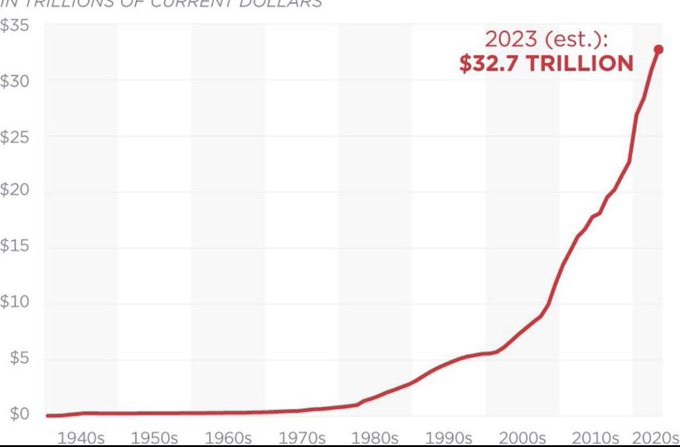
This is not Apple, Nvidia, or Tesla.
It is the US national debt which has grown by $1.3 trillion in the past 8 weeks since the debt ceiling was suspended.