@__simt__ hi. Is it possible to program in CUDA without shared memory without losing in peff? In other words can one achieve same perf just by using the cache efficiently?
@ahcohen A formal characterization of the algorithms for which polyhedral optimization works would save user a lot of time and energy. In the meantime, I could just adapt the computation I am interested in to algorithms for which polyhedral techniques do work.
@ahcohen Example: I have a list with ints and a binary operation that I apply to all possible pairs of ints in the list. The results are stored in a right triangular matrix.
@ahcohen I thought there were transforms that could optimize memory access, minimise cache misses, latency etc. How computationally hard it is to obtain one of those is another issue.
Two teams compete.
Team A uses modern SAT solvers on a 20-year-old computer.
Team B uses 20-year-old SAT solvers on a modern computer.
Who solves more problem instances?
New @cp2020conf paper ➡️https://t.co/VyZibKj8y1
➡️https://t.co/mw5NQ2jml9
Funded by @FWF_at @WWTF
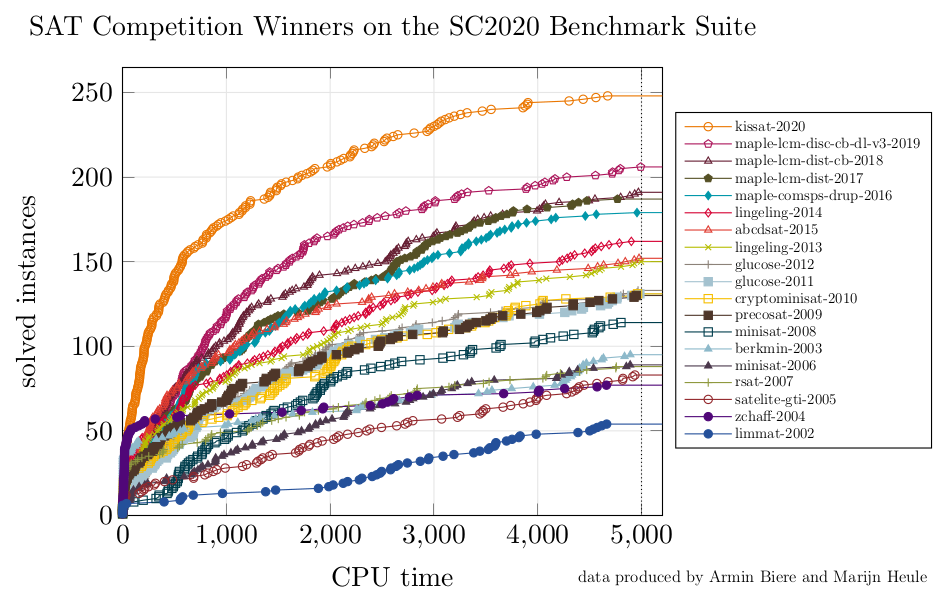
SAT solvers get faster and faster: all-time winners of the SAT Competition on 2020 instances, featuring our new solver Kissat (https://t.co/iO9GicfFoO), which won in 2020. The web page also has runtime CDFs for 2011 and 2019.