@KaiserKuo interviewed American journalist @robertwrighter on his podcast Sinica yesterday, where they discussed a number of topics related to US-China relations and artificial intelligence. In the first segment, the two float around the idea of whether new technology will lead to more peaceful coexistence between nations. While I tend to agree with, or at least hope for, their belief that framing an “arms race” is dangerous because it creates a structure built to result in antagonism, I am skeptical about artificial intelligence’s potential role in enforcing a better world. In fact, if we step back from their desire for the two world powers to put aside their differences and collaborate, we will encounter a more essential question regarding human nature that isn’t simply crucial for guessing what artificial intelligence could do but also why perhaps the two nations, although mostly the US, are hesitant to share in building the road to a new technological future. This question itself can be broken down into two parts:
Can humanity become more egalitarian, or is a certain level of hierarchy necessary?
Can power be decentralized and shifted away from human actors toward nonhuman systems capable of restraining our darker impulses?
Full article: https://t.co/y8ywBwhBng
In a world run by financial systems, events can play out in counterintuitive ways precisely because of the tangible representation of real-world value in monetary terms. Traditionally, this has been seen in capital rushing to invest in certain sectors, most notably oil, arms, and gold, in times of war.
The result is that our incentive structures get mixed up. What people initially saw as bad may begin to not actually look so bad after all. While some people take the more obvious position that human suffering is bad, others may actually be cheering as the number goes up, even if they initially invested partially for stability. In some cases, they could find themselves hoping a conflict goes on longer to profit from it more.
Markets can therefore tell us a lot about how humans calculate value, at least under certain incentive structures. Sometimes profit, especially in high-risk scenarios where it can be assumed events will stabilize, trumps all else.
In the context of the US-Iran War, however, gold has fallen despite oil prices going up. With this, the value of electric vehicles has actually increased, too. EV Geek Studios reported on Tuesday that April marked the smallest year-over-year sales drop this year, arguing that rising oil prices have made electric vehicles look like a cheaper alternative to traditional cars.
This is not all. Meanwhile, as @GlennLuk has argued on X, 2025 had seen a slight stabilization of sales for ICE vehicles in China due to policies implemented to even the competitive playing field. GAST (盖斯特汽车战略咨询) has reported that this brief reprieve has ended for the same reason Americans are rethinking electric vehicles. Domestic brands have benefited from this, having moved from 62% of sales in March to 70% in April. German autos fell from 16% to 13%, Japanese from 13% to 11%, and American from 7% to 4%.
Analysts like EV Geeks have previously warned that the US being slow to adopt new energy cars may make it an island in the future, even hurting domestic brands further as their local market's needs may prevent them from being competitive abroad, especially if we assume Chinese cars will eventually come to the US.
With Canada having reduced tariffs this week and begun allowing a limited number of Chinese-made cars, eyes will be on whether more access to electric vehicles in the northernmost American nation puts pressure on their southern neighbor to do the same. To make matters even more ironic, the first batch of these was actually composed of China-made Teslas, a US company. Will Elon become even more wealthy from more middle-class consumers driving his cars?
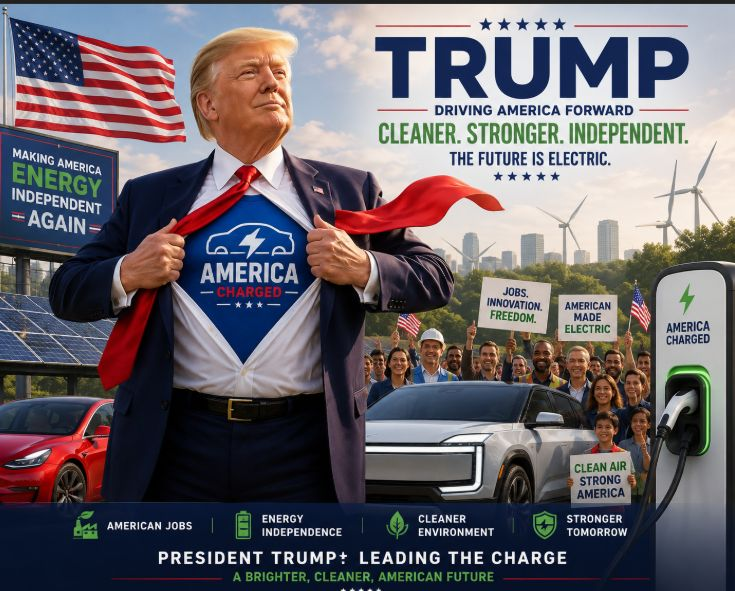
Many have argued Trump is a genius playing 3D chess. Others like Paul Musgrave have jokingly asked how many hours have been wasted trying to make heads or tails out of the 47th President of the United States. Whatever the case, he may turn out to be an unexpected catalyst for electric vehicle adoption.
Links:
https://t.co/nnzSqOpzHh
https://t.co/g54ji0aJsK
https://t.co/oZMU9HEc7Z
https://t.co/JIP3q5TZ1B
https://t.co/UteYnd7uu8
On BYD's notably slowdown in domestic growth:
Since none of this has been discussed publicly (nor would it), the conspiracy theorist in me wonders if higher-ups had a discussion at some point about how BYD's increasing dominance of the sector was harmful from a competitive stance.
Chinese policymakers aim for optimal competitive balance (at least domestically) as a key component of industrial policy.
In 2024, BYD's share of NEVs rose to a dominant 33%, with the next largest competitor (SAIC) less than one-third the volume (and fading fast).
Here is a perfect example of why analyzing business is necessary for international relations. Tesla comprised 70% of the first shipment of “Chinese” vehicles to enter Canada post-tariff reductions.
I was walking around Beijing the other month and noticed the prices were lower than elsewhere. Restaurants catering to seniors.
I then passed a supermarket and saw someone getting a haircut for 10¥ ($1.48).
According to 洞见商机, the "fast haircut" industry has been causing headaches for traditional hairdressers recently.
"In Shanghai, there is a fast-cut chain called "Very Model," which opens at 8: 30 a.m. every day, there is an queue of people waiting immediately after opening the door. Each hairdresser can cut 40 customers' hair on average every day, and the turnover of a single shop can reach 400-600 yuan per day, and a monthly turnover can reach 12,000-18000 yuan. This is not an isolated case; this price range is 10-15 yuan at fast cutter shops, and now it is spread all over the country.
According to https://t.co/s50vOK5tjk, more than 180 thousand hairdressing related businesses will be canceled from 2023 to 2025. But the fast cutting industry is booming, according to data from iResearch, as of early July this year, domestic fast cutting enterprises had reached 5,190, and in the first half of 2024 alone, the number of registrations reached 755, an increase of 8.2% year-on-year.
From a consumer group perspective, the customer base of fast cutting shows a diverse character. In the beginning, it was true that there were more elderly people, but gradually, younger customers became the main force, and now about 7 out of 10 are young people. At present, male consumers are still the main force of fast hair cutting shops, and the demand for hair cutting is relatively stable for this group, and the complexity of hair hairstyle is not high."
Anyone who has received a haircut in China knows it differs from the US and UK in that the initial hairwash resembles a head massage. This new industry has cut that out to save time. Unfortunate, but such is the market.
Other ways these shops are reducing prices is by using less space and expensive equipment. Barbers don't need to be high-end either. A standardized course is enough.
Last year, I gave a speech for the The American Chamber of Commerce in Shanghai (AmCham Shanghai) where I showed a chart illustrating how value progresses over time as a country develops. The initial stage was simply "function". Eventually, as more competitors emerged, value became more abstract as aspects like branding, personal experience, and quality took center stage. In this case, we are seeing the peeling back of "unnecessary" value like store decorations and size to the bare bones product.
This can happen for a number of reasons. One, society is now seeing through the smoke and mirrors companies often use to bump up prices. Two, people are more cost-conscious due to broader economic concerns.
Still, as the main customer is male, what else can we hypothesize here?
Link: https://t.co/1oaPgujvLj
Only "Left" if we include those not in power. The Democrats are very much still not those things. The real breach in "mainstream" politics is found by looking at the investor class and libertarian types. Will they go along with the more pro-nationalism politics of the right and left or continue wanting free trade?