Founded in 1957, Modern Age is THE forum for debate and discussion of the most important ideas of concern to conservatives of all stripes. Published by @ISI.
“Hawthorne and Melville were born to a great tradition, but they did not stop there. They worked to refine it, enliven it, and reconcile it with their communities, their families, and their souls,” writes Glen Austin Sproviero: https://t.co/OWCMaVr1EK
“A morally populist politics would be more comfortable with moralism precisely because it would be more confident—with Hadley Arkes—in the universality of the natural law.”
Damian Bell: https://t.co/nJV4bjzdXY
Hawthorne and Melville’s work shows how inheritance requires contemplation through the moral imagination.
Read more from Glen Austin Sproviero: https://t.co/OWCMaVqtPc
“Lord Acton’s high appeal to conscience, dedication to liberty, defense of Catholicism, and transforming influence on the study of history in England make him one of the most important figures in European thought in the nineteenth century and one of the most influential in the twentieth century.”
From Stephen Tonsor: https://t.co/1cSjVPF1Zk
“Rock was an idiom of freedom, as postwar conservatism was . . . no matter how left-wing the musicians themselves might be.”
@ToryAnarchist on Rock 'n' Roll and American conservatism from our Fall 2026 issue:
https://t.co/3OAJSJdqBL
“Lord Acton shares with Tocqueville the roles of prophetic critic of socialism and tyranny and apostle of liberty.”
From Stephen Tonsor: https://t.co/1bNDuQaqhZ
“Hadley Arkes’s distinctive form of populism can also be glimpsed in the title of his most recent book—‘Mere Natural Law: Originalism and the Anchoring Truths of the Constitution’—an allusion to C. S. Lewis’s ‘Mere Christianity.’”
Read more from Damian Bell: https://t.co/tHxfuJCKpW
From subjectivism to utilitarianism and egoism, C.S. Lewis dismantled the many methods for rejecting moral truth.
Peter Kreeft from the Fall 1994 issue of Modern Age:
https://t.co/6rF17BAAAl
Peter Kreeft, drawing from C.S. Lewis, dissects sixteen moral heresies that undermine a search for natural moral law.
Read this essay from Modern Age’s Fall 1994 issue:
https://t.co/6rF17BA2KN
The conservative movement and the Rock 'n' Roll of the 1950s were both acts of defiance in their own right.
Read @ToryAnarchist’s editorial from the new issue:
https://t.co/3OAJSJdYrj
“As strange as it may sound, rock and roll is the conservative movement’s fraternal twin,” writes @ToryAnarchist
Read his editorial from our new Fall 2026 print issue:
https://t.co/3OAJSJdqBL
Tom Angier wages war against the fact-value dichotomy in his most recent book from @CambridgeUP, Human Nature, Human Goods.
Craig Knoche reviews it for Modern Age:
https://t.co/3dIftXaa9r
Tom Angier’s Human Nature, Human Goods and its attempt to ground morality demand attention in an age of moral relativism.
@CambridgeUP
Read Craig Knoche’s review:
https://t.co/3dIftXaa9r
Likewise. Always an honor to write for @ModAgeJournal@ToryAnarchist@Hannah_Cristine in the pages of Dr. Kirk's esteemed journal. I'm in this time with a review of @MZHemingway's biography of our finest justice today, Sam Alito. Her book is a pleasure to read and insightful.
“Burke commences his excursion into the realm of thought with an essay on the sublime,” writes Donald Atwell Zoll.
From the Spring 1970 issue of Modern Age:
https://t.co/Eu677ZlHlP
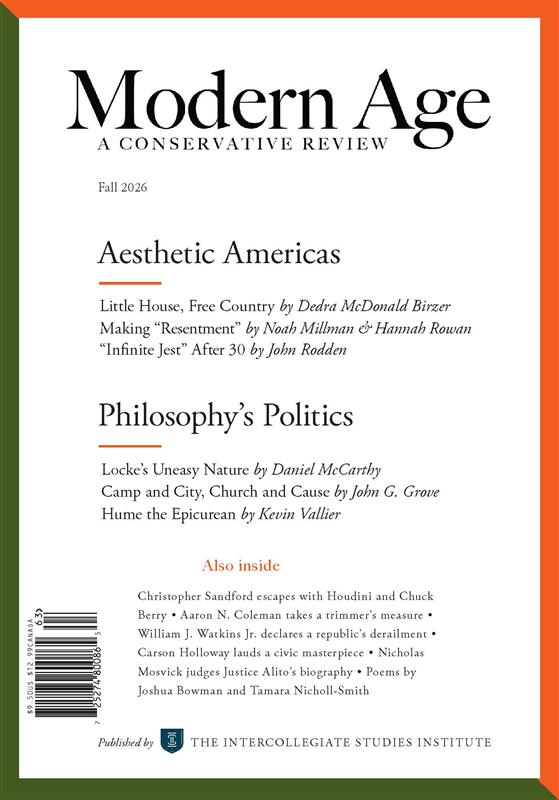
The Fall 2026 issue of Modern Age is now available online for subscribers!
Find essays and reviews by...
• @ToryAnarchist on John Locke’s anthropology
• Dedra McDonald Birzer on Little House on the Prairie
• John Rodden on David Foster Wallace’s Infinite Jest
• and more!
https://t.co/AKCrN0pvs8