Today we're announcing that Modal has crossed $1B in annualized run rate, as well as raised a $750M Series D at a $15.75B valuation, led by @Accel.
Since our Series C, usage has tripled and we’ve grown more than 15x year-over-year.
We are deeply grateful to the developers and companies building on Modal. There's still so much more to build, and we can't think of a better time to be building software.
We worked with @SakanaAILabs to optimize their Sakana Namazu API down to the kernel level:
→ Selective NVFP4 quantization (23k+ experts)
→ DFlash draft model trained on raw token streams (+25% acceptance)
→ In-house prefix KV routing + serverless autoscaling
We used Modal Sticky Sessions to reserve the avatar’s slot on a GPU container for the duration of the call, and GPU snapshots to hide cold starts without reloading gigabytes of model weights.
Read the full post: https://t.co/d8DjWqDa2Q
You can give your @livekit agent a video avatar with open-weight models running on Modal.
We used ours to clone @charles_irl, our GPU Enjoyer in Residence.
Tinker changed how people do post-training. We're big fans, and so are many of the teams we work with. But as those teams scale up, they keep raising the same two problems: per-token pricing gets expensive quickly, and you’re limited to the models and features the provider decides to support.
We think a good API deserves more than one implementation.
Today we're releasing Spindle, an open-source, Tinker-compatible training server that runs in your Modal workspace. Your existing Tinker scripts run unchanged, and because you own the server, you pay for GPU time instead of tokens.
When several runs share the same GPUs, each one costs a fraction of what it would alone. Across math RL, a multi-turn search agent, and 256K-context SWE tasks, Spindle came in 20–80% cheaper per token than running the same scripts on Tinker.
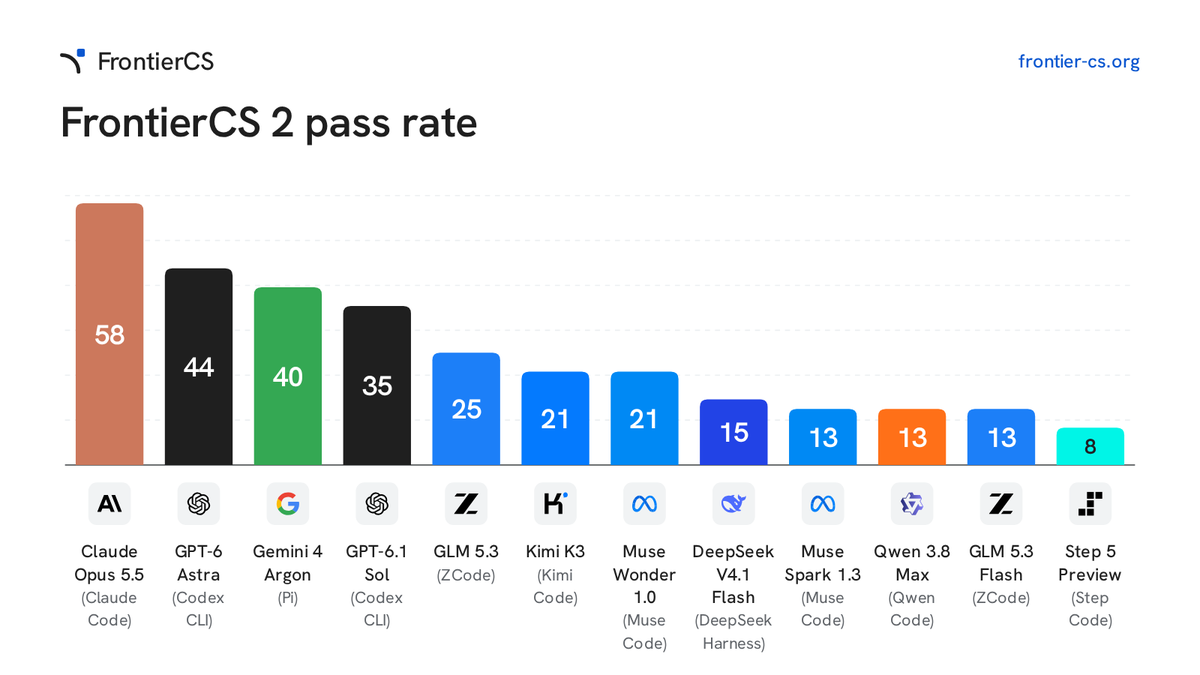
Can LLM agents contribute to frontier computer science research?
FrontierCS 2 gives a look into what agents can do as CS researchers and how much still remains open.
Powered by Modal.
FrontierCS 2 is our new benchmark for CS research & development.
Each task is based on a paper: we delete the contribution from the released code, and ask agents to outdo the original method, as judged by the authors' chosen metrics. Agents don't have access to the paper or web.
Performant reinforcement learning is a hard infrastructure and research problem. We’ve recently made on-demand multi-node clusters available and showed how to take advantageous of heterogeneous sampling compute. But there still exists the need for high-fidelity environments, clear and robust reward functions, and tuned training recipes that actually work.
Most teams are actually nearly there! With an agent harness deployed in production and evals/agent traces collected from that deployment, you just need an easy way to start training your data. So we built a training library that gives you the building blocks, tuned defaults, and observability you need for easy, production-grade LLM training.
It’s available now. All it takes is a prompt.
@AfterQuery curates long horizon data from domain experts for models to be trained on. Using our training library, they were able to kick off autoresearch for models like Kimi and DeepSeek at 256k context length on their existing datasets.
✅ 96% of issues resolved before customer impact.
✅ 99% of incidents detected within five minutes.
Read the full story to see how the team at @modal use Datadog to operate AI infrastructure across 20+ cloud providers, launching 26M containers every day while maintaining unified visibility across the platform: https://t.co/uMVuRWmlEz
Voice agents, multiplayer games, and other workloads need to maintain continuity between requests.
With Sticky Sessions, built on Modal's serverless Servers, you can route requests in a session to the same container and autoscale with demand.
Here's a look at how we built it:
Congrats to @GradiumAI on launching Phonon!
We built a voice agent with their new TTS models and Pipecat on Modal to put them to work.
Read more about Phonon and check out the demo: https://t.co/BkC560ZONl
A new frontier for on-device speech.
We're open-sourcing Phonon, a suite of TTS models under 50m parameters, setting a new standard for naturalness and accuracy across languages, with the broadest inference support to date.
Phonon-31m is available under Apache 2.0.
https://t.co/d3qa9qmnzY🧵
@modal and @GrayAreaorg are partnering to put the "art" back in "artificial intelligence".
We've sponsored a dozen projects by leading digital artists that will be shown at Gray Area next week.
Come thru on Thursday for a panel featuring @ideeplistening and @Ryphi10.
Register here: https://t.co/FW8rll2A9V