Philosopher of mind, language and society. FWF-project "What is in a question?" at CEU. Tweets about philosophy, science, politics and their intersections.
(1) Reductive non-materialism on the mind-body problem
(2) Illocutionary force is representational
(3) The 'Frege point' is BS
(3) There is knowledge – practical knowledge – expressible through imperatives
(4) Computationalism anthropomorphizes the brain
1. Does drawing harder boundaries between science and "misinformation" increase or decrease public trust in science?
In four studies conducted in the context of COVID-19, we tested this question by comparing different approaches to science communication.
https://t.co/gCXWe5KscK
I really enjoyed Apoorva's essay. It's rare these days to hear what a *student* thinks about what's going on in AI and Math, and I highly recommend you take a look at her piece – it's thoughtful, curious, idealistic, and unmistakably human.
It‘s subjective, a human activity and pure method. Mathematical operations are neither theoretical/epistemic, nor practical. They are neutral between the two and can be embedded in either. This is consistent with thinking that at least some mathematical questions have definitive answers. Some may not because they are not sufficiently clearly formulated.
To settle a troublesome discourse, I have provided here the most faithful and poetic possible translation of the beginning of the Odyssey.
We male sex. We
complex. We
fake horse. We
off course. We
sail long. We
hear song. We
pig crew. We
home soon.
@JoyfulSisyphean One can tell that you are a student of Derrida‘s by how you endlessly bait me into making statements and then ask further questions or criticize me without ever saying anything of substance yourself.
The intention is to sound profound and for him to retain plausible deniability at the same time, so that whenever it is challenged under some interpretation, he can always say that‘s not what he meant. Foucault called it „obscurantisme terroriste“.
@Modemichael@JamesWHankins1 how? please explain how obscurity is an intentional part of Derrida's writing and philosophy and what that intention is and be specific.
@JoyfulSisyphean When he says „il n'y a pas de hors-texte" but when challenged falls back on saying he only meant everything is in some context or other. When he endlessly, tediously, obscurely draws out a lame joke in „Limited Inc.“
It is not enough to think or write philosophy, it must also be performed.
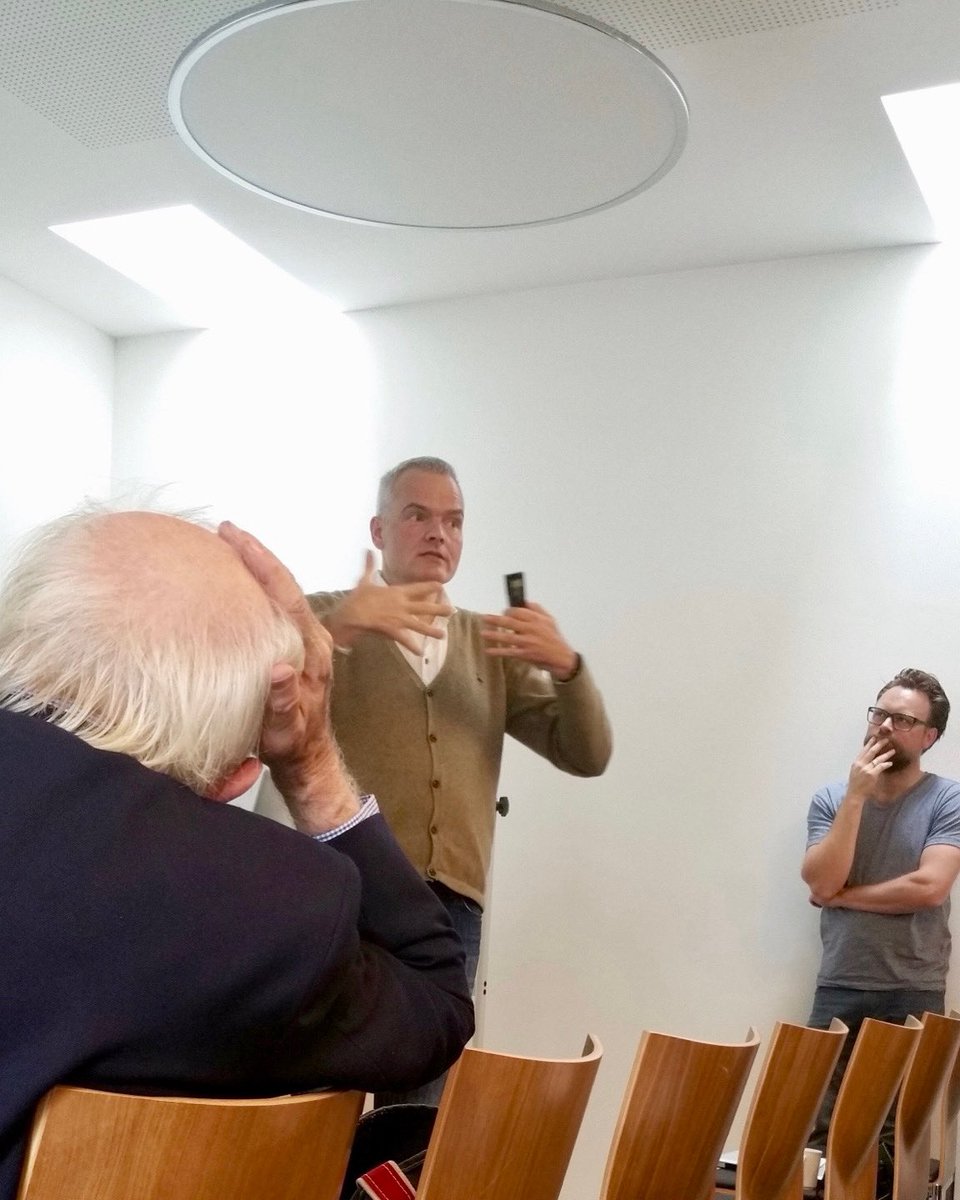
10 years ago on this day I gave a talk at a workshop organized by Tobias Schlicht around lectures by John Searle, and somebody in the audience took this shot where we all strike archetypal philosophy poses.
New piece defending the applied turn in analytic philosophy. I say what the applied turn is, how it differs from the social turn, and why it isn't just left progressivism cloaked in the language of analytic philosophy. Link in the reply.
I think you do a good job of distinguishing the „applied turn“ from the politics of some of its practitioners, from the „social turn“ and from the normal top-down understanding of „applied“. Another buzzword to consider here: „synthetic philosophy“. More arcane-sounding admittedly, it has the advantage of also including related tendencies in other parts of philosophy that you don‘t mention like the philosophy of mind in general and consciousness studies in particular.
Had an idea of making an "almost-Great Books" syllabus, which might include things like
- The best expressions of worldviews which ended up losing
- The second-best expressions of worldviews which ended up winning
- Less-known works by canonical authors
What would you put on it?
Well, I guess I've always thought that philosophy should study real world phenomena in close interdisciplinary cooperation, but I don't think this makes all this work "applied". For example, I cooperate with linguists in my work on speech acts, but it's still pretty fundamental and not applied in the sense in which e.g. applying speech act theory to pornography is. So for you all interdisciplinary work is applied?
@rbnmckenna86@robsica Interesting. I've never been told in an Austrian or German context that we'd have better chances with an applied topic. In Germany though at one point and maybe still now, there was a push for interdisciplinary projects.
@rbnmckenna86@robsica So do you think it comes partly from outside of philosophy like from politicians? That‘s possible. I would tend to think that funding rather amplifies trends already existing in the discipline, but I don‘t really know.