In by grace, kept by obedience/works/faithfulness is not the nature of the Covenant of Grace.
This is not the nature of the gospel.
We are saved by works, the works of Christ.
There is no hope without the imputed active obedience of Christ.
The standard of the law is perfect, personal, perpetual obedience.
There is only one man who has ever loved God with all His heart, soul, mind, and strength, and His neighbor as Himself. That man is Jesus Christ.
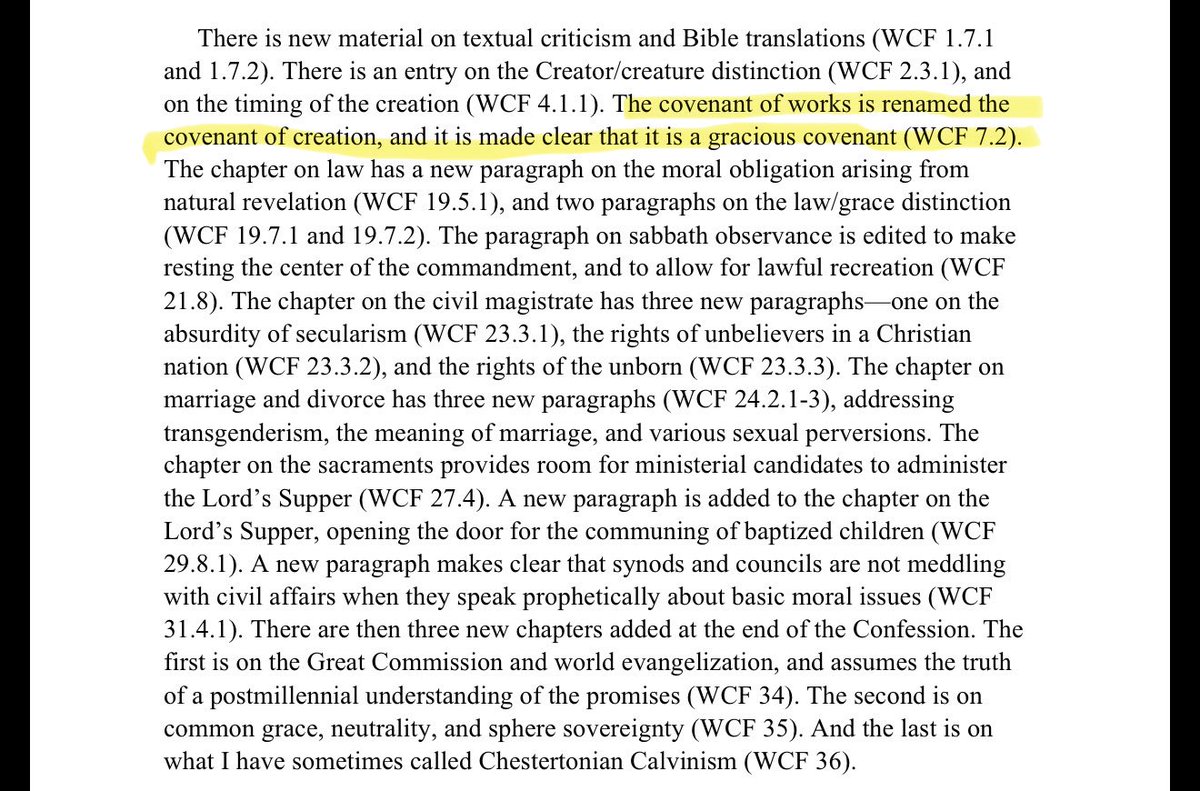
Now would be a good time to re-read my post on Wilsonian FV from 2020. They're still insisting Adam would have received eternal life "by grace through faith alone" if he had perfectly obeyed.
From their proposed "New Westminster Confession"
@AJKocman Presbyterian here: the CREC is not Presbyterian. Never has been. They are a schizophrenic denomination that believes they are a half way point between Presbyterianism and Anglicanism, but are actually neither and rely on novel theology while claiming it is ancient and catholic.
It’s almost like false teachers thrive by creeping in through a lack of clarity. God is not the author of confusion.
All things in Scripture are not alike plain in themselves, nor alike clear unto all; yet those things which are necessary to be known, believed and observed for salvation, are so clearly propounded and opened in some place of Scripture or other, that not only the learned, but the unlearned, in a due use of ordinary means, may attain to a sufficient understanding of them.
@livmeaningfully Tell that to your own denomination which have published study reports against federal vision. It’s now being confessionalized because “I’m Westminsterian through and through” assertion wasn’t holding up.
The recipients of baptism and polity are not of the same importance, as important as they are, as this.
We didn’t call it New Westminster either though, did we? Read the letter To The Judicious and Impartial Reader that prefaced the 1689 and tell me if it carries with it the same spirit as what is being done here. I’m not even Westminsterian and I’m here to defend the Westminster because of our substantial agreement with it, particularly on this point.
https://t.co/aLNzuXRWRV
I give you the “New Westminster Confession” and Catechism
The subjects of paedocommunion, Christian nationalism, postmillennialism, and other confessional innovations are issues that deserve their own attention.
But don’t let this sneak by as some inconsequential difference in terms. It is redefining the nature of the gospel.
@GeluTimoficiuc It is very here and there. The point is that the terminology is loaded beyond God merely being benevolent or condescending through covenant.
Yet when the baptists did their "New Westminster Confession", that was fine and glorious.
In one case they scorn that it's "new", in the 1689 case they want you to do a Bible study.
The provision of sacrifice and the promise of redemption belong to God’s gracious dealings with fallen sinners, not the original terms of the covenant of works.
Wilson himself explained his objection to the language of works and merit on the grounds that it obscured the gracious nature of God’s dealings with man, regardless of the covenant in view.
Consider what the proposed confession actually says. WCF 7.2 describes Adam’s perfect personal obedience as being made possible “by grace through faith alone.” This goes well beyond acknowledging God’s gracious condescension in establishing the covenant. It introduces the language of grace and faith alone into the very principle by which Adam was to fulfill its obligations.
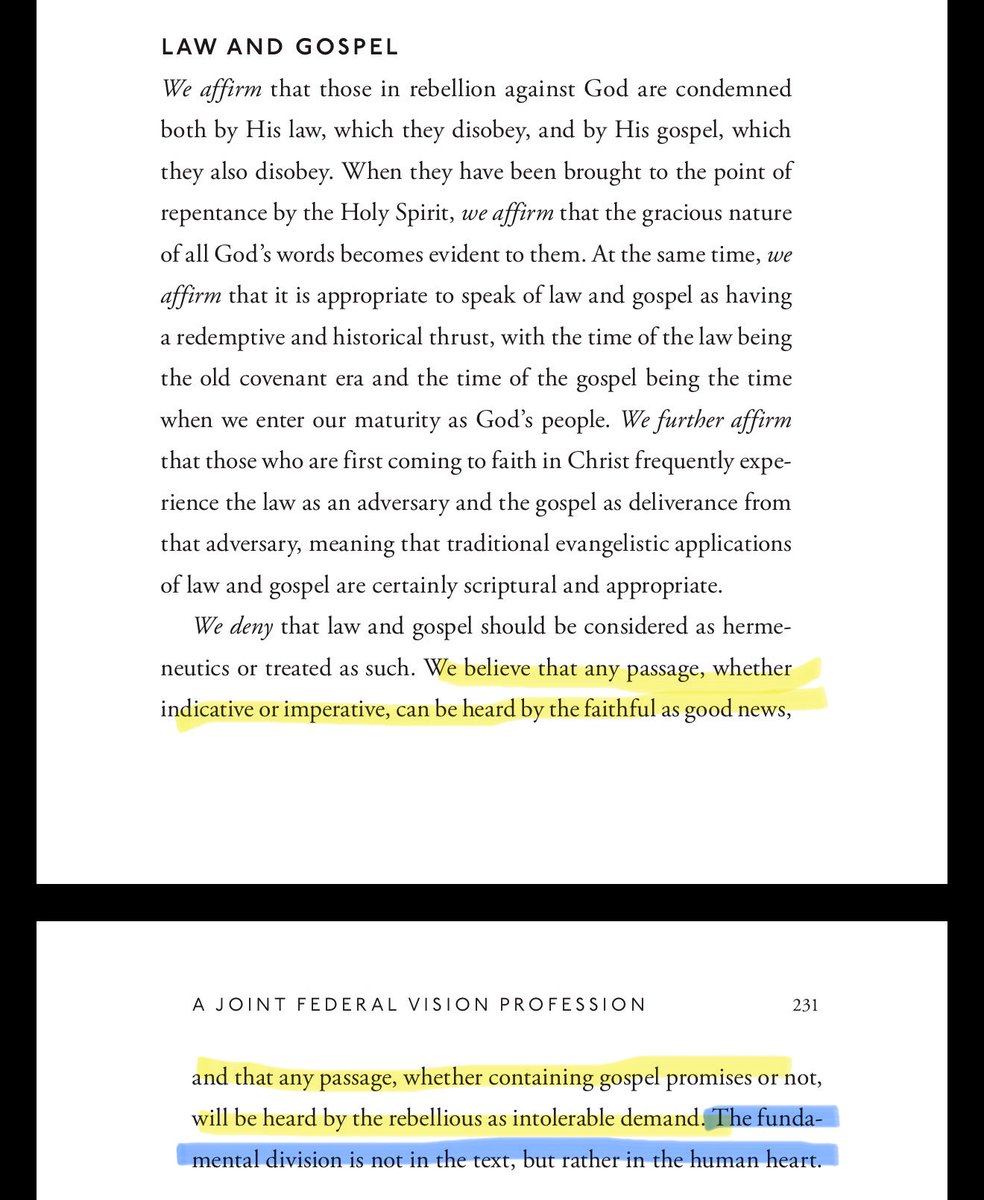
Wilson in his Joint Federal Vision Profession explicitly declares, “The fundamental division is not in the text, but rather in the human heart,” referring to law and gospel. The proposed WCF 19.7 reproduces that same theological distinction almost verbatim.
The historic Reformed distinction between works and grace is not merely a distinction between how regenerate and unregenerate men receive God’s Word. It concerns the objective difference between the righteousness required by the law and the righteousness freely bestowed through Christ in the gospel.
Adam was promised life upon perfect personal obedience. Fallen sinners receive life through the obedience of another, imputed to them and received by faith alone. God’s benevolence in establishing the former does not make it operate upon the same covenantal principle as the latter.
When these revisions are read together the issue is plainly more substantial than an innocent preference for different terminology. They reflect identifiable Federal Vision commitments concerning covenant, law, grace, and obedience, precisely where the historic Reformed distinctions must be maintained.