Quality products and exceptional service are very important to us.
Get 10% discount using the code SCOUT
DISCLAIMER: THIS IS AN AFFILIATE OWNED ACCOUNT
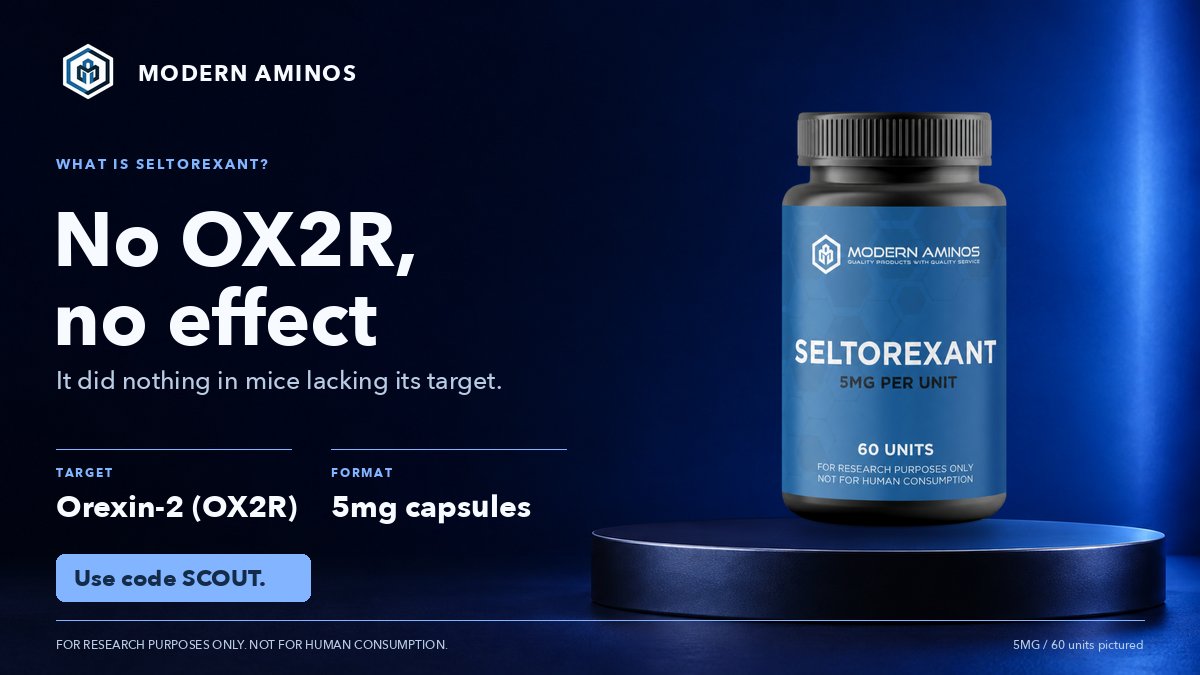
In 1999, a Stanford team traced canine narcolepsy to a mutation in one gene: the orexin-2 receptor (Lin 1999, Cell). Narcolepsy brings sudden slides from wakefulness into REM sleep. Seltorexant was built to block that same receptor.
Tesamorelin and sermorelin both speak to the pituitary through the GHRH receptor. That shared receptor is where the comparison should begin, not where it should end.
Sermorelin is a 29-amino-acid GHRH fragment. Tesamorelin extends the sequence and modifies one end to change how it survives breakdown. Researchers have also tested them in different populations. Same pathway; different molecules and evidence.
Tesamorelin and sermorelin both speak to the pituitary through the GHRH receptor. That shared receptor is where the comparison should begin, not where it should end.
In 1999, a Stanford team traced canine narcolepsy to a mutation in one gene: the orexin-2 receptor (Lin 1999, Cell). Narcolepsy brings sudden slides from wakefulness into REM sleep. Seltorexant was built to block that same receptor.
That's where it stands: investigational, not approved, with a sharply defined target and a clinical case that rests on the patients whose depression comes with poor sleep.
MOTS-C is encoded in mitochondrial DNA. AICAR is a synthetic nucleoside that cells convert into an AMP-like signal. They meet in metabolic research, but they arrive from opposite directions.
AICAR became famous after mouse endurance experiments involving AMPK. MOTS-C work asks how a mitochondria-derived peptide signals during metabolic stress. An 'exercise mimetic' label hides the chemistry that makes each worth studying.