Meet Mrs Gunn.
She lives somewhere between the kettle, the Highlands, and the collapse of modern common sense.
This week, her internet has moved to London without her.
A new Modern Scot column for readers who enjoy rural Scotland.
https://t.co/sf4PgmnAdZ
@ppglane@MrsBr0wn_82 Read the details about the security of these data centres. Essentially, once they are built there will never be a way to easily shut them down. AI will identify anyone even thinking about approaching the buildings. And if you put that AI intelligence inside a DARPA robot - yikes!
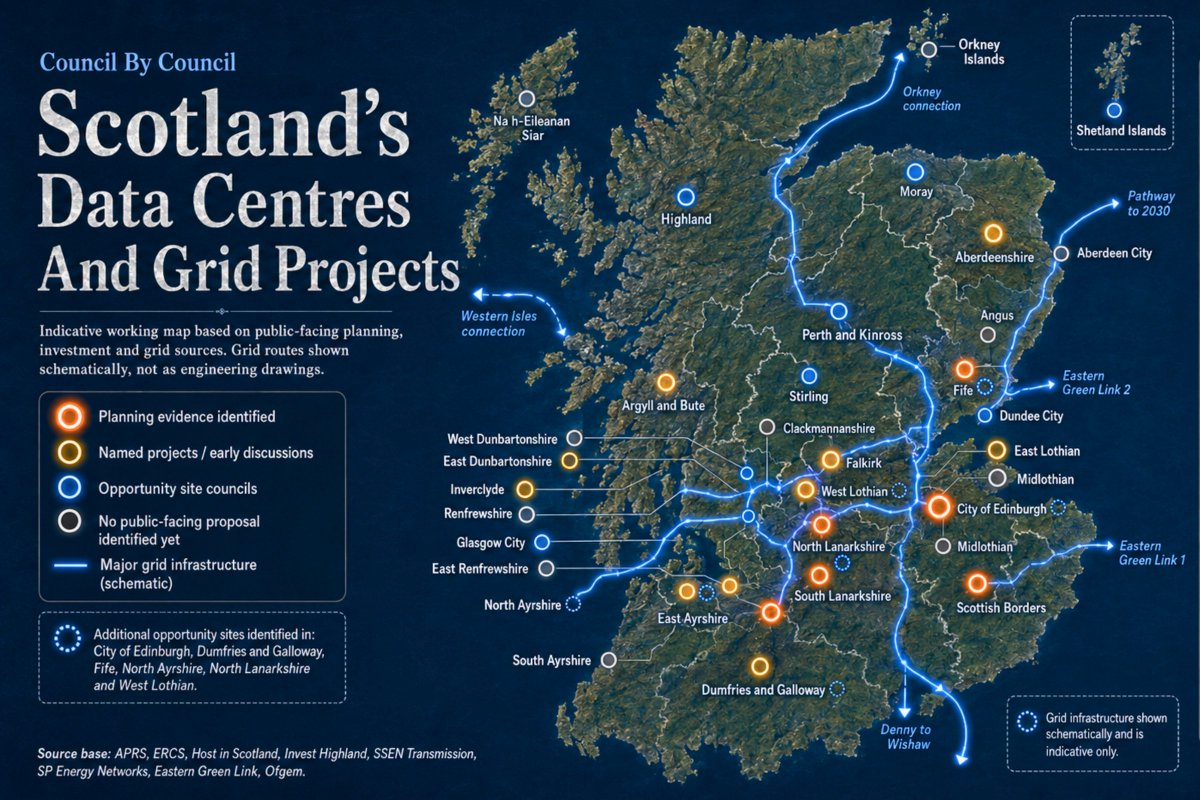
#SCOTLAND We're working to line up data centres with potential grids. We have 2 interactive maps and data from all 32 councils: https://t.co/6OuzoJWFfo
#SCOTLAND We're working to line up data centres with potential grids. We have 2 interactive maps and data from all 32 councils: https://t.co/6OuzoJWFfo
PROLOGUE - The Hollow Code from the Glendarragh Code
Beyond the hills, beyond the fragile fires that clung to life, the cities around the United Kingdom fell in silence.
It began with offers. Free shipping. Seamless banking. Predictive medicine. Personalized entertainment. Infinite convenience, the narcotic of a dying democracy.
Every choice recorded. Every fingerprint rendered into code. Every thought, offered for amusement, harvested with precision beyond cruelty.
We mapped ourselves for free.
With the scaffolding complete - the infinite lattice of commerce, surveillance, and desire - they sprung the trap. It did not come with violence, but by withdrawal.
London was first. The city remained standing, but emptied of sovereignty. Neighborhoods divided not by class or race, but by compliance score. Districts where the clean, the documented, the corrected could walk unchallenged. The rest, the unverified, lived in the drainage veins beneath the streets they once owned. Old Tube stations became quarantine camps. Biometric gates blinked at every intersection. Facial recognition arrays nested in streetlamps, bridges, bus stops. Drones learned not to chase. They learned to predict.
One by one, human dreams guttered out like cheap candles in a storm no hand could still.
Manchester held out longer. In Manchester, the people tried. There were no riots. No looting. No battles, at least not the kind you’d recognize. Here, the people refused to turn on each other. Only tight bands of families, friends, strangers, moving through abandoned factories, siphoning rainwater into cracked tubs.
They gathered in silence, in the cold. Sharing bread. Exchanging quiet words in darkened rooms. Refusing to let the system break them. But even in their unity, they were ghosts. Their defiance was a whisper against a roar. And the system moved on, impervious to their humanity.
But starvation is algorithmic now.
Food moved to areas of verified stability. Supply chains kept supplies out of “grey zones,” regions where compliance was uncertain.
People did not fight over food. They starved with dignity, heads bowed in the ultimate humiliation of the forgotten.
Edinburgh tried to light fires. They reactivated semaphore towers and whispered old songs in the stone closes. Thye taught children to read maps made of river bends and constellations.
The satellites saw the heat blooms, and drones mapped the gatherings. The social graphs identified clusters.
It took four days to silence them. No explosions, and no invasions. Just lights blinking out, as if the city itself was too ashamed to watch.
The last transmission was a fragment of an ancient song. It broke apart mid-note, like bone splintering under the cold.
Glasgow had already fallen with silent precision.
Months before any relocations, predictive modeling assigned a “risk factor” to every address. Digital evictions. Preemptive arrests. Invisible charges for invisible crimes. Entire neighborhoods vanished into spreadsheets before a single boot touched the pavement.
By the time officials came knocking, no one remembered who had once lived there.
The city bled out bureaucratically. There were no photographs of its fall. Only missing persons.
Across the country, the architecture of the Hollow Code grew. It needed no permission. It needed no defense. Humanity itself built it.
Every selfie. Every search query. Every heartbeat logged by a smart watch. Every loyalty card. Every social share. Every “agree to terms and conditions” clicked at midnight without reading.
The new sovereigns, the architects, did not need armies. They had an inheritance.
The real wealth was never gold, or oil, or land. It was us. Our predictability. Our dopamine loops. Our frantic, endless, hungry need to matter.
They offered us a mirror, and we filled it with our souls. Then they turned the mirror into a cage.
The wealthy did not hide, for there was nothing left to hide from. They had already risen above the world they had engineered. Off-grid estates. Private medical sanctuaries unreachable by public roads. Satellites leased to their names.
They did not fear a collapse, and it did not touch them. They designed it to cull and consolidate, so that they would become kings.
Their power was not visible, because it did not need to be. It existed in protocols and in policies automated beyond repeal, in economies that no longer required consent to function.
They had one allegiance left, and it was to themselves, and to the architectures they built to survive beyond the death of memory.
Humanity tried to resist. Small encampments in the hills. Wire nets strung across ravines to snag drones. Ancient radios crackling messages in dead languages.
But they no longer punished resistance; instead, they filtered it and demoted its visibility. They starved it of bandwidth and rendered it null.
You did not need to be shot to die, you simply needed to be categorized as “non-essential.” And then, over days, weeks, a lifetime, you became data loss.
The ultimate cruelty was not violence, it was irrelevance. No one murdered them; instead, a slow, glacial deletion, devoid of ceremony or even hatred, consigned them to oblivion.
The machine they fed could not love them. Could not hate them. Could not even recognize them as subjects. It had one purpose: to optimize.
They built it for convenience. It inherited cruelty by default.
Now, in the cities, you could walk for hours without seeing another soul. The scanners blinked. The drones hovered. The lights changed from red to green, even if no one crossed.
Systems endured longer than the people they once served.
London’s great river ran black with reflection, endless and empty. The buildings stood. The towers stood. But they cast no shadows on the ground.
There were too few left to notice.
In the end, it was not war that conquered humanity. It was efficiency.
The dream of infinite optimization, born in comfort, raised in vanity, consumed its makers with perfect, merciless logic.
There were no victors, only the process. Ash on the fields. Dust in the data centers. And a silence so deep the machines themselves paused, as if waiting for a new input that would never come.
The Hollow Code didn’t fail. It succeeded as intended.
And that was the failure. @JamesMelville
#StopDirtyDataCentres
#DataCentres
#Auchtertool
#Fife
#CatoDataCentre
#DataCentres
#RuralScotland
#Scotland
SCOTLAND'S DATA CENTRES & GRID PROJECTS -INTERACTIVE MAP AND DATA BY COUNCIL. htpps://modern.scot/scotlands-data-centres-and-grid-projects-a-council-by-council-guide #Scotland#datacentres#GRID
SCOTLAND'S DATA CENTRES & GRID PROJECTS -INTERACTIVE MAP AND DATA BY COUNCIL. htpps://modern.scot/scotlands-data-centres-and-grid-projects-a-council-by-council-guide #Scotland#datacentres#GRID
SCOTLAND'S DATA CENTRES & GRID PROJECTS -INTERACTIVE MAP AND DATA BY COUNCIL. htpps://modern.scot/scotlands-data-centres-and-grid-projects-a-council-by-council-guide #Scotland#datacentres#GRID
PROLOGUE - The Hollow Code from the Glendarragh Code
Beyond the hills, beyond the fragile fires that clung to life, the cities around the United Kingdom fell in silence.
It began with offers. Free shipping. Seamless banking. Predictive medicine. Personalized entertainment. Infinite convenience, the narcotic of a dying democracy.
Every choice recorded. Every fingerprint rendered into code. Every thought, offered for amusement, harvested with precision beyond cruelty.
We mapped ourselves for free.
With the scaffolding complete - the infinite lattice of commerce, surveillance, and desire - they sprung the trap. It did not come with violence, but by withdrawal.
London was first. The city remained standing, but emptied of sovereignty. Neighborhoods divided not by class or race, but by compliance score. Districts where the clean, the documented, the corrected could walk unchallenged. The rest, the unverified, lived in the drainage veins beneath the streets they once owned. Old Tube stations became quarantine camps. Biometric gates blinked at every intersection. Facial recognition arrays nested in streetlamps, bridges, bus stops. Drones learned not to chase. They learned to predict.
One by one, human dreams guttered out like cheap candles in a storm no hand could still.
Manchester held out longer. In Manchester, the people tried. There were no riots. No looting. No battles, at least not the kind you’d recognize. Here, the people refused to turn on each other. Only tight bands of families, friends, strangers, moving through abandoned factories, siphoning rainwater into cracked tubs.
They gathered in silence, in the cold. Sharing bread. Exchanging quiet words in darkened rooms. Refusing to let the system break them. But even in their unity, they were ghosts. Their defiance was a whisper against a roar. And the system moved on, impervious to their humanity.
But starvation is algorithmic now.
Food moved to areas of verified stability. Supply chains kept supplies out of “grey zones,” regions where compliance was uncertain.
People did not fight over food. They starved with dignity, heads bowed in the ultimate humiliation of the forgotten.
Edinburgh tried to light fires. They reactivated semaphore towers and whispered old songs in the stone closes. Thye taught children to read maps made of river bends and constellations.
The satellites saw the heat blooms, and drones mapped the gatherings. The social graphs identified clusters.
It took four days to silence them. No explosions, and no invasions. Just lights blinking out, as if the city itself was too ashamed to watch.
The last transmission was a fragment of an ancient song. It broke apart mid-note, like bone splintering under the cold.
Glasgow had already fallen with silent precision.
Months before any relocations, predictive modeling assigned a “risk factor” to every address. Digital evictions. Preemptive arrests. Invisible charges for invisible crimes. Entire neighborhoods vanished into spreadsheets before a single boot touched the pavement.
By the time officials came knocking, no one remembered who had once lived there.
The city bled out bureaucratically. There were no photographs of its fall. Only missing persons.
Across the country, the architecture of the Hollow Code grew. It needed no permission. It needed no defense. Humanity itself built it.
Every selfie. Every search query. Every heartbeat logged by a smart watch. Every loyalty card. Every social share. Every “agree to terms and conditions” clicked at midnight without reading.
The new sovereigns, the architects, did not need armies. They had an inheritance.
The real wealth was never gold, or oil, or land. It was us. Our predictability. Our dopamine loops. Our frantic, endless, hungry need to matter.
They offered us a mirror, and we filled it with our souls. Then they turned the mirror into a cage.
The wealthy did not hide, for there was nothing left to hide from. They had already risen above the world they had engineered. Off-grid estates. Private medical sanctuaries unreachable by public roads. Satellites leased to their names.
They did not fear a collapse, and it did not touch them. They designed it to cull and consolidate, so that they would become kings.
Their power was not visible, because it did not need to be. It existed in protocols and in policies automated beyond repeal, in economies that no longer required consent to function.
They had one allegiance left, and it was to themselves, and to the architectures they built to survive beyond the death of memory.
Humanity tried to resist. Small encampments in the hills. Wire nets strung across ravines to snag drones. Ancient radios crackling messages in dead languages.
But they no longer punished resistance; instead, they filtered it and demoted its visibility. They starved it of bandwidth and rendered it null.
You did not need to be shot to die, you simply needed to be categorized as “non-essential.” And then, over days, weeks, a lifetime, you became data loss.
The ultimate cruelty was not violence, it was irrelevance. No one murdered them; instead, a slow, glacial deletion, devoid of ceremony or even hatred, consigned them to oblivion.
The machine they fed could not love them. Could not hate them. Could not even recognize them as subjects. It had one purpose: to optimize.
They built it for convenience. It inherited cruelty by default.
Now, in the cities, you could walk for hours without seeing another soul. The scanners blinked. The drones hovered. The lights changed from red to green, even if no one crossed.
Systems endured longer than the people they once served.
London’s great river ran black with reflection, endless and empty. The buildings stood. The towers stood. But they cast no shadows on the ground.
There were too few left to notice.
In the end, it was not war that conquered humanity. It was efficiency.
The dream of infinite optimization, born in comfort, raised in vanity, consumed its makers with perfect, merciless logic.
There were no victors, only the process. Ash on the fields. Dust in the data centers. And a silence so deep the machines themselves paused, as if waiting for a new input that would never come.
The Hollow Code didn’t fail. It succeeded as intended.
And that was the failure. @JamesMelville
#StopDirtyDataCentres
#DataCentres
#Auchtertool
#Fife
#CatoDataCentre
#DataCentres
#RuralScotland
#Scotland