Contending Modernities is a global interdisciplinary research & education initiative examining Catholic, Muslim and secular interactions in the modern world.
Associate Professor David Newheiser was featured in @FloridaState's May 2026 Faculty and Staff Briefs for authoring “Hope as a Political Practice,” published on @NotreDame's blog @Modernities.
Read more: https://t.co/dn6wY92ar1
In his post on the enthnocultural empathic turn, Branko Sekulić asks: "How do religious actors reinterpret belonging, responsibility, and suffering once the violence they helped to sustain—or failed to prevent—has passed?"
https://t.co/x8U0M8JPtY
As the US threatens to again attack Iran @babakrahimi1228 writes on Habermas's death and on liberal democratic ideals: "Law no longer appeared as a rational normative force restraining power, but increasingly as the juridical expression of sovereign will."
https://t.co/kxJWrXfWqW
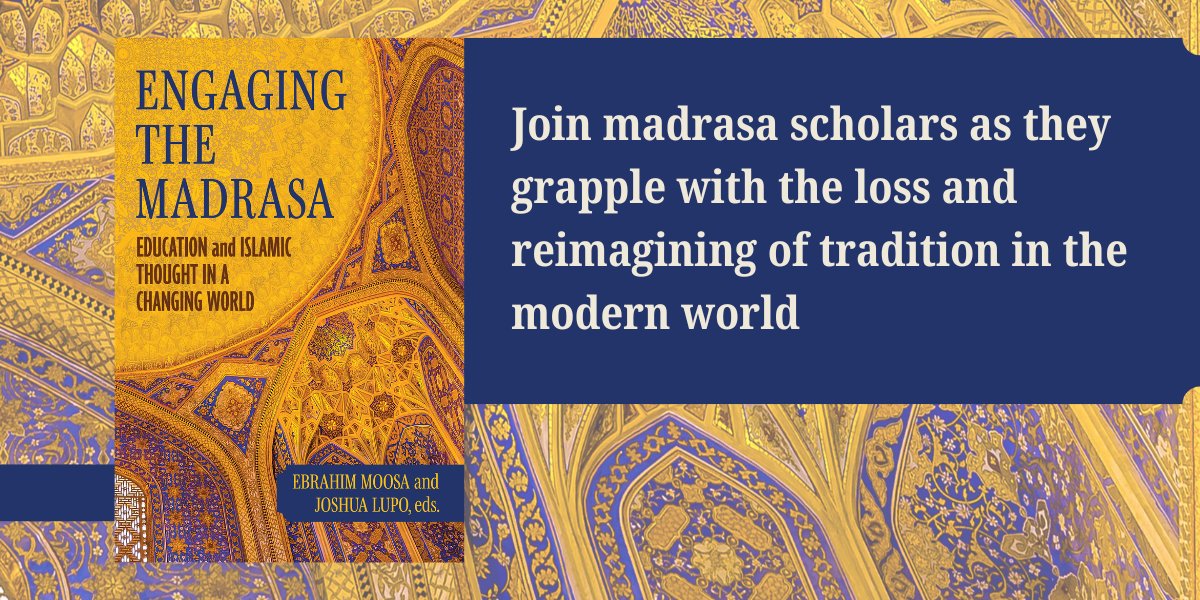
_Engaging the Madrasa_ (@UNDPress) edited by @EbrahimMoosa and Joshua Lupo is now out. Amir Hussain writes, "This marvelous volume details the madrasa tradition....It is that rare collection, filled not only with erudition but also with hope.”
https://t.co/S1WbK7KmSz
In his response to CM's symposium on _Hope in a Secular Age_, @dnewheiser writes, "By sustaining affirmation while facing uncertainty, hope sustains social movements that resist authoritarianism with creativity and courage."
https://t.co/gisbkpFZaC
Atalia Omer writes, "In contexts where people’s hopelessness is often also expressed in their hunger and marginalization, hope against despair means survival within, rather than transcendence of, the...structures shaping their predicaments of insecurity."
https://t.co/p21lCLOlbE
Exciting news! My open access book, "Muslim Theological Encounters with Science," part of the Cambridge Elements Series, is now available. This work explores the complex and nuanced relationship between Islamic theology and scientific inquiry, offering insights into historical and contemporary perspectives.
You can read it for free here: Muslim Theological Encounters with Science.
Please share this with your network!
https://t.co/Q8Ws1aTEIq
On _Hope in a Secular Age_, Joseph Winters writes, “It may be that a kind of giving up on certain prospects and objects of desire is precisely what is necessary to refuse the violent order of things (even though there is no escaping what is refused).”
https://t.co/TJV10rqwlk
In this short video, CM Co-Director @EbrahimMoosa introduces his new volume, _Muslim Theological Encounters with Science_ for @CambridgeUP's
https://t.co/ykTGiY2kMg
S. Sayyid argues that a win like Mamdani's "can show that Islamophobia is not inevitable or invincible. It can spark the recognition that Islamophobia links the local and the global, the metropole and the periphery, the racial and the colonial."@Reorient
https://t.co/36AowJn35K
Jane Barter outlines a political theology of witnessing grounded in the remnant: "Witnessing without redemption offers no catharsis. . . . But it may be the only form of witness that does not repeat the catastrophe it seeks to remember."
https://t.co/Ajnpir0kjz
Prof. Ebrahim Moosa on the pulpit today as our Khatib for the Friday prayer. He spoke about the responsibilities of a mosque in an age of global violence, drawing on Q. 41:36, verses that speak to conflict transformation.
1. Stand firmly for God
2. When they go low, go high
3. Be patient and persevere
4. If you waver, for this is not easy, seek refuge in God
An inclusive sermon and prayer about partisanship, politics, identity, forgiveness, and justice, addressing all people: migrants, natives, and citizens of the nations of the world. I wish it were recorded. He should publish it! #TGIF @EbrahimMoosa
Here are 10 Khutba Flashcards: 1/God commands in Q. 41:33: "Who is more beautiful in speech than one who calls to God, acts righteously, and says: I am among the Muslims?" This is the identity God places at the beginning. Not a tribe. Not a sect. Not a nationality. A witness to truth. And then He tells that witness exactly how to respond to a violent world. 🧵 2/The command comes in verse 34: "Repel with what is more beautiful — and the one between whom and you there was enmity will become as though a cherished intimate." Not good. More beautiful. The comparative is deliberate. God is not asking us to respond in kind. He is asking us to respond at a higher register entirely. This is the most demanding verse in the Qurʾān. 3/This pulpit does not tell you who to vote for. Many in our congregation come from Yemen, Iraq, Syria, Iran, Sudan, Libya, across Africa, Asia, and Latin America — carrying more intimate knowledge of conflict than I do. The mosque's role is not partisan advocacy. It is moral clarity: not which side is right in every war, but how a Muslim carries themselves during war. 4/Being informed means facing uncomfortable truths. Senior American counter-terrorism officials have argued that the invasion of Iraq, engineered power vacuums, and the arming of Syrian factions created the conditions in which ISIS thrived. Our government and its allies have played a malign and destabilizing role across the Muslim world. This is not conspiracy. It is documented history, spoken by insiders. 5/But Islamic ethics requires honesty about all sources of violence. The 1980's US-sponsored Iran-Iraq War killed close to a million. Saudi Arabia and the UAE have devastated Yemen. The Assad regime, backed by Iran and Russia, killed nearly half a million and displaced millions more. The capacity for mass violence runs across the entire international system. We cannot demand accountability only when the perpetrators are Western — and fall silent when they are Muslim. That is a moral failure of our own. 6/There is a war now being waged against Iran — and I say this plainly: it is illegal under international law. Whatever the legitimate grievances against the Iranian government, none of it justifies what is unfolding. We watched Iraq destroyed. Libya destroyed. Syria destroyed. In each case those who said the regime deserves it did not reckon with what followed — not the fall of a government, but the collapse of a society. If Iran is subjected to that destruction, the catastrophe will be unfathomable. 7/Q. 11:113 issues one of the Qurʾān's most severe warnings: "Do not lean toward those who have committed wrong — lest the Fire come to touch you." Do not incline. Not: do not commit the wrong yourself. Do not even tilt your posture in its direction. Do not allow sectarian preferences or old grievances to make you incline toward endorsing what is being done. The Fire comes not only to those who commit the wrong — but to those who lean toward it. 8/A man insulted Abū Bakr in the Prophet's presence. The Prophet ﷺ sat smiling — an angel was responding on Abū Bakr's behalf. When Abū Bakr finally retaliated, the Prophet stood and walked away. "There was an angel with you. But when you answered back, Satan appeared — and I am not one to sit with Satan." Forbearance keeps divine presence in the room. Retaliation changes the architecture entirely. When we feel the pull to say anyone deserved it — we should ask: who enters the room when we speak that way? 9/The Prophet ﷺ also said: "There will be a chaos (fitnah) in which the one who is seated is better than the one standing, and the one walking is better than the one hastening forward." And: "Be the furnishings of your homes." The greatest Companions — Saʿd ibn Abī Waqqāṣ, Ibn ʿUmar, men who stood at Badr — withdrew from civil strife not from cowardice but from wisdom: some fires are fed by every hand that reaches toward them, including the well-meaning one. Cultivate stillness. Guard your tongue. But do not support injustice — quietly, in every way, resist it. 10/God honored all the children of Adam (Q. 17:70) — not those with certain passports. Every child killed in Gaza, all civilians dying and who will die if this war in Iran escalates, is a soul God honored. Our religious sectarianism is visible to our children — and it is costing us them. Justice must be the standard, not sect and not nationality. The verse ends not with a command but a promise — and a description of those capable of receiving it: "none is granted this except one who possesses great fortune." God calls it a gift. So: call to God. Repel with beauty. Endure with patience. And when Satan stirs — seek refuge in God-istaʿidh billāh. آمين
@cmrmmedia@Modernities@IDHNetwork@naderalihashemi@IMESuoe@OCISOxford
In his response to Newheiser's _Hope in Secular Age_, Andrew Prevot writes, "Letting differences in content generate a more differentiated account of kinds of hope...might bring us closer to Derrida’s desired future of radical democracy and justice."
https://t.co/RVRP6NlYoa
Roger Baumann analyzes the weaponization of the Amalek narrative on a "mission" trip to Palestine/Israel with Pentecostal African American Christians and what it took to break through the dominant dehumanizing narrative about Palestinians they heard.
https://t.co/mN6xhTWf5e