@shagbastic@drogbag1@itz_taser Unfortunately, the daft and stupid ones are the loudest. Those kids probably didn't understand what was happening. I don't understand the narrative they are pushing.
It just goes to show how much the people have lost trust in the government and it is not surprising.
9. Rebuild discipline step by step, not all at once (Luke 16:10)
Don’t try to recover everything in one day. Focus on rebuilding consistency gradually. Small daily discipline will restore what was lost over time. Sustainable growth is built through steady habits, not emotional bursts.
This is why regardless of what men do, if you are a woman being kidnapped, it is always in your best interest to fight your kidnapper at the spot where they tried to kidnap you, and do your best to kill them.
Even if you die in the attempt, it’s okay.
The kidnapper doesn’t want to remain in the location where they are kidnapping you for long.
Every second you can delay them there, the odds of the situation get worse against the kidnapper.
The worst thing you can ever do is cooperate with them to move you to the location they prepared beforehand because in that location they have total control and they can and WILL do anything to you.
Your best chances of survival in a kidnapping are always in the first location at the place where they are trying to kidnap you.
Do everything in your power to remain in that location by making kidnapping you the most inconvenient thing the kidnapper has ever tried.
I experienced what @Sisi_Yemmie has been saying here on the TL today!
I was coming back from an outing and decided to get a few items from Bokku Mart.
I bought only 3 items. The attendant asked if I wanted a nylon bag and I said yes.
He said the bag was #100. But why did he deduct #1700 for the nylon?
I didn’t check the receipt until I got into the car, then I remembered and decided to check.
I went back inside and asked what the #1700 was for. He said it was an error and that I had to wait for the supervisor to fix it!
This pissed me off! He could simply have given me my change instead of making me wait for their error.
Apparently the supervisor was in on it too. He came out and quickly asked the guy to give me my change.
I can’t imagine how long this has been going on! @bokkumart, call your staff to order.
Business owners, please be very involved in your business and don’t trust any staff.
#1700 is not a lot of money but imagine doing this to 5-10 customers a day!
I never imagined I would be making this kind of plea.
My wife, Dasola, went in for a Caesarean Section to deliver our baby, but what should have been the happiest moment of our lives suddenly became a fight for survival.
She developed severe sepsis after surgery, leading to
@NancyAigbebhalu I have seen a man paralysed on one side of his body from a stroke driving a small commercial bus (korope) to earn a living. People are really struggling and suffering.
@SolaTheAnalyst I believe anyone stuck or feeling stuck should be free to come back home. And we at home, we must be more accommodating. We shouldn't beat them up or compare their journey to others. We must be more supportive. Everyone's journey is not the same.
@kingnnamdi_@WallstreetJade@switkeyz@Mochievous She didn't say that. Why are you trying to twist her words? She is giving another perspective to the conversation. That's what makes it robust.
@WallstreetJade@everytingseraph@Mochievous I think you might be right. Actually chefs earn way more than 100k even at small eateries. Unless the person was a kitchen assistant or "cook". Many chefs know their worth.
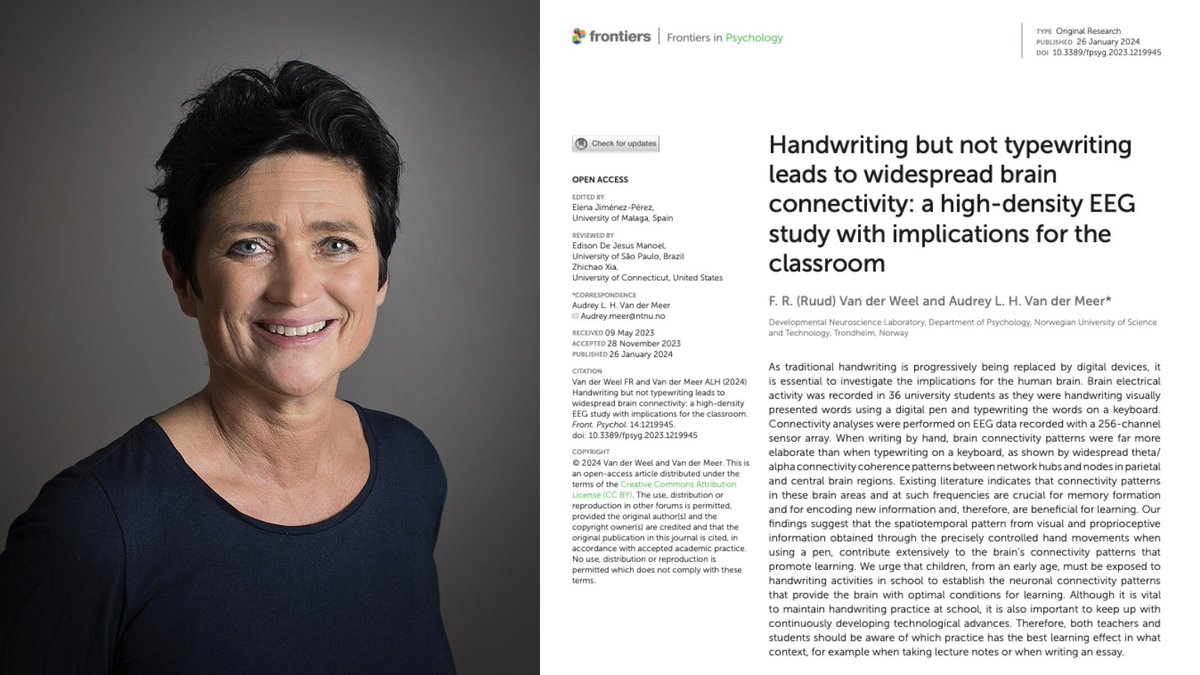
A Norwegian neuroscientist spent 20 years proving that the act of writing by hand changes the human brain in ways typing physically cannot, and almost nobody outside her field has read the paper.
Her name is Audrey van der Meer.
She runs a brain research lab in Trondheim, and the paper that closed the argument was published in 2024 in a journal called Frontiers in Psychology. The finding is brutal enough that it should have changed every classroom on Earth.
The experiment was simple. She recruited 36 university students and put each one in a cap with 256 sensors pressed against their scalp to record brain activity. Words flashed on a screen one at a time.
Sometimes the students wrote the word by hand on a touchscreen using a digital pen, and sometimes they typed the same word on a keyboard. Every neural response was recorded for the full five seconds the word stayed on screen.
Then her team looked at the part of the data most researchers had ignored for years, which is how different parts of the brain were communicating with each other during the task.
When the students wrote by hand, the brain lit up everywhere at once.
The regions responsible for memory, sensory integration, and the encoding of new information were all firing together in a coordinated pattern that spread across the entire cortex. The whole network was awake and connected.
When the same students typed the same word, that pattern collapsed almost completely.
Most of the brain went quiet, and the connections between regions that had been alive seconds earlier were nowhere to be found on the EEG.
Same word, same brain, same person, and two completely different neurological events.
The reason turned out to be something nobody had really paid attention to before her work. Writing by hand is not one motion but a sequence of thousands of tiny micro-movements coordinated with your eyes in real time, where each letter is a different shape that requires the brain to solve a slightly different spatial problem.
Your fingers, wrist, vision, and the parts of your brain that track position in space are all working together to produce one letter, then the next, then the next.
Typing throws all of that away. Every key on a keyboard requires the exact same finger motion regardless of which letter you are pressing, which means the brain has almost nothing to integrate and almost no problem to solve.
Van der Meer said it plainly in her interviews.
Pressing the same key with the same finger over and over does not stimulate the brain in any meaningful way, and she pointed out something that should scare every parent who handed their kid an iPad.
Children who learn to read and write on tablets often cannot tell letters like b and d apart, because they have never physically felt with their bodies what it takes to actually produce those letters on a page.
A decade before her, two researchers at Princeton ran the same fight using a completely different method and ended up at the same answer. Pam Mueller and Daniel Oppenheimer tested 327 students across three experiments, where half took notes on laptops with the internet disabled and half took notes by hand, before testing everyone on what they actually understood from the lectures they had watched.
The handwriting group won by a wide margin on every question that required real understanding rather than surface recall.
The reason was hiding in the transcripts of what the two groups had actually written down.
The laptop students typed almost word for word, capturing more total content but processing almost none of it as they went, while the handwriting students physically could not write fast enough to transcribe a lecture in real time, which forced them to listen carefully, decide what actually mattered, and put it in their own words on the page.
That single act of choosing what to keep was the learning itself, and the keyboard had quietly skipped the choosing and skipped the learning along with it.
Two studies. Two countries. Same answer.
Handwriting makes the brain work. Typing lets it coast.
Every note you have ever typed instead of written went into your brain through a thinner pipe. Every meeting, every book highlight, every idea you captured on your phone instead of on paper was processed at half depth.
You did not forget those things because your memory is bad. You forgot them because typing never woke the part of the brain that would have made them stick.
The fix is the thing your grandmother already knew.
Pick up a pen. Write the thing down. The slower road is the faster one.
In my classroom, I noticed my students do better when they write notes with pen and paper. Even though it is easier to send printed texts to their WhatsApp or emails, they often have difficulty recalling what they read. But what they write gets stuck in their brains.
Piece of advice: if you are a parent, watch out what the Finns are doing and copy them. It's one of the few countries that pays closer attention to their youth. They observe, study, and adjust all the time!
For example, they are now gradually reversing their decade-long, tech-heavy education model to combat declining cognitive performance and severe classroom distractions. Schools are scaling back on devices in favor of printed textbooks, handwriting instruction, and pen-and-paper assignments.