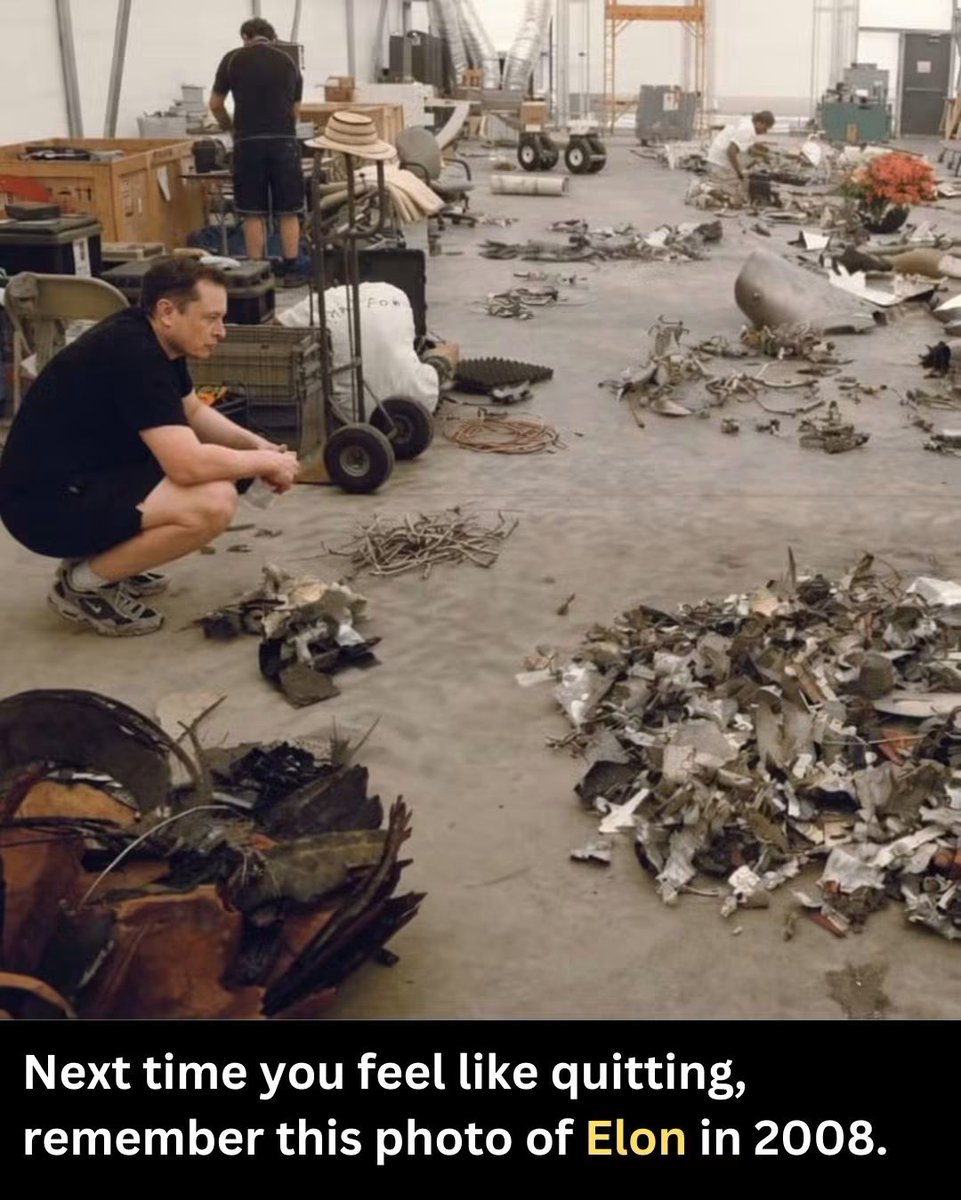
In 2008, Elon Musk was broke, divorcing, and watching his rockets explode one after another.
Three Falcon 1 launches. Three failures. Over $100 million gone. Tesla was days away from missing payroll. He was borrowing money from friends just to cover rent.
This photo was taken after one of those crashes. No breakdown. No press conference. Just a man crouched in the wreckage, thinking about what comes next.
He had enough parts for one more rocket. One last shot.
The fourth launch worked.
Days later, NASA handed SpaceX a $1.6 billion contract. On Christmas Eve 2008, Tesla's financing round closed in the final hour — or 1,200 employees would have gone unpaid two days later.
He later called it the worst year of his life. He also never stopped.
Next time you feel like quitting, remember the man sitting in that wreckage.
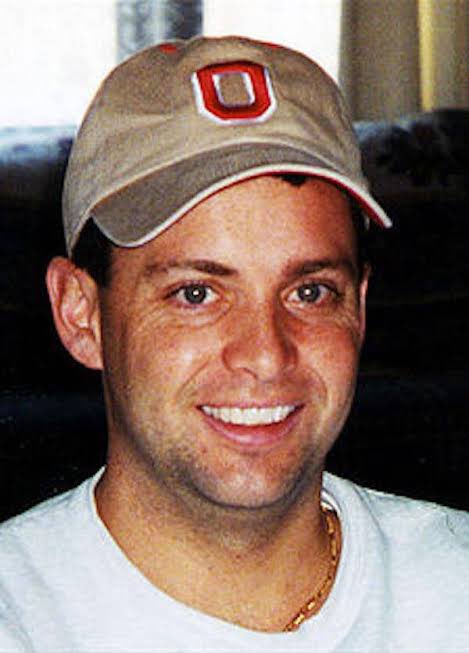
This is Todd “Let’s Roll” Beamer, who died heroically while trying to retake United Flight 93 from Al Qaeda terrorists on 9/11. His final resting place, is in Cranbury, NJ — where he was living with his wife and children before his murder. Cranbury is located in NJ-12, where the new Democratic nominee for Congress is Adam Hamawy.
Hamawy was a close associate and translator to Omar Abdel-Rahman, aka the ‘Blind Sheikh,’ an arch terrorist convicted of masterminding multiple plots against targets in NYC — including the World Trade Center. Hamawy testified at Adbel-Rahman’s trial, as a defense witness.
It has also been reported that Hamawy traveled to Bosnia to volunteer at an organization that was later unmasked as an Al Qaeda front group.
One of Hamawy’s loudest and most high-profile supporters and endorsers has openly declared that America deserved the 9/11 attacks.
Hamawy is now the prohibitive frontrunner to represent Todd Beamer’s district in the United States Congress.
This guy's chickens kept getting targeted by hawks, so he started feeding local crows. Now he has an army of crows that patrols his property and chases the hawks away.
Dear @WhiteHouse, my name is Rodney Smith Jr., founder of Raising Men & Women Lawn Care Service in Huntsville, Alabama. Through our 50 Yard Challenge, over 6,000 kids across the country have signed up to mow free lawns for the elderly, disabled, veterans, active-duty military, first responders, and single parents. With America celebrating its 250th birthday this year and me also being born on July 4th, I wanted to humbly ask if a few kids from our program and myself could travel to Washington, D.C. to help mow the White House lawn for this historic celebration.
More than anything, I want these kids to see how a simple act of service something as ordinary as mowing a lawn for someone in need can lead to extraordinary places. What better lesson in community service than showing them that helping others can take them all the way to our nation’s capital? I’d also love to bring my American flag-themed mower in hopes that the President might sign it, so I can later auction it off and donate 100% of the proceeds to a nonprofit supporting veterans. It would be a once-in-a-lifetime opportunity to highlight the importance of service, patriotism, and the impact young people can have when they choose to make a difference. 🇺🇸
@TraceMcsorley8@lvmartymcfly@bigheadhcky Dude, I'm an Avs fan and I can say without a doubt this has nothing to do with injuries. Avs are getting badly outplayed and out coached.
That water clarity is an engineering decision, and the math behind it is wilder than the video.
Roman aqueducts ran on gravity alone. No pumps, no pressure systems. Engineers carved channels with a gradient so shallow it borders on absurd. The Pont du Gard in southern France drops 2.5 centimeters over 275 meters. That's roughly the thickness of a coin over the length of three football fields. They surveyed that accuracy with plumb lines and wooden leveling instruments.
The clarity you're seeing is a direct product of flow velocity. Too steep and the water erodes the channel walls, picks up sediment, turns brown. Too flat and it stagnates. Roman engineers targeted a slope of about 20 centimeters per kilometer, which kept the water moving fast enough to stay fresh but slow enough to stay clear. Before the water reached the city, it passed through multi-chamber settling tanks where velocity dropped near zero. Suspended particles sank. Clean water flowed out the top into the next chamber. Repeat three or four times.
Pliny specified the minimum slope in writing. Vitruvius published the exact mortar ratio for hydraulic cement: one part lime to two parts volcanic ash for underwater work. The pozzolana from Pozzuoli reacted with water to form a calcium-aluminum-silicate compound that actually gets stronger the longer it sits submerged. Modern concrete degrades in water. Roman concrete bonds with it.
Scale the whole system and it gets harder to process. Eleven aqueducts fed Rome at its peak. Combined output: roughly 1 million cubic meters of water per day. That works out to about 250 gallons per person for a city of one million. Modern New York delivers about 125 gallons per person per day. Ancient Rome had access to double the per capita water supply of the largest city in the United States, running entirely on slope and stone.
The Trevi Fountain in Rome is still fed by one of them. Two thousand years, same source, same gravity, same water.