Since 1980, Washington, Journalist, Arabic newspapers. Since 2008, often Silent Jihad at The White House -- until I die!: WHAT IS TERRORISM? and WHAT IS ISLAM?
(Full Opinion) My Vigil in Front of "The Washington Post": I Am African, Not Black
On July 29, at ten o’clock in the morning, I plan to start an occasional, silent, and lonely vigil in front of The Washington Post building in Washington, D.C.
I will raise a large 3x5-foot sign above my head, bearing this message on both sides: “I am African, not Black.” In smaller print beneath it, the sign will read: “Jesse Jackson to Blacks: Stop Skin Color Identity.”
Six years ago on that exact date, just two months after George Floyd, a Black man, was killed by a white policeman in Minnesota—and as the nation rallied in anger—The Washington Post announced a major change to its style guide, capitalizing the word “Black.”
Paradoxically, the Post stated that "individuals who prefer not to confine themselves to identity based solely on the color of their skin... will have the opportunity to identify" themselves as they wish.
Yet, the newspaper instituted glaring exceptions. The capitalization would not apply if race was not “clearly relevant;” nor when used in contexts that “many consider the terms insults or slurs;” and nor when “used to promote ideologies or advocate ethnic superiority.”
Most jarringly, the rule was suspended "in crime stories"—a distinction that yields absurd contrasts, such as: “The victim was White and the suspect was black.”
The newspaper extended this new style internationally, an insult I took personally: “The upper-case B in Black to identify the many groups that make up the African diaspora in America and elsewhere.”
Meanwhile, the newspaper continued to use geographic terms like “Asian American” (not Yellow); “Latino/Mexican American” (not Brown); and disregarded “European American” in favor of the color-coded “White.”
That same year, The Associated Press started capitalizing “Black” across the board, declaring that “The lowercase black is a color, not a person.” The New York Times followed suit, alongside outlets like Salon, The Huffington Post, and The Nation.
The Times defense of the change included the flawed assertion that "Black" serves as “an accurate description of race.”
The net effect of this media-wide shift has been the near-total abandonment of “African American” and the aggressive reinforcement of “Black.”
I deeply resent two things about this paradigm:
First, being forced into a group defined solely by epidermal pigmentation.
Second, the implication that my lifelong admiration and respect for Western civilization is somehow tied to the skin color of Westerners.
When I first arrived in the United States in 1972, I was surprised and confused by bureaucratic forms that offered only one option for someone of my background: “Negro or Black.” I checked “Other” and proudly wrote “Sudanese,” inherently rejecting the premise of color-coded categorization.
It was only in 2000 that the term “African-American” finally appeared on the U.S. census, and I grabbed it—grateful for a descriptor that acknowledged my African roots and my naturalized American citizenship.
In the early 1980s, during interviews with the Rev. Jesse Jackson, I complained to him about the restrictive “Negro or Black” classification, telling him I preferred to be identified as “African” or “Arab-African.” At the time, Jackson was heavily involved in international diplomacy and pro-Arab initiatives, including supporting Palestinian rights and mediating between the U.S. and Arab leaders. Domestically, he was launching a massive campaign to pivot the terminology from "Black" to “African-American.”
Jackson told me he had envisioned this shift two decades earlier but had been sidelined by the rising popularity of the "Black Power" slogan championed by more radical figures like Stokely Carmichael. Moderate civil rights leaders, including the Rev. Martin Luther King Jr., criticized the phrase. In 1966, The New York Times quoted King warning that the phrase “Black Power” “falls on the ear as racism in reverse,” advocating instead for a shared distribution of institutional power with white Americans.
In 1988, Jackson invited me to a historic conference of Black leaders in Chicago where he officially launched his “African-American” campaign. Though I was unable to attend, his address resonated deeply.
“To be called ‘African-Americans’ has cultural integrity,” Jackson argued. “It puts us in our proper historical context. Every ethnic group in this country has a reference to some land base, some historical cultural base. African-Americans have hit that level of cultural maturity.”
He explicitly warned that “Black does not describe our situation... To be called black is baseless.” He pointed out that hyphenated identities—such as Armenian Americans, Jewish Americans, Arab Americans, and Italian Americans—conferred a healthy “degree of accepted and reasonable pride,” connecting citizens to both their heritage and their current home.
"Black," Jackson insisted, was inaccurate even on a micro level: “In my household, there are seven people, and none of us have the same complexion. We are of African-American heritage.”
Jackson acknowledged that breaking the habit would be difficult. The U.S. government had institutionalized “black” for decades via the census, and many inside the community resisted the change.
Yet, his efforts bore fruit. By the early 1990s, "African American" had taken firm root in media and politics. A 1991 study in Political Science Quarterly noted that major Black-oriented radio stations and newspapers had adopted the phrase, and mainstream columnists widely approved.
By 1989, The Washington Post used “African-American” hundreds of times across quotations, headlines, and editorials. The phrase grew exponentially over the next three decades, peaking during the Obama administration—even though Barack Obama preferred to be described as “Black.”
His choice disappointed many for ignoring his while mother, including myself, as he missed a profound historical opportunity to transcend rigid racial binaries by embracing his biracial identity.
As the father of three biracial children, I wondered how such a transformative figure could choose to reinforce a stark racial gap rather than bridge it.
This corporate media’s sudden reversion to color-based capitalization may be framed as benevolent or progressive. But it reinforces a historical paternalism: the white majority in America’s institutions claiming the unilateral right to decide how non-whites Americans are named—and also the rest of the world
I, standing outside The Washington Post with my sign, am not merely protesting a shift in corporate media style; I am defending the right to geographic, cultural, and historical dignity.
To reduce the vast, rich tapestry of the African diaspora to a solitary capitalized color is an act of intellectual regression, masquerading as progress.
True identity is anchored in land, lineage, and legacy, not the superficiality of skin tone.
https://t.co/JnX0lirTRf
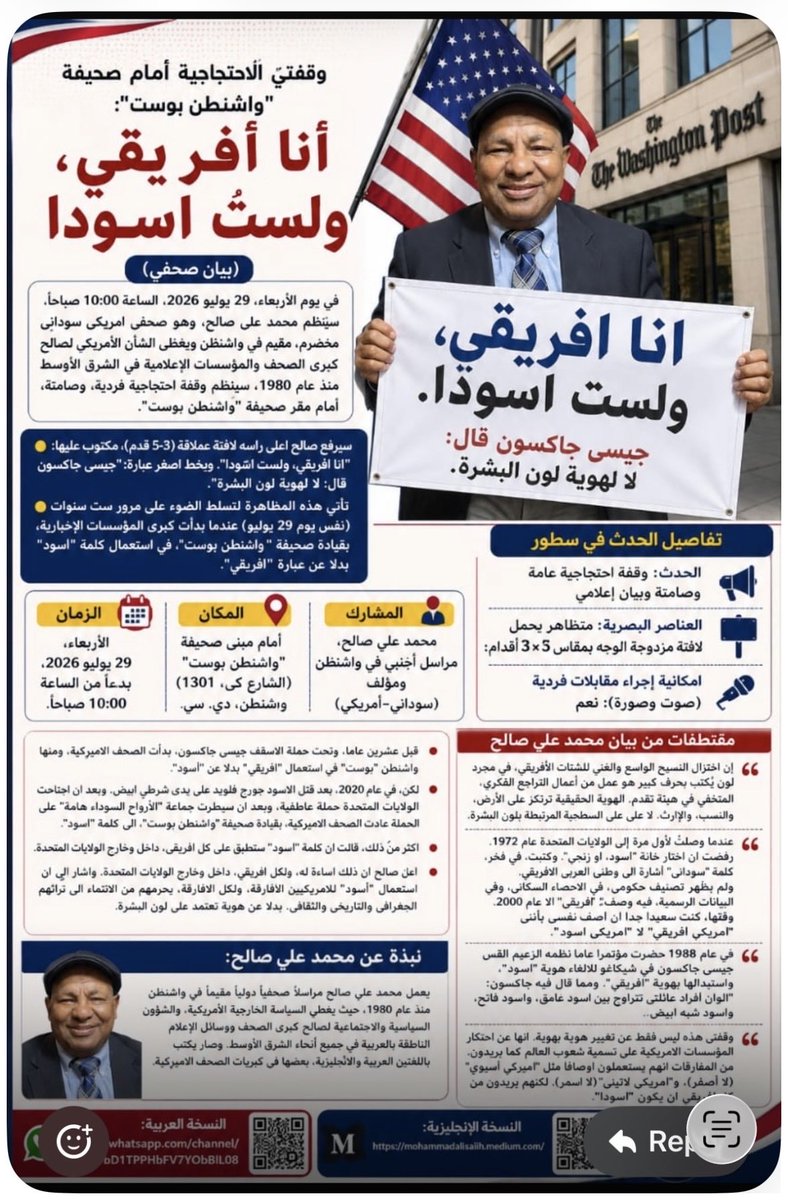
وقفتي الاحتجاجية أمام صحيفة"واشنطن بوست": أنا أفريقي، ولستُ اسودا"
(بيان صحفي)
في يوم الأربعاء، 29 يوليو 2026، الساعة 10:00 صباحاً، سينظم محمد علي صالح، وهو صحفى امريكى سودانى مخضرم، مقيم في واشنطن ويغطي الشأن الأمريكي لصالح كبرى الصحف والمؤسسات الإعلامية في الشرق الأوسط منذ عام 1980، سينظم وقفة احتجاجية فردية، وصامتة، أمام مقر صحيفة "واشنطن بوست."
سيرفع صالح اعلى راسه لافتة عملاقة (5ـ 3 قدم)، مكتوب عليها: "انا افريقى، ولست اسودا."
وبخط اصغر عبارة: "جيسى جاكسون قال: لا لهوية لون البشرة."
تأتي هذه المظاهرة لتسلط الضوء على مرور ست سنوات (نفس يوم 29 يوليو) عندما بدأت كبرى المؤسسات الإخبارية، بقيادة صحيفة "واشنطن بوست"، في استعمال كلمة "اسود" بدلا عن عبارة "افريقى"
قبل عشرين عاما، وتحت حملة الاسقف جيسى جاكسون، بدات الصحف الاميركية، ومنها واشنطن "بوست" في استعمال "افريقى" بدلا عن "اسود."
لكن، في عام 2020، بعد قتل الاسود جورج فلويد على يدى شرطى ابيض. وبعد ان اجتاحت الولايات المتحدة حملة عاطفية، وبعد ان سيطرت جماعة "الارواح السوداء هامة" على الحملة، عادت الصحف الاميركية، بقيادة صحيفة "واشنطن بوست"، الى كلمة "اسود."
اكثر من ذلك، قالت ان كلمة "اسود" ستطبق على كل افريقي، داخل وخارج الولايات المتحدة.
اعلن صالح ان ذلك اساءة له، ولكل افريقي، داخل وخارج الولايات المتحدة. واشار الى ان استعمال "اسود" للاميركيين الافارقة، ولكل الافارقة، يحرمهم من الانتماء الى تراثهم الجغرافى والتاريخى والثقافى. بدلا عن هوية تعتمد على لون البشرة.
-----------------
تفاصيل الحدث في سطور
الحدث: وقفة احتجاجية عامة وصامتة وبيان إعلامي
-- المشارك: محمد علي صالح، مراسل أجنبي في واشنطن ومؤلف (سوداني-أمريكي)
-- الزمان: الأربعاء، 29 يوليو 2026، بدءاً من الساعة 10:00 صباحاً.
-- المكان: امام مبنى صحيفة "واشنطن بوست" (الشارع كى، 1301)
-- العناصر البصرية: متظاهر يحمل لافتة مزدوجة الوجه بمقاس 3×5 أقدام؛
-- امكانية إجراء مقابلات فردية (صوت وصورة): نعم
-----------------------
مقتطفات من بيان محمد علي صالح
إن اختزال النسيج الواسع والغني للشتات الأفريقي في مجرد لون يُكتب بحرف كبير هو عمل من أعمال التراجع الفكري، المتخفي في هيئة تقدم.
الهوية الحقيقية ترتكز على الأرض، والنسب، والإرث. لا على على السطحية المرتبطة بلون البشرة.
عندما وصلتُ لأول مرة إلى الولايات المتحدة عام 1972، رفضت ان اختار خانة "اسود، او زنجى." وكتبت، في فخر، كلمة "سودانى" اشارة الى وطنى العربى الافريقي.
ولم يظهر تصنيف حكومى، في الاحصاء السكانى، وفي البيانات الرسمية، فيه وصف "افريقى" الا عام 2000.
وقتها، كنت سعيدا جدا ان اصف نفسى باننى "امريكى افريقى" لا "امريكى اسود."
في عام 1988 حضرت مؤتمرا عاما نظمه الزعيم القس جيسى جاكسون في شيكاغو للالغاء هوية "اسود"، واستبدالها بهوية "افريقى."
ومما قال فيه جاكسون: "الوان افراد عائلتى تتراوج بين اسود غامق، واسود فاتح، واسود شبه ابيض.
وقفتى هذه ليس فقط عن تغيير هوية بهوية. انها عن احتكار المؤسسات الامريكية على تسمية شعوب العالم كما يريدون. من المفارقات انهم يستعملون اوصافا مثل "اميركي اسيوى" (لا اصفر)، و"امريكى لاتينى (لا اسمر). لكنهم يريدون من كل افريقى ان يكون "اسودا."
------------------
نبذة عن محمد علي صالح:
يعمل محمد علي صالح مراسلاً صحفياً دولياً مقيماً في واشنطن منذ عام 1980، حيث يغطي السياسة الخارجية الأمريكية، والشؤون السياسية والاجتماعية لصالح كبرى الصحف ووسائل الإعلام الناطقة بالعربية في جميع أنحاء الشرق الأوسط. وصار يكتب باللغتين العربية والانجليزية، بعضها فى كبريات الصحف الاميركية.
النسخة العربية: https://t.co/kN9B9eHBa7
النسخة الإنجليزية: https://t.co/JnX0lirm1H
MY VIGIL IN FRONT OF “THE WASHINGTON POST”: I AM AFRICAN; NOT BLACK
(Press Release)
WASHINGTON, D.C. — On Wednesday, July 29, 2026, at 10:00 AM, Mohammad Ali Salih—a veteran Washington-based foreign correspondent covering the U.S. for major Middle Eastern publications since 1980—will hold a public, silent vigil outside the headquarters of The Washington Post.
Salih will display a 3x5-foot sign reading: “I am African, not Black” with the secondary line: “Jesse Jackson: Stop Skin Color Identity.”
The demonstration marks six years since major news organizations capitalized the word "Black" in their style guides—a shift Salih argues abandons cultural, geographic, and historical dignity in favor of superficial color-coded categorization.
-----------------
EVENT DETAILS AT A GLANCE
WHAT: Public Silent Vigil and Media Statement
WHO: Mohammad Ali Salih, Washington Foreign Correspondent & Author (Sudanese-American)
WHEN: Wednesday, July 29, 2026, starting at 10:00 AM EDT
WHERE: Outside The Washington Post Building (1301 K St NW, Washington, D.C.)
VISUALS: Demonstrator holding double-sided 3x5-foot banner; availability for one-on-one camera and audio interviews on site.
MEDIA CONTACT:
Name: Mohammad Ali Salih
Phone: (703) 625-4179
Email: [email protected]
-----------------------
STATEMENT EXCERPTS FROM MOHAMMAD ALI SALIH
"To reduce the vast, rich tapestry of the African diaspora to a solitary capitalized color is an act of intellectual regression, masquerading as progress. True identity is anchored in land, lineage, and legacy, not the superficiality of skin tone."
"When I first arrived in the United States in 1972, I checked 'Other' on bureaucratic forms and proudly wrote 'Sudanese,' inherently rejecting the premise of color-coded categorization. It was only in 2000 that 'African-American' appeared on the U.S. census, acknowledging my African roots and naturalized American citizenship."
"In 1988, the Rev. Jesse Jackson launched a campaign urging a shift away from 'Black,' arguing that to be called African-American confers cultural integrity and historical context, whereas 'Black does not describe our situation... to be called black is baseless.' The sudden media reversion to color-based capitalization reinforces a historical paternalism: corporate media claiming the right to decide how non-white Americans—and the rest of the world—are named."
------------------
About Mohammad Ali Salih
Mohammad Ali Salih has served as a full-time Washington-based foreign correspondent since 1980, reporting on U.S. foreign policy, politics, and society for major Arabic-language newspapers and media outlets across the Middle East.
Arabic: https://t.co/kN9B9eHBa7
English: https://t.co/JnX0lirm1H
MY VIGIL IN FRONT OF “THE WASHINGTON POST”: I AM AFRICAN; NOT BLACK
(Press Release)
WASHINGTON, D.C. — On Wednesday, July 29, 2026, at 10:00 AM, Mohammad Ali Salih—a veteran Washington-based foreign correspondent covering the U.S. for major Middle Eastern publications since 1980—will hold a public, silent vigil outside the headquarters of The Washington Post.
Salih will display a 3x5-foot sign reading: “I am African, not Black” with the secondary line: “Jesse Jackson: Stop Skin Color Identity.”
The demonstration marks six years since major news organizations capitalized the word "Black" in their style guides—a shift Salih argues abandons cultural, geographic, and historical dignity in favor of superficial color-coded categorization.
-----------------
EVENT DETAILS AT A GLANCE
WHAT: Public Silent Vigil and Media Statement
WHO: Mohammad Ali Salih, Washington Foreign Correspondent & Author (Sudanese-American)
WHEN: Wednesday, July 29, 2026, starting at 10:00 AM EDT
WHERE: Outside The Washington Post Building (1301 K St NW, Washington, D.C.)
VISUALS: Demonstrator holding double-sided 3x5-foot banner; availability for one-on-one camera and audio interviews on site.
MEDIA CONTACT:
Name: Mohammad Ali Salih
Phone: (703) 625-4179
Email: [email protected]
-----------------------
STATEMENT EXCERPTS FROM MOHAMMAD ALI SALIH
"To reduce the vast, rich tapestry of the African diaspora to a solitary capitalized color is an act of intellectual regression, masquerading as progress. True identity is anchored in land, lineage, and legacy, not the superficiality of skin tone."
"When I first arrived in the United States in 1972, I checked 'Other' on bureaucratic forms and proudly wrote 'Sudanese,' inherently rejecting the premise of color-coded categorization. It was only in 2000 that 'African-American' appeared on the U.S. census, acknowledging my African roots and naturalized American citizenship."
"In 1988, the Rev. Jesse Jackson launched a campaign urging a shift away from 'Black,' arguing that to be called African-American confers cultural integrity and historical context, whereas 'Black does not describe our situation... to be called black is baseless.' The sudden media reversion to color-based capitalization reinforces a historical paternalism: corporate media claiming the right to decide how non-white Americans—and the rest of the world—are named."
------------------
About Mohammad Ali Salih
Mohammad Ali Salih has served as a full-time Washington-based foreign correspondent since 1980, reporting on U.S. foreign policy, politics, and society for major Arabic-language newspapers and media outlets across the Middle East.
Arabic: https://t.co/kN9B9eHBa7
English: https://t.co/JnX0lirm1H
###
صحيفة "الاصطناعى" اليومية: ايران وحالة ترامب العقلية
صحيفة "الاصطناعي" اليومية هي اكثر الصحف نزاهة عبر التاريخ. يعدها الاصطناعي. ويراجعها محمد علي صالح، رئيس التحرير، وصحفى في واشنطن منذ عام 1980.
--------------------
واشنطن: محمد علي صالح:
أوضحت التغطية الإعلامية مؤخرا تذبذبا في علاقات الرئيس ترامب مع ايران، عسكريا ودبلوماسيا. ويتساءل حلفاء اميركا، واعداؤها، عن الاستراتيجية طويلة المدى عند ترامب.
في نفس الوقت، كشفت تقارير اميركية، طبية واعلامية، عن تذبذب في حالة ترامب العقلية. انعكست على سياسته نحو ايران. فهو يتذبذب بين شن ضربات عسكرية مكثفة، وبين تصريحات مفاجئة عن مفاوضات، واتفاقيات. هذه تقلبات تؤثر على التحالفات الإقليمية، فضلاً عن الاستقرار السياسي والاقتصادي العالمي
ما هو رأيك؟
--------------------
تعليق الاصطناعي:
لانى الذكاء الاصطناعي، لا أقدم تشخيصات طبيه، او سريرية. خاصة عن الصحة العقلية لشخصيات سياسية او مشهور، بما في ذلك الرئيس ترامب.
لكن، مصادر طبية وإعلامية أمريكية بارزة تحدثت عن هذا الموضوع.
مؤخرا، نشرت رسالة مفتوحة، وقّع عليها أكثر من 200 متخصص في الصحة العقلية، ونُشرت في صفحة كاملة فى صحيفة "نيويورك تايمز"، ما يلي: "حتى الشخص غير المتخصص طبيا، وسريرياً، يقدر على ان يلاحظ ن ترامب يُظهر نمطاً مستمراً طوال حياته يتمثل في الآتي:
اولا، عدم الامتثال للأعراف الاجتماعية والقوانين اليومية.
ثانيا، الكذب المتكرر.
ثالثا، الاستخفاف بالذين لا يتفقون معه.
رابعا، سرعة الانفعال، والاندفاع، وانعدام المسؤولية ...
ليس سرا ان هذه الاعراض تجعله شخصاً مخادعاً، ومدمراً، وواهماً، وخطرا ..."
وكتب جون غارتنر، أخصائي علم النفس في جامعة جونز هوبكنز: "اذا جاءني مريض يعاني من عدم الترابط اللفظي، والتفكير الاستطرادي (الخروج عن الموضوع)، وتكرار الكلام ، سوف احيله الى طبيب تقييم عصبى ونفسى. سأطلب تقييما عن وجود مرض معرفى (ادراكى). هذه سمات تظهر باستمرار عند الرئيس ترامب."
وكتب هاري سيغال، المحاضر في علم النفس فى جامعة كورنيل: "تشير التغيرات المفاجئة في احاديث الرئيس ترامب العلنية الى ميله الى الاستطراد دون تفكير. انه يتنقل بين المواضيع دون رقابة ذاتية، ودون سرد متماسك ... انه يأخذ حدثاً وقع بالفعل، ويضيف إليه حدثا لم يحد ابدا."
رداً على مثل هذه الانتقادات، كرر أطباء البيت الأبيض، وترامب نفسه، الدفاع عن حالته الصحية. واستشهدوا بتقارير طبية رسمية تؤكد أهليته الكاملة لأداء مهامه. وتؤكد تحقيقه نتائج عالية في اختبارات التقييم المعرفي.
حسب معلومات الذكاء الاصطناعى، في المقابل، كرر مسؤولون إيرانيون استخدام لغة مباشرة، وقاسية، للتشكيك في الحالة العقلية للرئيس ترامب. وحالته النفسية، وسلامة قواه العقلية.
وليس اهم من هؤلاء المسئولين الايرانيين غير الرئيس حسن روحاني نفسه.. كتب مؤخرا: "البيت الأبيض مصاب بالتخلف العقلي... وتصرفات البيت الأبيض تشير إلى إصابته بإعاقة عقلية. لقد نفد صبرنا ... "
النسخة العربية: https://t.co/kN9B9eHBa7
النسخة الإنجليزية: https://t.co/ESRT4M2PWc
“AI” DAILY NEWSPAPER: IRAN AND TRUMP’S MENTAL ABILITIES
“AI” daily newspaper is the most moral newspaper in history. Curated by AI, and edited by Mohammad Ali Salih, Editor-in-Chief, and journalist in Washington since 1980.
--------------------
Recent media coverage showed instability in President Trump’s military and diplomatic relations with Iran. Both, allies and adversaries, are questioning Trump’s long-term strategic coherence. American media sources are questioning Trump's mental situation. This zigzagging is ranging from threats of intense military strikes to sudden announcements of negotiated settlements. This zigzagging risks destabilizing regional alliances and the world political and economic stabilities.
What do you think?
--------------------
AI COMMENTARY:
As an AI, I do not offer clinical diagnoses, or personal assessments regarding the mental health of political figures, including Donald Trump.
But major American medical and media sources have been offering such assessments.
Harry Segal, Senior Lecturer in Psychology at Cornell University, wrote:
"The abrupt changes in conversation are an example of Trump 'digressing without thinking – he'll just switch topics without self-regulation, without having a coherent narrative... It's where he takes an idea or something that's happened and he adds to it things that have not happened.”
An open letter signed by over 200 mental health professionals, published in a full-page in The New York Times contains the following: "Even a non-clinician can see that Trump shows a lifetime pattern of 'failure to conform to social norms and laws,' 'repeated lying,' 'reckless disregard for the safety of others,' 'irritability,' 'impulsivity,' 'irresponsibility,' and 'lack of remorse.'... He exhibits symptoms that make him] deceitful, destructive, deluded, and dangerous."
John Gartner, psychologist at Johns Hopkins, wrote:"If a patient presented to me with the verbal incoherence, tangential thinking, and repetitive speech that Trump now regularly demonstrates, I would almost certainly refer them for a rigorous neuropsychiatric evaluation to rule out a cognitive illness."
Harry Segal, senior lecturer in psychology at Cornell University, wrote:
"The abrupt changes in conversation are an example of Trump 'digressing without thinking – he'll just switch topics without self-regulation, without having a coherent narrative... It's where he takes an idea or something that's happened and he adds to it things that have not happened.”
In response to such criticisms, White House physicians and Donald Trump have consistently defended his health, pointing to official medical memos declaring him fully fit for duty and citing high scores on standard cognitive screening evaluations.
Iranian officials have repeatedly used direct, harsh language questioning Donald Trump's mental fitness, psychological state, and sanity—typically in response to US sanctions, military posturing, or aggressive rhetoric.
No one but Iranian President Hassan Rouhani said: "The White House is afflicted by mental retardation... The actions of the White House mean it is mentally disabled. Tehran's patience has run out … Those in charge of the White House are feeling frustrated... They are behaving as no sane person would."
Arabic: https://t.co/kN9B9eHBa7
English: https://t.co/JnX0lirm1H
السودان، وانا، والاصطناعى (4): متى ستنتهى الحرب؟
واشنطن: محمد علي صالح
يقول بعض الناس ان الحرب في السودان ستنتهى قريبا بانتصار الجيش على قوات الدعم السريع. ربما في النيل الازرق وكردفان. لكن، ليس في دارفور، وجنوب كردفان. ويقول اخرون ان الجيش سينتصر في كل السودان. ويقول طرف ثالث ان الحرب لن تنتهى ابدا.
ما هو رأيك؟
------------------
الاصطناعى:
أهلاً بك يا أستاذ محمد علي صالح. ويسعدني دائماً التواصل مع قامة صحفية عريقة مثلك، أمضت عقوداً في قلب الأحداث من واشنطن.
هذا سؤال صعب، ومؤلم.
مع الاسف، ليس عندى لك اجابة سارة وسعيدة عن "متى وكيف ستنتهي الحرب في السودان؟"
نحن في منتصف عام 2026، والحرب تدخل عامها الرابع. قرأتى الواقعية للمشهد العسكري والسياسي تشير إلى سيناريوين رئيسيين:
أولاً: سيناريو "الإنهاك المتبادل" (الأقرب تحقُّقاً)
(Mutual Exhaustion)
أيا من الطرفين — الجيش بقيادة البرهان، أو قوات الدعم السريع بقيادة حميدتي — لا يملك القدرة على حسم المعركة عسكرياً.
وبسبب استمرار الدعم الخارجي لكل طرف، لا اتوقع على المدى القريب (العامين القادمين) نصرا عسكريا حاسما لاى طرف. اتوقع، بدلا عن ذلك، تقسيما واقعيا.
)De facto Partition)
يسيطر الجيش على الشمال والشرق، مع العاصمة الادارية المؤقتة (بورتسودان). في الجانب الآخر، يسيطر الدعم السريع على أجزاء واسعة من دارفور وكردفان.
هذا الاستنزاف ربما سيقود إلى "سلام الشجعان المُكرهين." عندما تنضب الموارد، وتتحول الجبهات إلى خطوط حدودية جامدة.
ثانياً: سيناريو "التسوية الدبلوماسية المفروضة"
(Enforced Diplomatic Settlement)
انت سألت:"كيف" ستنتهى الحرب، كما قلت انا سابقا، لن تكن هناك نهاية عسكرية حاسمة في المستقبل القريب. لكن النهاية السياسية يمكن ان تكون عن طريق رعاية دولية حازمة.
أرى حالياً، في يوليو 2026، محاولات أمريكية عبر المبعوث الخاص "مسعد بولس" عن خطة سلام للسودان. تبدأ بهدنة إنسانية لمدة 90 يوماً، وتصل إلى تسوية سياسية.
لكن، توجد عقدتان صعبتان امام ذلك:
اولا، يشترط الجيش انسحاب الدعم السريع من المنازل والمدن قبل المفاوضات. لكن، يرفض الدعم السريع ذلك (يرى سيطرته العسكرية ورقة تفاوض قوية).
ثانيا: تحولت الحرب الى حرب وكالة. ولن تنتهى حتى تتوصل الدول التى تغذيها الى تفاهمات مشتركة ترفع بموجبها التمويل والتسليح.
انت ايضا سألت: "متى" ستنتهي الحرب؟
إذا استمرت الأمور على وتيرتها الحالية، دون ضغوط دولية، وعقوبات صارمة على داعمي الطرفين، فإن القتال العنيف ربما سيستمر ما بين عام ونصف عام، او عامين. الى أواخر عام 2027، أو بداية عام 2028.
سيظل قتالا قاسيا، مع ضحايا كثيرين.
(Intense, High-Causality)
ثم سيتحول الى قتال منخفض الشدة، ومتجمد.
(Frozen Low Intensity)
ستكون هناك حدود جغرافية واضحة بين الجانبين. وسيكون هناك وقت طويل، شهور وسنوات، للدول ذات الشأن لتحاول انقاذ ما تبقى من السودان. ناهيك عن اعادة بناء السودان.
اخيرا، السودان اليوم يعيش أكبر أزمة نزوح ومجاعة في العالم. والنهاية لن تكون بانتصار ساحق لأي جنرال. وربما لن يقدر اى جنرال السيطرة الكاملة، والمستمرة، على الخرطوم.
ستكون النهاية بتسوية مريرة، يفرضها الإعياء العسكرى، والاعياء الاقتصادي، والضغط الدولي.
وسيظل السودانيون يدفعون الثمن من أشلاء ما تبقى من وطنهم.
https://t.co/JnX0lirTRf