The Tesla Model 3 with FSD is mind-blowing. Jessica and I drove to the gym without touching the controls once. It backed out of our driveway, drove there, and backed into a parking space. It's amazing that you can buy so much future for $40k.
An update on FSD Supervised in Europe
FSD is currently approved in five EU countries (NL, DK, BE, EE, LT), used by >70k customers for over 1 million km per day, and is 4.1x less likely to get into a crash compared to manual driving, measured across 100 million km on public EU roads.
Leading up to a potential EU-wide approval vote for FSD Supervised on October 6th, 2026, we have decided to open-source one of the key pieces of evidence used to support the Netherlands approval.
As a reminder, we adjusted the FSD design to be compliant with existing regulation (UN-R-171 DCAS) but requested an exemption for certain behaviors via the EU Article 39 procedure. The following dashboard is evidence of safety for those exemptions.
This exact dashboard was shared with all EU Member States in April 2026, shortly after RDW’s approval, and all data presented is from before that date.
https://t.co/hh2dAKi8oP
European countries recorded 19,400 road deaths in 2025. That's around 53 deaths/day, with the vast majority of these crashes attributed to human error. These deaths are largely preventable with technology we have today.
FSD Supervised is already saving lives where it’s approved – yet in much of Europe, that safety benefit remains locked behind bureaucracy.
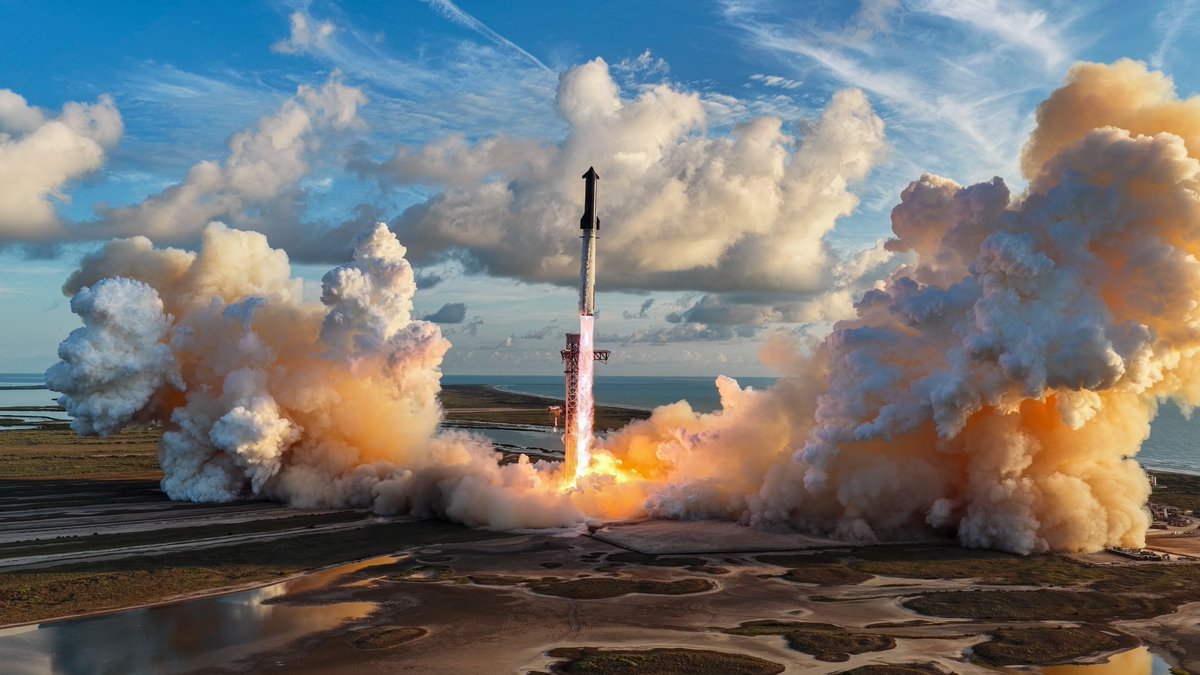
Starbase Louisiana will ultimately have over a dozen launch towers, enabling more than 30 Starship flights per day and making it the biggest launch site on Earth!
SpaceX makes sci-fi real.
I finally have all 1.2 million raw image files from my latest mission to ISS! Here is a sample of one of my favorite Milky Way photos, taken from the Cupola with Nikon Z9, Arri Zeiss 15mm lens, T1.8 with custom sidereal drive that cancelled out star motion relative to our orbit.
Starlink Mobile is providing free connectivity to @MASORANGE_ES and @movistar_es customers in regions affected by the wildfires near Madrid.
Families, communities and businesses with compatible LTE smartphones can now stay connected through SMS even if terrestrial networks are not available and customer phones will automatically connect to Starlink Mobile. Coverage will work best with a clear view of the sky.
NEW GERMANY RESTART REPORT: Restarting up to 18.7 gigawatts of Germany’s nuclear fleet is technically feasible, cost-effective, and supported by a majority of Germans.
Germany has an untapped energy resource at a scale matched nowhere else in the West. Per capita, the nuclear capacity Germany could add this decade is nearly an order of magnitude greater than what China is planning to.
Despite the nuclear phaseout, German law already allows work to begin on reactor restarts as long as the electricity is not sold before the law is changed.
In @RadiantEnergyG's most in-depth analysis of Germany’s reactor restart opportunity to date, we find that this program would be:
FAST: 5 reactors could be returned to service in less than 5 years, 14 reactors total in under a decade.
COST-EFFECTIVE: Every reactor studied could produce electricity well below current wholesale prices in Germany. With public financing, these plants could significantly undercut the inflation‑adjusted average of the 2010s.
CHEAPER THAN NEWBUILDS: The cost to bring back the 5 easiest-to-restart reactors is cheaper than any single Western nuclear newbuild currently under construction.
SUPPORTED BY THE PUBLIC: 61% of Germans support making use of existing nuclear in Germany, nearly three times the 22% who favor a complete phaseout and ban.
The missing ingredient remains political will.
In our conversations with the German Energy Minister, it was clear that with the right information, including a sober, accurate picture of what's actually possible, there's real interest in saving this energy supply.
Now, German nuclear industry leaders, several of whom informed our analysis, are urging support for restarts. In a letter sent to Chancellor Merz and members of Parliament, the authors wrote that “reactivating German nuclear power is technically a possible and sensible option,” attaching Radiant Energy Group's report for reference.
Germany once had one of the finest nuclear programs in the world. As more countries across the West recommit themselves to expanding nuclear, Germany has a unique chance to rebuild that expertise while directly addressing the energy cost and supply security issues it's facing.
Water usage has been a hot topic in the AI data center world, but the numbers may surprise you.
According to the Manhattan Institute, data centers use 0.2 percent of daily water usage in the U.S. and that number has dramatically decreased in the past few years due to a new method: liquid cooling.
By moving to 45°C liquid cooling, AI factories in favorable climates can use dry coolers instead of conventional cooling-tower-based systems, cutting facility cooling water use from roughly 2.6M gallons per MW per year to near zero.
Liquid cooling enables AI factories to be both water and energy efficient, while creating opportunities for heat reuse and dispersal to local communities, allowing these factories to become energy grid assets.
Learn more below ⬇️
https://t.co/7WanoPNKTR
Starship should be able to deliver around 300 GW per year of solar-powered AI satellites to orbit, maybe 500 GW. The “per year” part is what makes this such a big deal.
Average US electricity consumption is around 500 GW, so at 300 GW/year, AI in space would exceed the entire US economy just in intelligence processing every 2 years.
Solar cell production for terrestrial applications is already far above this number at >1500 GW of annual production capacity.
Tonnage to orbit will be solved by Starship.
Chip production is therefore the major piece of the puzzle to be solved.
The Tesla Terafab is needed for this, as there is otherwise no solution at sufficient scale.
These numbers are immense by earthly standards, but don’t register materially on the Kardashev II scale. For that, lunar production of solar-powered AI satellites is needed to take things to the 100+ TW/year level.
When I reported to Elon, we would have X product meetings at 5 or 6pm (because he was with the Tesla team for 10 hours before that), then my 1:1 checkin would be at 10pm, but that would regularly get moved to 11pm or midnight or 1am.
Usually around 2am, he’d go take a nap for a couple hours in the office and then repeat the same schedule again the next day with a different set of companies, 7 days a week.
Congratulations to the SpaceX team on completing 500 (!!!!) missions with flight-proven rocket boosters. You’ve made the impossible possible with reusable rockets, paving the way to land huge amounts of cargo and lots of people to establish permanent human presence on the Moon and beyond with Starship!